Work backwards from the complaint. That's the shortcut nobody hands a new clinic buyer. Aesthetic laser treatments only earn their keep when the wavelength matches whatever sits in the tissue, so this guide maps the concern groups clinics really see, hair, pigment, vascular, scars, ageing and body, onto the technology and the Pmise platform built for each job.
One idea runs under all of it. Light does useful work only when something in the skin absorbs it. Get that pairing wrong and you've bought pain, downtime and a lost patient.
The short version: which laser for which concern?
Four technologies carry most of a clinic's caseload. The table pairs each concern group with the technology that suits it, plus the Pmise platform in that class. Every model name in the last column links to its catalogue page, so you can open the specs yourself.
| Concern | Technology that fits | Why it works | Pmise platform |
|---|---|---|---|
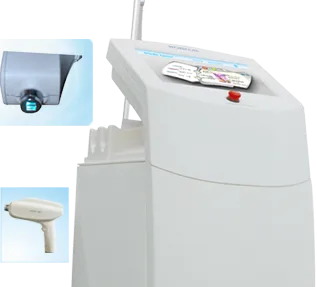
| Unwanted hair, face and body | 808nm diode laser | Reaches follicle depth, and melanin in the hair root absorbs it | Pmise DL-04 |
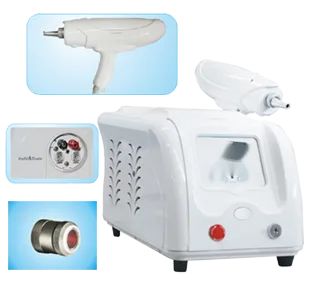
| Freckles, age spots, nevus of Ota, tattoos | Q-switched Nd:YAG, 1064nm and 532nm | Nanosecond pulses fracture pigment so the body can clear the debris | Pmise QN-09 |
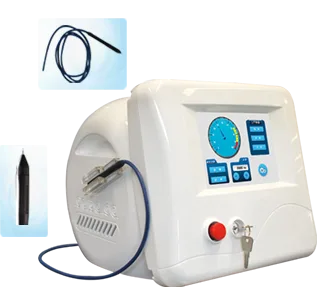
| Spider veins, telangiectasia, cherry angioma | High-frequency thermo-coagulation | Controlled heat coagulates haemoglobin and seals the vessel wall | Pmise VF-05 |
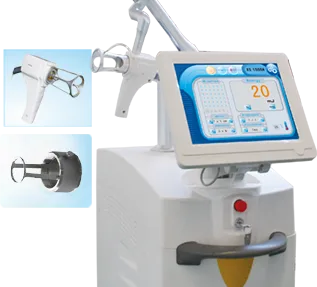
| Acne scars, wrinkles, pores, laxity | Fractional CO2, 10600nm | Water soaks up the beam, so ablated microcolumns trigger collagen renewal | Pmise CF-01 |
| Body shaping and circumference | RF, cavitation, cryolipolysis (not laser) | Works on fat and connective tissue, not on a light-absorbing chromophore | Pmise slimming range |
Each catalogue page carries several models in the same class, so the code above is a starting point, not your only option. Body work is the odd row out. Fat holds no strong light-absorbing target, which puts it in a different family of machines.
Why can't one machine cover everything?
Skin holds a very short list of things that absorb light, and they don't absorb the same wavelengths. Our internal light-tissue training material names three that matter in practice: melanin, haemoglobin, water. Separate absorption curves for each. That's why a hair-removal laser is a poor tool for thread veins, and why a resurfacing laser does nothing at all to a tattoo.
Depth is the second variable. The same archive puts the optical window into skin at roughly 600 to 1200nm, where light scatters less and travels further. Follicles sit deep, so follicle work wants near-infrared. A freckle on the surface wants something shorter and more greedily absorbed.
Colour counts too, and our technical documentation is blunt about it: 532nm is taken up readily by red and brown pigment yet does little against black and blue-green ink. 1064nm behaves the other way round. Two wavelengths on one platform isn't a brochure bullet. It's what lets the same trolley clear a brown sunspot in the morning and a black tattoo after lunch.
Wavelength follows the target's colour. Pulse duration follows its size. Turn the power up to compensate for either and you'll burn something.
All of it traces back to selective photothermolysis, set out by Anderson and Parrish in Science in 1983. Every credible manufacturer still designs to it. Our primer on laser wavelengths and chromophores has the physics.
Which laser removes unwanted hair?
An 808nm diode, in almost every case. The wavelength sits inside that optical window, so it reaches the follicle, and melanin in the hair root soaks it up and heats. Contrast between dark hair and lighter skin is what the beam exploits, which is also why grey and white hair barely responds.
The Pmise DL-04 is the diode platform for this work. Our device manuals give the high-power model 600W, energy density up to 120 J/cm2, pulse widths of 5 to 200ms, a 12mm by 12mm square spot, 1 to 10Hz repetition, sapphire contact cooling and coverage across Fitzpatrick I to VI. In clinic terms, that buys three things:
- Long pulse durations for darker skin, where heat needs spreading out rather than dumping in.
- A square spot that tiles without gaps, so a pair of legs doesn't swallow the afternoon.
- Cooling that holds up through back-to-back appointments, not just the first ten minutes.
Set expectations about cycles early. Hair grows in phases, and only follicles in the active phase respond to any single session, so a course over months is normal. The American Academy of Dermatology frames hair removal as a series of treatments. Anyone promising one and done is selling something. If your patient mix skews darker, our comparison of diode, alexandrite and Nd:YAG hair removal is worth ten minutes.
What handles pigment, spots and tattoos?
Q-switched Nd:YAG owns this category, and it wins on time rather than heat. Our technical documentation puts the single pulse width for this class at 6 to 8 nanoseconds, brief enough to shatter a pigment particle before energy bleeds into surrounding tissue. Closer to a shockwave than a burn. Phagocytes and the lymphatic system then carry the fragments off, which is why a treated spot keeps fading after the appointment.
The Pmise QN-09 carries both wavelengths, 1064nm and 532nm, with a continuously adjustable spot size. Indications recorded in our archive for this class:
- Endogenous pigment: nevus of Ota, sunspots, age spots, Mongolian spot, cafe au lait macules, assorted nevi.
- Exogenous pigment: tattoos in black, blue, brown and red, plus permanent makeup and traumatic pigment.
- Melasma, treated conservatively and never with enthusiasm.
Melasma deserves its own warning label. It relapses, it reacts badly to heat, and an eager operator can hand a patient a face worse than the one she walked in with. The AAD lists melasma among the conditions lasers can address, while stressing how much the result rides on operator experience. Read our melasma laser treatment guide first.
How do you treat facial veins and red marks?
Fine surface vessels respond to controlled heat that coagulates the blood inside and closes the wall. The Pmise VF-05 does that with high-frequency energy at 13.56MHz. Our vascular documentation gives the treatment tip diameter as 0.01mm, fine enough to work the vessel without disturbing the epidermis, lists continuous and pulsed modes, and describes coagulated tissue sloughing away within three to seven days.
So why keep a dedicated vascular unit when lasers also target haemoglobin? Precision. A broad beam struggles to isolate one thread vein on a nose wing. A point device goes straight at it. Larger or deeper lesions belong with a long-pulsed Nd:YAG instead, and our piece on vascular conditions and the Nd:YAG laser marks that line. Stay conservative with energy. Patients remember a mark on the face far longer than a vein that needed a second visit.
What fixes scars, wrinkles and rough texture?
Fractional CO2, and for atrophic scarring there isn't a close second. At 10600nm water absorbs nearly all of the beam, so the laser ablates precise columns and leaves untreated skin between them to speed healing and drive collagen remodelling. The downtime is genuine. So is the improvement.
Our CO2 series documentation gives the Pmise CF-01 three output modes, continuous wave, ultrapulse and fractional, with a focal spot diameter that adjusts continuously from around 80 micrometres upward. Small spot, deeper column. Larger spot, shallower peel. One platform therefore stretches from a light refresh to real scar work. Recorded indications include wrinkles, stretch marks, traumatic, burn and surgical scars, enlarged pores, rough skin and loss of firmness.
Running one well is a discipline problem, not a hardware problem:
- Match spot size and depth to the concern. A scar pass and a rejuvenation pass are not the same settings.
- Brief the patient on redness, crusting and sun avoidance. Unexpected downtime destroys reviews faster than an average result.
- Keep ablative work with operators trained in wound care and infection control. No exceptions there.
Session planning is covered in our guide to acne scar removal with a fractional laser.
How should a clinic build the menu?
Buy for demand you're already turning away, not for the longest spec sheet in the pile. A shortlist method that works:
- Write down the five requests you currently refuse, then map each onto the table above.
- Lead with the concern that brings people back. Hair and pigment run as courses, and courses mean repeat revenue.
- Check the regulatory route early. The FDA regulates medical lasers as devices, and its cosmetic list runs from tattoo and hair removal through scars, wrinkles and spider veins. Other markets reason similarly.
- Ask about consumables, handpiece lifespan and service response before you ask about price. Uptime decides your return, and it beats sticker price.
Body contouring sits outside this map. If it's on your list, start with our comparison of cavitation, cryolipolysis and RF. Otherwise browse the range on our products page, or read the condition-led protocols under solutions. Two platforms matched to demand you can actually see will out-earn five that only photograph well.
Frequently Asked Questions
Can one machine treat every skin concern?
No, and be sceptical of any rep who says otherwise. Melanin, haemoglobin and water absorb different wavelengths, so hair, pigment, veins and texture need different light. Multi-application platforms exist and suit a small clinic testing local demand. Clinics doing volume end up with four boxes: a diode, a Q-switched Nd:YAG, a vascular device and a fractional CO2 laser.
How many sessions do aesthetic laser treatments take?
Plan for a course, not a visit. Hair removal only affects follicles in an active growth phase, so sessions get spaced across months. Pigment and scar work improve gradually too. The American Academy of Dermatology describes laser treatment in terms of repeated sessions, with yearly follow-up for some conditions. Real numbers shift with lesion, skin type and settings, so quote a range with an honest review point, never a promise.
Are these treatments safe on darker skin?
With the right device and a careful operator, yes. Longer wavelengths such as 1064nm, paired with longer pulse durations, cut unwanted absorption in the epidermis, which is where burns start. The AAD does caution that darker skin is more prone to burns and dark marks after laser treatment, and advises seeing someone experienced with darker skin. Test spots, conservative energy and dependable cooling all help. Training helps most.
What should I check before buying?
Match the device to demand you can already see in your appointment book. Confirm the regulatory route for your market before you order, and ask which safety standards the unit is built to. Then work out total cost of ownership: consumables, handpiece life, spare parts lead time, service and training. A cheap platform that sits idle, or waits three weeks for a part, turns out to be the expensive one.
Written by the Pmise Technical Team. Pmise builds laser and light-based aesthetic equipment and supports foreign-trade buyers with device selection, operator training and service.