Acne scar removal with a fractional laser comes down to one fork in the road: ablative fractional CO2 at 10600nm for deep, set-in scarring where the patient accepts real recovery, or non-ablative 1550nm for milder texture and people who can't vanish for a week. Neither erases a scar in one visit. Both drop microscopic columns of controlled injury into skin so it rebuilds collagen over a course. Here's how to match scar type to settings, screen your cases, and buy well.
What kind of acne scar are you actually treating?
Classify first, pick settings second. Get that backwards and you'll under-treat half the face. Most acne scars that answer to lasers are atrophic: they sit below the surrounding skin because collagen was lost as the lesion healed. Jacob, Dover and Kaminer, in the Journal of the American Academy of Dermatology in 2001, split them into three shapes.
- Ice-pick scars. Narrow, deep, V-shaped tracks. Stubborn. The defect runs deeper than a broad resurfacing pass reaches.
- Boxcar scars. Round or oval craters with sharp vertical walls. Those defined edges are what ablative resurfacing softens well.
- Rolling scars. Wide, shallow dips with sloping shoulders. Fibrous tethering causes them, so subcision helps more than light alone.
Hypertrophic and keloid acne scars sit above the surface and aren't first-line targets for fractional resurfacing. Assess depth, wall shape and phototype before anyone touches a panel; our guide to Fitzpatrick skin types and laser settings covers the darker-skin side.
How fractional lasers work on scarred skin
Fractional means the laser injures skin in a grid. Each pulse makes a tiny zone of thermal damage and leaves the tissue around it untouched, and that untouched tissue speeds healing and drives new collagen. Manstein and colleagues named the principle, fractional photothermolysis, in Lasers in Surgery and Medicine in 2004, building on Anderson and Parrish's 1983 work on selective photothermolysis. CO2 vaporizes tissue and leaves heat that contracts collagen; 1550nm heats columns into the dermis without stripping the surface.
What a patient photographs at week eight is collagen laid down after the appointment, not tissue removed during it.
Fractional CO2 at 10600nm: picking lens, density and zone
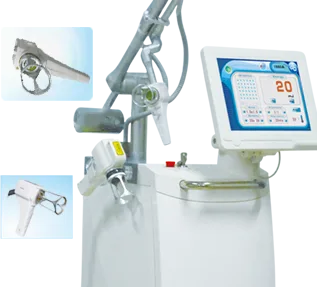
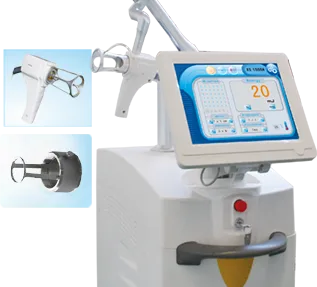
CO2 is the aggressive option and the reference standard for deep, established atrophic scarring. The beam ablates tissue while depositing collagen-tightening heat around every micro-column, so it treats scar depth and laxity at once. Our engineering archive for our ultrapulse 10600nm CO2 fractional platform documents a focal spot adjustable from roughly 80 to 2000 microns, three output modes (continuous, ultra-pulse and fractional), densities of 6x6, 12x12 or 24x24 spots per square centimetre, and three lenses: fixed-focal for the smallest spot and deepest ablation, adjustable-focal where a larger spot peels shallower and a smaller one goes deeper, and a roller-type fixed-focal lens listed for orbital, perioral and nose wing work.
Turn that into an operator rule. Scar-field work runs in fractional mode; continuous and ultra-pulse modes are for focal lesion work, not for resurfacing a cheek. Deep, sharp-walled boxcar scars call for the smallest focal spot on the fixed-focal lens at a lower density such as 6x6, so each column reaches depth without stacking heat across the field. Broad rolling texture wants the reverse: a larger focal spot for a shallower peel, with density raised to 12x12 or 24x24 for coverage. Around eyes, mouth corners and the nasal ala, switch to the roller-type lens and step density down; that skin is thinner. Higher phototypes take the conservative end of every dial. Energy is set by region and by whether topical anesthetic is used, off the parameter tables.
Depth has a price: several days of redness, crusting and oozing, and pigment risk climbing in darker skin. Conservative settings aren't optional.
1550nm non-ablative: mild scars, minimal downtime
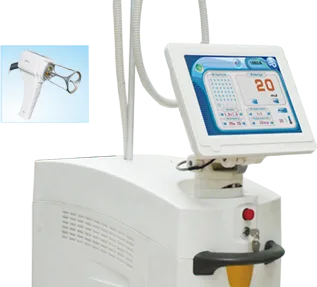
The gentler route vaporizes nothing. Our device manuals for the 1550nm erbium glass fractional platform describe micro-channels roughly 0.12mm across reaching toward 2mm, with coverage scaling with density: about 1.56 percent of the treated area at 36 spots per square centimetre, about 6.25 percent at 144, and roughly 25 percent at 576.
So the rule here is density and area, not brute energy. Our 1550nm parameter sheets put mild to moderate acne scarring at a 2 x 2 cm scan area with 12 x 12 spots per square centimetre, then drop to a 1 x 1 cm area at the same density for depressed acne scars, so the dense work lands on the crater, not healthy skin. Those sheets fix no energy number for scars: the operator reads it off how the acne presents. Shallow rolling texture and higher phototypes belong at the low-coverage end, near 36 spots per square centimetre, gaining density across visits rather than energy. Deeper scarring on cheek skin is where 144 or 576 spots make sense.
Recovery is the selling point: redness and mild swelling that settle quickly, not days of crusting. The catch? More sessions. See our CO2 vs Er:YAG vs 1550nm comparison.
CO2 vs 1550nm, side by side
The real decision: how much recovery time buys how much correction. Tendencies, not guarantees.
| Attribute | Fractional CO2 (10600nm) | 1550nm fractional |
|---|---|---|
| Mechanism | Ablative | Non-ablative |
| Best scar targets | Deeper boxcar, established atrophic, laxity | Shallow rolling, mild atrophic texture |
| Main intensity control | Focal spot size and lens choice | Spot density and scan area |
| Typical downtime | Several days of redness and crusting | Short redness, mild swelling |
| Sessions needed | Fewer | More |
| Risk in darker skin | Higher, demands caution | Lower, still needs care |
Ice-pick scars resist resurfacing alone, so the literature pairs lasers with punch excision or subcision. Our scar treatment solution shows how those tools stack.
Who should not be treated: screening before you fire
Case selection protects your results and your clinic. Each item is a reason for a qualified physician to defer or exclude after examining the patient.
- Recent isotretinoin. Our CO2 documentation lists use in the past year or two among situations linked to abnormal wound healing. Practice varies; defer and discuss.
- Active infection or active inflammatory acne in the field. Obvious skin infection is listed as a contraindication. Clear it first; firing through inflamed skin risks worse scarring.
- History of herpes simplex. Flagged in our documentation. Ablative work can reactivate cold sores across a treated face, so the prescriber decides on antiviral prophylaxis beforehand. An active outbreak stops the session.
- Keloid or hypertrophic scarring tendency. Listed as a contraindication. Exclude, or treat only under specialist supervision after a test area.
- Recent sun exposure or photosensitising medication. Sun over a treated site is documented as a route to hypopigmentation, and our 1550nm manual advises caution in photosensitivity. Postpone until the tan fades.
- Pregnancy and breastfeeding. Pregnancy appears in our contraindication lists. Elective scar work waits.
- Recent procedures or unstable systemic disease. Our 1550nm manual lists filler in the area, botulinum toxin or RF within seven days, and recent resurfacing among reasons to wait, alongside diabetes, hypertension and heart disease.
Session planning and aftercare
Nobody credible promises one-and-done. Our 1550nm parameter sheets schedule acne scar work at 3 to 6 treatments, with facial intervals of roughly three weeks. That's a framework, not a prescription.
- Screen, then consult. Work the exclusion list above and document the answers. Only then classify scar types, judge depth and phototype, and shoot baseline photos.
- Test, then treat. Start conservative in darker skin, and test-spot before a full pass.
- Space the sessions. Ablative courses run fewer and further apart; non-ablative run longer.
- Reassess every visit. Compare photos, then adjust density or lens to the response.
- Combine where needed. Add subcision or punch excision for tethered rolling scars and ice-pick tracks.
Aftercare decides how safely skin heals and whether pigment problems surface later.
- Protect the barrier. Gentle cleansing plus the moisturizer or ointment your protocol specifies, especially while ablative skin crusts.
- Sun protection, no exceptions. Daily broad-spectrum sunscreen and real sun avoidance are the biggest lever on pigment risk.
- Know the red flags. Spreading redness, escalating pain or infection gets reported the same day. No picking at crusts; retinoids and acids wait.
Should your clinic buy CO2, 1550nm, or both?
Buy for your patient mix, not the spec sheet. A practice seeing deep, old scarring in patients who'll take a week off gets more from an ablative platform. A med-spa serving busy professionals across mixed skin tones books far more easily against a low-downtime device. High-volume clinics run both, or consolidate into a dual-mode fractional platform instead of two cabinets.
Case mix settles the wavelength. It doesn't settle the purchase. Cross-border buyers lose more to paperwork, spares and training gaps than to the wrong laser. Put these questions in writing, and ask for documents, not reassurance.
- Compliance. Which certifications does the unit hold, can you see the certificates with their scope and validity dates, and who handles registration in your market? Our note on FDA 510(k) versus CE marking explains why the two differ.
- Warranty and after-sales. What is the warranty period, what does it exclude (tube, handpieces, optics), and how fast do spares ship? See our guide to warranty and spare parts terms.
- Training and parameter handover. Is training on-site or remote, and do you get written parameter tables by indication and skin type?
- Consumables and running cost. Which parts are consumables, what is their rated service life, and what do replacement lenses, handpieces or a tube cost?
- Lead time and order terms. What is the lead time for a first unit, is there a minimum order quantity, and what are the payment terms?
- Distribution and OEM. Is OEM configuration available, what territory protection comes with a distributor agreement, and is there a demo unit?
Frequently Asked Questions
Is fractional CO2 or 1550nm better for acne scars?
Depends on severity and downtime tolerance. CO2 ablates deeper and adds collagen-tightening heat, so it suits established atrophic scarring, at the cost of several days of visible recovery. Non-ablative 1550nm fits shallower scars and patients who can't take time off, and it improves rather than erases them.
How many sessions does acne scar removal take?
There's no fixed number. Ablative CO2 courses tend toward fewer, more widely spaced treatments, while 1550nm needs several sessions for a comparable result. Our 1550nm parameter sheets budget 3 to 6 treatments at roughly three-week facial intervals, set by a practitioner after classifying the scars.
Who is not a candidate for laser acne scar treatment?
Anyone with active infection or active inflammatory acne in the treatment area, a keloid tendency, recent isotretinoin use, a fresh tan or photosensitising medication, or pregnancy should be deferred pending a physician's assessment. A herpes simplex history means antiviral prophylaxis must be considered before ablative work.
Written by the Pmise Technical Team. Pmise builds laser and light-based aesthetic systems, including fractional CO2 and 1550nm erbium glass platforms. This guidance draws on our device documentation and the sources cited above. Confirm protocols with a physician.