Last updated: June 2026. Choosing between a q-switched vs picosecond laser for tattoo work comes down to pulse length, how many visits your clients will sit through, and how much cash you can park on the treatment floor. Both fire 1064nm and 532nm light at ink the body then clears itself. What separates them is timescale. For most clinics buying a first Q-switched Nd:YAG laser, that machine is still the sensible workhorse. Picosecond is a premium upgrade with a narrower business case.
What is the real difference between q-switched and picosecond lasers?
The difference is the dominant way the ink comes apart. Both rely on selective photothermolysis, the principle Anderson and Parrish published in Science in 1983: send light the target absorbs, in a pulse shorter than the time it needs to shed heat, and you wreck the target without cooking the tissue around it. A Q-switched Nd:YAG does that mostly with heat. Our device manual for the Pmise QN-06 puts it plainly: the light "penetrates the tissue and is absorbed by the pigment and result in an instantaneous blast", and the fragments are engulfed by phagocytes and cleared by the lymphatic system.
Picosecond pulses tip the balance the other way. DermNet NZ describes the mechanism as "predominantly photoacoustic damage" instead of "photothermal destruction of pigment or ink particles". Less diffused heat, more pressure wave. Ink shatters into smaller pieces, and smaller pieces are easier for the body to haul off. That is the whole argument for picosecond in one sentence.
Does that mean nanosecond fragments don't clear? They clear. They just need more appointments and more patience. New to the physics? Our explainer on selective photothermolysis covers the groundwork.
Nanoseconds vs picoseconds: does a shorter pulse really matter?
Pulse duration is the single spec that separates these families, and yes, it matters. Q-switched Nd:YAG systems fire in the nanosecond range. Our documentation shows the spread: the Pmise QN-10 is specified at 6ns, the QN-03 and QN-05 leaflet lists 6 to 8ns, and the QN-06 sheet lists 10 to 20ns with a 1 to 5mm adjustable spot. Picosecond machines sit a tier below. DermNet NZ defines them as using "pulse durations of less than 1 nanosecond". Read that literally. "Picosecond" is a class label for sub-nanosecond emission, not a promise of a one-picosecond pulse, and vendors vary widely inside that band. Ask for the figure on the spec sheet.
Squeeze the same energy into a shorter window and peak power climbs steeply. That pushes the interaction toward the pressure-wave effect above, and less heat leaks sideways into surrounding tissue. DermNet NZ reports that compared with traditional Q-switched lasers, picosecond devices "require fewer treatments, cause fewer side effects, and result in reduced post-procedural downtime".
Read the caveat too. The same page notes that picosecond lasers are "relatively contraindicated in patients with darker skin tones (ie, Fitzpatrick skin types 4-6)". Neither category is a free pass. Both depend on an operator who tests conservatively. Our notes on Fitzpatrick skin types and laser settings cover how that changes your parameters.
Q-switched vs picosecond laser: side-by-side comparison
The trade-offs buyers weigh most often. Purchasing guidance, not clinical protocol.
| Factor | Q-switched Nd:YAG | Picosecond laser |
|---|---|---|
| Pulse duration | 6 to 20ns across Pmise models | Below 1 nanosecond (DermNet NZ) |
| Dominant mechanism | Photothermal, with a photomechanical component | Predominantly photoacoustic |
| Ink fragment size | Larger, clears over a longer course | Smaller, often clears in fewer visits |
| Wavelengths | 1064nm and 532nm dual output | 1064nm and 532nm, often plus 755nm |
| Awkward colours | Limited on green and sky blue | Better served by added wavelengths |
| Capital cost | Lower, accessible entry point | Substantially higher |
| Best fit | General tattoo, pigment and permanent-makeup work | Tattoo-led clinics, difficult inks |
How many sessions and passes should you plan for?
Plan for a course, never a single visit. Pmise device documentation for the QN-10 states that "tattoo removal needs about 2-5 times regarding different colors and tattoo inks", with 45 to 90 days between treatments so the body can clear fragmented pigment. That is a manufacturer figure reflecting lighter amateur and single-colour work, not a universal clinical expectation. Dense professional pieces, layered cover-ups and multi-colour sleeves routinely run well past it. No responsible clinic quotes a fixed count before a test patch and an assessment of ink depth, density and skin type. The US FDA gives no number at all, describing removal as a repeated process across multiple visits with healing time between them, and warning of real risks including scarring. Picosecond can compress a course. It doesn't eliminate one.
Colour drives wavelength choice on either machine. Our manuals are specific: 1064nm handles black and blue ink, 532nm goes after red and brown, and because black absorbs every wavelength it usually responds fastest. Light green and yellow demand the most sessions, since yellow tends to reflect light rather than soak it up. FDA guidance calls dark blue and black the simplest colours, and flags flesh tones and white ink as tricky because those pigments can darken. Tell clients before you start.
- Log ink colour, depth and whether the work is amateur or professional, then pick the wavelength that pigment absorbs.
- Test-patch at conservative energy and watch the endpoint rather than chasing a number on the panel.
- Leave the interval the manual calls for, on the order of 45 to 90 days.
- Reassess residual ink at every visit and set energy and spot size to what's left, not last session's numbers.
What will each machine cost you, in purchase and in running?
Capital cost is where these categories split hardest, and for most buyers it decides the argument. Q-switched Nd:YAG platforms are the accessible way in: shipped in volume for well over a decade, spare parts easy to source, technicians in most markets already trained on them. Picosecond systems carry a serious premium, and service and consumable costs follow.
So ask the blunt question. Does faster clearance win you enough extra clients, at a high enough ticket, to repay the difference in your market? In price-sensitive regions, or where tattoo removal sits beside pigment and permanent-makeup work, a proven Q-switched platform models out more predictably. Where rivals advertise on "fewest sessions", picosecond earns its keep. For indicative figures, see our breakdown of Q-switched Nd:YAG laser pricing.
What should you check before raising the purchase order?
Technology choice is only half the decision. The rest decides whether the machine clears customs, gets installed, and still runs in year three. Put these six items to any supplier in writing:
- Market access for your country, not the factory's. A CE test report or an ISO 13485 certificate is not a registration in your market. Our compliance archive holds LVD and EMC test certificates for Nd:YAG systems plus ISO 9001 and 13485 files; ask for current versions and check them against your own regulator's rules. FDA clearance matters only if you sell into the United States.
- Warranty period and what it covers. Our service terms give a standard one-year free warranty against defects in workmanship or materials under normal use, with the usual exclusions for drops, shock and unauthorised disassembly. Get the laser cavity, power supply and handpiece named separately. Those are the parts that fail.
- Training and commissioning. Remote or on-site? How many staff, in which language, and does it cover parameter guidance for your local skin-type mix?
- Lead time and shipping terms. Production time, packing, and whether the quotation is EXW, FOB or CIF. Nail it down before you promise an opening date.
- Spare parts and consumables. Pump-source replacement interval and cost, handpiece and articulated-arm servicing, and how long parts stay stocked for that model.
- OEM and private-label options. Distributors building their own brand should ask early about badging, manual rebranding and minimum quantities. It moves the lead time.
When is a Q-switched Nd:YAG simply the smarter buy?
A Q-switched Nd:YAG is the pragmatic purchase for most clinics: dependable dual-wavelength tattoo and pigment removal at a fraction of the outlay, and it earns its floor space on days when nobody books a tattoo. If most of this list describes your business, buy the Q-switched machine.
- You're opening or expanding a general clinic, not a tattoo-only studio.
- Your caseload is mostly black, blue, red and brown ink, plus pigmented lesions and eyebrow or lip-line correction.
- Budget discipline and a predictable payback period outrank shaving a session off a course.
- You want one platform that also covers freckles, age spots and carbon-peel facials.
- Your operators are trained to work conservatively across mixed skin types.
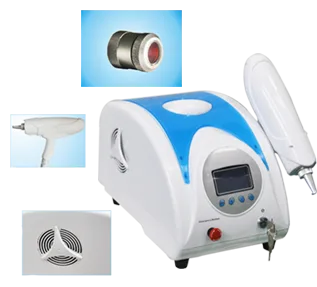
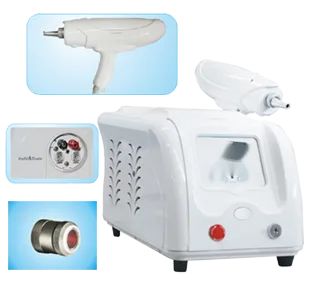
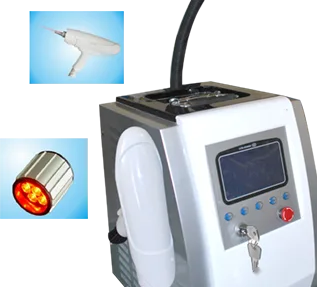
Pmise builds several Q-switched platforms around this profile. The QN-09 and QN-10 suit steady tattoo and pigment lists, while the compact QN-06, with dual 1064nm and 532nm output and a 1 to 5mm adjustable spot, fits smaller rooms and mobile setups. Our tattoo removal solution page matches devices to caseload.
Send us your weekly caseload profile and your local skin-type mix. Our engineers will match a QN-series model to it and come back with a spec sheet and a quotation covering warranty, training and lead time.
Frequently Asked Questions
Is a picosecond laser always better than a Q-switched laser?
No. Picosecond systems clear ink in fewer visits with less downtime, and DermNet NZ reports fewer side effects too. They also cost considerably more, and the same source calls them relatively contraindicated in Fitzpatrick types 4 to 6. For a general clinic treating black, blue, red and brown tattoos alongside pigment work, a Q-switched Nd:YAG still delivers reliable results at far lower cost.
Can a Q-switched Nd:YAG remove every tattoo colour?
It handles the common palette well. Our manuals specify 1064nm for black and blue ink and 532nm for red and brown, and note that light green and yellow are hardest to shift and need the most sessions. FDA guidance agrees that dark blue and black are easiest. Difficult greens and sky blues are where picosecond systems with extra wavelengths win.
How many sessions does tattoo removal actually take?
More than clients expect, and nobody should quote a fixed number up front. Pmise device documentation for the QN-10 cites roughly 2 to 5 sessions spaced 45 to 90 days apart, which reflects lighter amateur or single-colour work. Dense professional, layered or multi-colour tattoos commonly need considerably more. The FDA gives no session count at all.
Which Pmise machine should a new clinic start with?
Most start with a dual-wavelength Q-switched Nd:YAG: one platform covers tattoo, pigment and rejuvenation work at an accessible price. The compact QN-06 suits lower-volume rooms and mobile operators. The QN-09 and QN-10 suit busier lists. Match the model to your weekly caseload and local skin-type mix, not to the biggest number on a spec sheet.
Pmise Technical Team. Pmise (pameisi.com) manufactures laser and light-based aesthetic equipment, with more than a decade of Q-switched Nd:YAG development and OEM export experience behind these notes.