
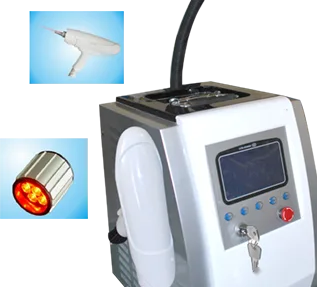
Q-Switched Nd:YAG Laser
Pmise QN-10
- 1. Big LCD, convenient for operation.
- 2. LED for quick recovery after treatment.
- 3. Dual-wavelength (1064nm & 532nm) output.
- 4. The handpiece of ceramic cavity with high temperature resistance, high reflectivity can still work without water in a short period.
- 5. Anti-knock laser hand piece that can still work even if the handpiece falls down on the ground.
Overview
The QN-10 is a Q-switched Nd:YAG laser built for professional pigment and tattoo work in clinics and aesthetic studios. It delivers laser light through a dual-wavelength handpiece so a single system can treat both surface-level and deeper pigment, which makes it a practical workhorse for tattoo fading, permanent makeup correction, and benign pigmented lesions. It belongs to Pmise's Q-Switched Nd:YAG Laser line.
Q-switched technology gives the QN-10 its defining trait: it releases energy in extremely short nanosecond pulses at high peak power. That timing is what lets it target pigment particles while sparing the tissue around them. The two wavelengths cover different jobs, one reaching deeper blue and black pigment and the other absorbed strongly by red, coffee, and brown tones near the surface.
This is professional equipment classed as a high-power laser, so it is intended for trained operators working with proper eye protection and treatment protocols, not for home or unsupervised use. For a fuller walk-through of how Q-switched tattoo work is planned, see our guide on Q-switched tattoo removal machines.
How It Works
The QN-10 works on the principle of selective photothermolysis, the idea that a pigment target can be destroyed by light it absorbs strongly, delivered fast enough that the heat and pressure stay confined to that target before spreading to nearby skin. Because the pulses are ultra-short, in the nanosecond range, the energy hits the pigment as a rapid photoacoustic shock rather than a slow burn.
When that pulse is absorbed by a pigment particle, the particle heats instantly and shatters into much smaller fragments. Some fragments are pushed out through the skin surface, and the rest are small enough for the body's phagocytes and lymphatic system to carry away over the following weeks. This is why treated pigment keeps fading between sessions rather than clearing all at once.
The dual-wavelength design is what makes this broad. The longer 1064nm wavelength penetrates deeper and is chosen for blue and black pigment, including many tattoo inks and deeper lesions such as nevus of Ota. The frequency-doubled 532nm wavelength is absorbed well by red, brown, and coffee tones sitting closer to the surface. An operator picks the wavelength and energy to match the pigment's color and depth, then works from lower to higher settings to keep treatment controlled.
Applications
The QN-10 suits clinics, tattoo-removal studios, and aesthetic practices that need one platform for pigment across a range of colors and depths. Suitability is always judged per client by the operator, since skin tone, pigment type, and history all affect the plan.
- Tattoo fading and removal across common ink colors (black, blue, red, brown)
- Permanent makeup correction: eyebrow, eyeliner, and lip-line pigment
- Pigmented lesions such as age spots, sunspots, and freckles
- Deeper dermal pigment including nevus of Ota and some birthmarks
- Laser facial and skin-refining sessions supported by the built-in LED recovery light
For tattoo-focused workflows and case planning, see our tattoo removal solution.
Key Advantages
- Dual-wavelength output covers both surface and deeper pigment from one handpiece, so a clinic can treat more indications with a single device.
- Water plus air cooling and a heat-radiating design support longer continuous working sessions.
- The ceramic-cavity handpiece is built to tolerate high temperature and keep working briefly even without water, and its rugged construction holds up to daily handling.
- An onboard LED light is included to help support skin recovery after laser passes.
- Large LCD and a simple control panel keep energy and frequency adjustments quick during treatment.
- Compact and portable, so it fits smaller treatment rooms and can be moved between rooms.
Specification
| Laser Type | Q-switched ND:YAG laser |
|---|---|
| Spot Diameter | 1-5mm continuously adjustable |
| Cooling | Water& Air |
| Energy | 180-200mj ; |
| Wavelength | 1064nm, 532nm |
| Pulse Width | 10ns-20ns |
| Repetition Rate | 1-5Hz |
| PDT Wavelength | 650-1200nm |
| Power Supply | AC 220V 50Hz; |
| Insurance Standard | Max10A |
| Input Power | 420W |
| Net Weight | 16kg |
| Gross Weight | 21kg |
| Dimensions (before packaged) | 400mm×260mm×600mm |
| Dimensions (after packaged) | 520mm×380mm×720mm |
FAQ
What conditions is the QN-10 used for?
It is used mainly for tattoo fading, permanent makeup correction on eyebrows, eyeliner and lip lines, and benign pigmented lesions such as age spots, freckles, sunspots, and deeper marks like nevus of Ota. The right wavelength and energy are chosen per case. It is professional equipment, so an assessment by a trained operator decides whether a given concern is suitable.
Does it work on every skin type and ink color?
Not equally. The 1064nm wavelength handles deeper blue and black pigment, while 532nm targets red, brown, and coffee tones nearer the surface. Black, blue, red, and brown clear more readily, while light green and yellow are harder and need more sessions. Darker skin needs conservative settings and careful operator judgment to reduce pigment-change risk.
How many sessions are needed?
Pigment clears gradually, so multiple sessions spaced roughly a month or more apart are normal. Light marks like freckles may need only one or two, while tattoos typically take several passes and stubborn dermal lesions can require more. The exact count depends on pigment type, depth, color, and how quickly the individual heals.
Is it safe, and what training is involved?
It is a high-power laser, so both operator and client must use proper eye protection and follow the treatment protocols. Temporary redness, crusting, or swelling can occur and usually settles within one to two weeks. Only trained operators should run it. Pmise provides operating documentation and warranty support; ask our team for training and service details.
More in Q-Switched Nd:YAG Laser
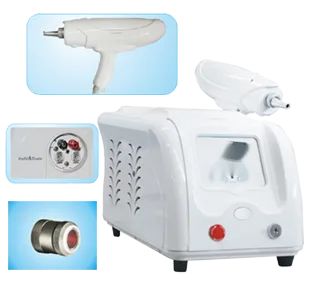
Pmise QN-09
Cost effective.Portable and smart design....
View details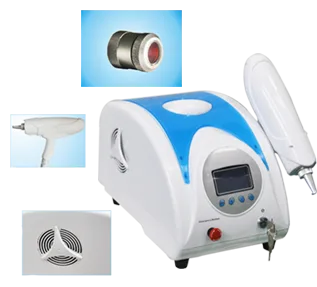
Pmise QN-06
Cost effective. Portable and smart design.....
View details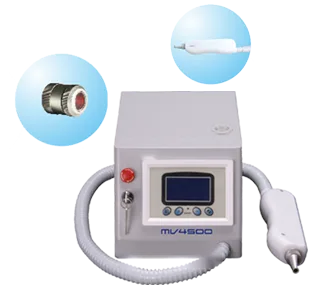
Pmise QN-08
Cost effective.Portable and smart design....
View details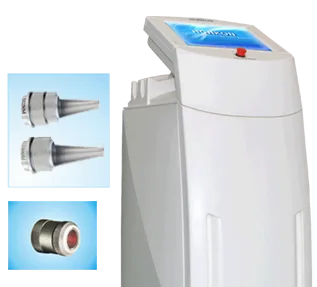
Pmise QN-03
Patented technology of single lamp and dual rods doubles energy output (400mj). Shorter pulse width (6-8ns) than ordina…
View details