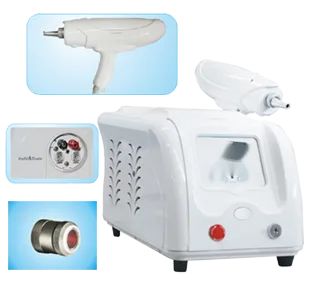
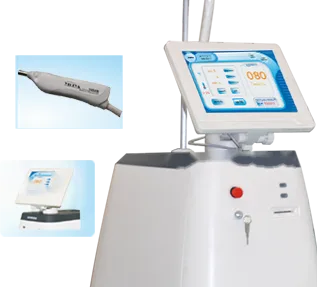
Ask what separates a long pulse Nd:YAG laser from a Q-switched one, and the honest answer is time. Same 1064 nm wavelength, same crystal, completely different jobs. The long pulse delivers its energy over milliseconds and heats the target. The Q-switched pulse dumps it in nanoseconds and cracks the target apart. Hair, veins and nail fungus belong to the first. Tattoos and pigment belong to the second.
Buyers get this wrong constantly. A distributor sees "1064 nm Nd:YAG" on two quotations, assumes the cheaper one does the same work, and ends up with a machine that can't touch half the menu the clinic promised. Here's how pulse duration splits the family in two, drawn from our device documentation and from physics that has governed this field since 1983.
Pulse duration, not wavelength, decides the job
Wavelength gets the light to the target. Pulse duration decides what happens once it arrives. Both types emit at 1064 nm, both often add 532 nm, so their reach into tissue is broadly similar. What differs is the clock. Our long-pulse technical archive for the Pmise LN-01 platform lists pulse widths running out to 50 ms. Our Q-switched documentation lists a single pulse of roughly 6 ns. That's a gap of several million times, and it flips the tissue effect from thermal to photoacoustic.
The rule underneath all of this is selective photothermolysis, published by Anderson and Parrish in Science in 1983. Their argument was simple and it still holds: you destroy a target selectively when the pulse is matched to that target's size and to how fast it sheds heat. Our internal training material defines thermal relaxation time as the interval a tissue needs to release roughly 63 percent of its absorbed heat. Big, deep, heat-holding targets such as a follicle or a vein want a long pulse. A pigment granule a fraction of a micron across wants a pulse so short the heat has nowhere to go. For the theory in full: what selective photothermolysis actually means and how thermal relaxation time sets pulse duration.
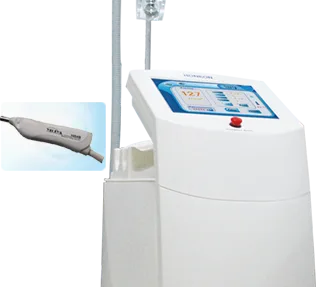
What does a long pulse Nd:YAG laser treat?
It treats things you want to cook, not shatter. Across a millisecond pulse, 1064 nm light is soaked up by haemoglobin inside a vessel and by the pigmented structures of the follicle. Temperature climbs. The vessel coagulates, the follicle is damaged, and the epidermis survives because the handpiece is chilling it throughout. Our device manuals for this platform specify sapphire contact cooling on the treatment handle, a spot range spanning roughly 1 to 10 mm, and fluences reaching 360 J/cm2 at the top of the scale.
The listed applications in that documentation are consistent and narrow:
- Hair removal, called out specifically for Fitzpatrick IV to VI skin, where 1064 nm sits far enough down the melanin absorption curve to largely bypass epidermal pigment.
- Vascular lesions, including leg veins and facial telangiectasia.
- Skin rejuvenation through gentle bulk heating of the dermis.
- Onychomycosis, which gets its own section below because the mechanism surprises people.
Don't oversell the hair results to your clinics. A study in the Journal of Cutaneous and Aesthetic Surgery (2008) followed Indian patients through six long-pulsed 1064 nm sessions and found coarse terminal hair responded far better than fine hair, with results improving session by session. Thick and dark clears well. Fine and pale is a fight. Say that out loud during a demo. We cover the usual failure modes in why laser hair removal fails.
Why nail fungus is a long-pulse job
Nail fungus laser treatment is pure heat work. The beam penetrates the nail plate and warms the bed underneath enough to suppress the organism. Nothing gets fractured. Our archived documentation for the fungus platform describes the mechanism as photothermal combined with photochemical action, with the nail surface rising to around 50 degrees Celsius in short bursts and cooling between passes. A nanosecond pulse simply cannot do this. It's over before the tissue has meaningfully warmed.
Now the part your sales team needs to memorise. In the United States, the FDA has cleared long-pulsed 1064 nm Nd:YAG systems for a "temporary increase of clear nail" in patients with onychomycosis. Temporary increase. Not cure. That wording came out of the 510(k) pathway and it's the language payer policies quote back. Published practice often pairs the laser with topical or oral antifungals, and relapse is a real risk. Promise a cure in your marketing and you'll be arguing with a regulator or a patient sooner or later.
Our long pulse Nd:YAG laser for fungus is built around this indication, with a compressor cooling system sized for back-to-back sessions. For protocol detail, see our guide to nail fungus laser treatment.
What a Q-switched Nd:YAG does instead
Different physics entirely. A Q-switch holds energy back inside the cavity and then releases it in one violent spike, so peak power goes through the roof while total energy stays modest. Our Q-switched manuals describe a single pulse of about 6 ns with energy up to roughly 850 mJ at 1064 nm, firing at 1 to 10 Hz.
Our technical documentation puts it plainly: the ultra-short pulse is absorbed by pigment and produces an instantaneous blast. The particles shatter into fragments, some are pushed out through the skin surface, and the rest are engulfed by phagocytes and cleared through the lymphatic system.
Because the pulse ends before heat can diffuse, thermal damage to surrounding tissue is minimal. Colour handling follows the absorption curves: 1064 nm for blue, black and green-blue inks, 532 nm for red, and both wavelengths together for coffee and brown tones. Typical indications are tattoo removal, nevus of Ota, freckles, age spots and carbon-peel rejuvenation. Browse the Q-switched Nd:YAG laser range, or read how Q-switched compares with picosecond if tattoo work is your main revenue line.
Long pulse vs Q-switched Nd:YAG side by side
| Feature | Long pulse Nd:YAG | Q-switched Nd:YAG |
|---|---|---|
| Pulse duration | Milliseconds, up to about 50 ms in our documentation | Nanoseconds, about 6 ns |
| Dominant effect | Photothermal, sustained heating | Photoacoustic, shockwave |
| Main chromophore | Haemoglobin, follicular melanin, nail bed tissue | Pigment granules, tattoo ink |
| Core indications | Hair, vascular lesions, onychomycosis, rejuvenation | Tattoos, pigmented lesions, carbon peel |
| Wavelengths | 1064 nm, sometimes with 532 nm | 1064 nm and 532 nm |
| Epidermal cooling | Essential, usually sapphire contact | Rarely needed on the epidermis |
| Spot behaviour | Larger spots for depth, roughly 1 to 10 mm | Small spots, high peak power |
Can you use one for the other?
No, and the failure modes run in opposite directions. Fire a nanosecond pulse at a leg vein or a follicle and the energy is spent before the target has warmed enough to coagulate. You waste the shot. Fire a 50 ms pulse at a tattoo and you bulk-heat the dermis around the ink instead of fracturing it, which buys burn risk and poor clearance in one session. Thermal relaxation time is the wall between them, and turning the power up doesn't move the wall.
Some cabinets house both modes, which suits a clinic with a mixed book. Just be clear about what you're buying. It's two lasers sharing a chassis, a chiller and a touchscreen, not one clever laser that does everything. Read each mode's spec sheet separately, and be sceptical of any dual platform that publishes only one set of numbers.
How to read the spec sheet before you commit
- Find the pulse width first. If it's quoted in nanoseconds, it's a pigment machine. Milliseconds means hair, vessels and nails.
- Check whether peak fluence is quoted at the largest spot or the smallest. A big J/cm2 number at a 1 mm spot is not the same machine as the same number at 8 mm.
- Confirm the cooling method for long-pulse work, and confirm the duty cycle. A salon running back-to-back sessions will find out fast whether the chiller was sized honestly.
- Match the wavelength options to your actual case mix. Paying for 532 nm you'll never fire is wasted budget.
A short buying checklist, for when you're comparing three quotations at once:
- Hair, veins or nail fungus on the menu? Long pulse.
- Tattoos or pigmented lesions? Q-switched, or step up to picosecond.
- Darker skin clientele? 1064 nm is the safer wavelength for hair work.
- Both indication groups? Price a dual-mode platform against two dedicated machines. Sometimes two is cheaper over five years once you count downtime.
Send us your case mix and we'll match the machine
Not sure which side of the line your clinic sits on? Send us your real case mix, hair and veins and nails on one side, tattoos and pigment on the other, and our engineers will come back with a shortlist instead of a catalogue. Request the spec sheets for both the long pulse and Q-switched lines, or ask for a demo video of the handpiece you're weighing up. Bring a difficult case with you. If a laser is the wrong tool, we'd rather say so before the purchase order than after.
Frequently Asked Questions
Is a long pulse Nd:YAG laser the same as a Q-switched laser?
No. They share the 1064 nm wavelength and nothing else that matters clinically. A long pulse lasts milliseconds and heats its target, which suits hair, blood vessels and nail fungus. A Q-switched pulse lasts nanoseconds and shatters pigment through a photoacoustic effect, which suits tattoos and pigmented lesions. Identical wavelength, opposite mechanism, non-overlapping treatment lists.
Can a long pulse Nd:YAG remove a tattoo?
Not effectively, and you risk hurting the patient trying. Ink particles need a nanosecond or picosecond pulse to fracture. Stretch the pulse into milliseconds and you heat the dermis around the ink instead, which raises the chance of blistering or scarring while clearing very little pigment. Use a Q-switched Nd:YAG for tattoos and stubborn dermal pigment.
Does laser actually cure nail fungus?
Treat it as an aid, not a cure. The FDA clearance language for long-pulsed 1064 nm Nd:YAG devices is a "temporary increase of clear nail" in patients with onychomycosis, which is deliberately modest. Several sessions are normal, results vary between patients, and combining the laser with antifungal therapy is common practice. Setting that expectation up front protects your clinic's reputation.
Why is 1064 nm preferred for darker skin?
Melanin absorbs 1064 nm relatively weakly compared with shorter wavelengths, and the longer wavelength penetrates deeper. So the energy can reach a follicle or a vessel while largely sparing the pigment sitting in the epidermis. That's why long-pulsed 1064 nm has become the default choice for hair removal on Fitzpatrick IV to VI skin, where alexandrite and diode systems carry more epidermal risk. Test patches still matter.
Pmise Technical Team. We manufacture and export laser and light-based aesthetic systems from Beijing, and write from device manuals and clinical training material rather than brochure copy.