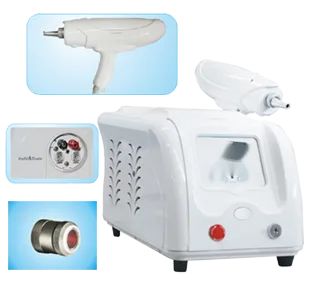
Five conditions come up over and over when clinics ask which vascular conditions a Nd:YAG laser can treat: spider veins, telangiectasia, port wine stains, hemangiomas and small leg veins. One thing ties them together. Each puts haemoglobin somewhere you can see it, and haemoglobin drinks up 1064 nm light. That single fact is why a long-pulse platform covers such a wide list, and it's where most buyers get the limits wrong.
Which five vascular conditions can a Nd:YAG laser treat?
A long-pulse 1064 nm Nd:YAG treats facial spider veins, diffuse telangiectasia, port wine stains, hemangiomas and small leg veins. Its job changes from lesion to lesion. On fine facial vessels it's the main tool. On port wine stains and infant hemangiomas it sits behind a pulsed dye laser or a drug protocol. That distinction belongs in your clinic copy.
| Condition | What you see | Where Nd:YAG fits | Realistic expectation |
|---|---|---|---|
| Facial spider veins | Fine red threads, nose and cheeks | Primary tool, traced vessel by vessel | Often clears in few sessions |
| Telangiectasia | Scattered capillaries, rosacea flushing | Primary tool, or paired with IPL | Several sessions |
| Port wine stain | Flat pink to purple birthmark | Second line, useful on thick or dark-skin cases | Many staged sessions |
| Hemangioma | Raised soft red growth, strawberry-like | Residual or superficial lesions | Case by case |
| Small leg veins | Leg telangiectasia, reticular veins | Valid option, often with sclerotherapy | Several sessions |
Session counts shift with vessel calibre, depth, skin type and operator skill. Quote a range, and never sell a fixed number.
How does 1064 nm light actually close a vessel?
It heats the blood inside the vessel until the wall gives out, while the skin above stays intact. That's selective photothermolysis, the principle Anderson and Parrish set out in Science in 1983. Our light-tissue interaction training material still treats their paper as the turning point for modern aesthetic lasers.
Wavelength choice follows the same logic. Both 532 nm and 1064 nm are absorbed by haemoglobin, but our technical archive is blunt about which to reach for: 532 nm scatters in the epidermis and invites pigment change, while 1064 nm penetrates more easily and lands on the target. The trade-off is speed. A small spot in the 3 to 6 mm range aims beautifully at one vessel, and it's slow work.
Long-pulse 1064 nm light is absorbed by haemoglobin, reaches the vessel through the epidermis, and damages it without hurting the skin above, provided cooling holds up its end.
A warning for spec-sheet comparisons. A Q-switched Nd:YAG is not a vascular device, whatever the wavelength column says. Nanosecond pulses shatter pigment; vessels need milliseconds of heat. We unpack it in our guide to long-pulse versus Q-switched Nd:YAG. It's the commonest spec mistake new distributors make.
The five conditions, one at a time
1. Spider veins
Fine facial threads are the easiest win here. They sit close to the surface, they're discrete rather than diffuse, and a small adjustable spot lets an operator follow each vessel like a pen line. Our clinical archive notes treated vessels frequently close after one or two sessions, though technique carries much of the outcome. Push the energy too hard and you get a burn, not a clearance. See our piece on facial telangiectasia and spider veins.
2. Telangiectasia
Telangiectasia is the catch-all term for capillaries widened enough to become visible, and most clinics see it weekly. Alcohol, hormones, steroids and sun all contribute, and rosacea flushing often travels with it. Our archive puts the dilated papillary capillary at roughly 0.1 to 1.0 mm across, a working range rather than a hard rule. These vessels are scattered, not singular. That means passes, not one heroic shot. Broadband IPL or E-light handpieces suit diffuse redness.
3. Port wine stains
Be honest with buyers here. Port wine stains are congenital capillary malformations, they don't fade on their own, and the recognised first-line device is the 595 nm pulsed dye laser, not Nd:YAG. Systematic reviews of pulsed dye laser for paediatric port-wine birthmarks describe it as the standard approach, with clearance building gradually. So where does 1064 nm come in? Longer wavelength, bigger spot, better epidermal protection. Our device manuals recommend the long-pulse 1064 series for darker skin tones and thickened lesions, exactly the group pulsed dye laser struggles with. Earlier treatment works better, and nodular stains respond poorly to any light source. Our article on port wine stain laser treatment covers sequencing.
4. Hemangiomas
Infantile hemangiomas are the most common benign tumour of childhood, occurring in up to roughly 5% of infants according to the American Academy of Pediatrics clinical practice guideline published in Pediatrics in 2019. Most shrink without help. That guideline names oral propranolol as first-line systemic therapy for lesions that do need treating, with lasers in a supporting role for superficial lesions, residual marks and ulceration. Any clinic marketing a laser as the primary cure here is overselling. Where a laser suits, our archive points to a long-pulse 1064 nm platform with adjustable pulse number, adjustable pulse width and contact cooling.
5. Small leg veins
Leg work has a clear ceiling, and knowing where it sits protects your reputation. A 2025 systematic review of long-pulsed 1064 nm Nd:YAG for leg veins by Baldaia and colleagues found it a valid option for leg telangiectasia and reticular veins, with minor side effects and better results combined with sclerotherapy. Our internal guidance agrees: vessels under about 3 mm are the target, and cooling has to protect the epidermis while the energy goes deep. Anything bigger belongs to a vascular surgeon. Say so plainly in the consultation.
Cooling is where vascular results are won or lost
A detail that rarely makes a brochure: cooling is not one setting you turn on and forget. Our engineering archive draws a sharp line between lesion types. Telangiectasia sits in the papillary dermis, so aggressive cooling over-protects the target and leaves the treatment doing nothing. Ease off. Port wine stains and hemangiomas are the opposite case: broad malformations needing higher fluence, where sapphire contact cooling is mandatory.
Train operators on that distinction. An expensive platform run with one cooling profile for every lesion loses to a cheaper one in trained hands.
How to spec a Nd:YAG for vascular work
Vascular capability is pulse regime plus handpiece plus cooling, not a wavelength on a datasheet. Optics first:
- Long-pulse 1064 nm as the core wavelength, with 532 nm for very superficial vessels.
- Adjustable pulse width and pulse number, so the operator matches the pulse to vessel calibre instead of fighting a fixed preset.
- Adjustable spot size: small for single threads, larger when you need depth.
- Sapphire contact cooling with a controllable profile, not a fixed one.
- A cooling system built for duty cycle, because a busy clinic running back-to-back sessions finds that limit fast.
Optics settled? The rest of the deal is commercial, and that's where import projects come unstuck. Put these questions to the supplier in writing, and keep the answers in the quotation:
- "Which regulatory clearance covers the vascular indication in my market, and can I see the certificate scope?" Ask for the document itself, check vascular treatment sits inside its stated scope, and find out what local registration your importer still has to complete. A blanket "we're certified" answers nothing. Our comparison of FDA 510(k) and CE routes explains what each covers.
- "How long is the warranty, and does it cover the laser module, the lamp and the chiller?" Those are the expensive failures. Get the term, covered parts, exclusions and who pays freight on a replacement in writing. More in our guide to warranty and spare parts.
- "What operator training and treatment protocols come with the machine?" You want parameter sheets by lesion and skin type, a named contact for clinical questions, and training your staff can actually attend, remote or on site. Handover matters more than the sticker price.
- "What's the lead time, and how do I buy handpieces and consumables in three years?" Pin down production and shipping time before you plan the launch, and check that spare handpieces, tips and lamps stay available for the model you're buying.
Evaluating suppliers rather than a single machine? Work through it in this order:
- Write down the lesion mix your clinic sees, weighted by revenue.
- Check which lesions the platform is first-line for, and which it only supports.
- Confirm the handpiece you need is included, not optional.
- Test on your own patients, across two skin types, before the order goes final.
- Price consumables and service into your payback model.
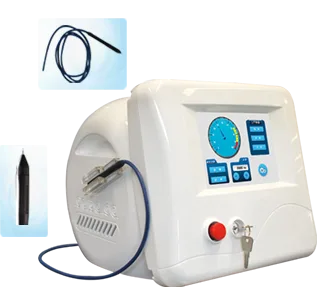
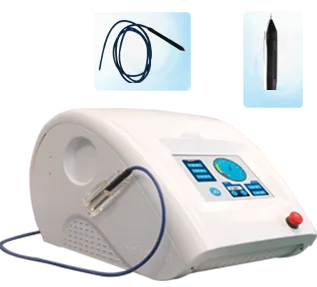
Shortlisting hardware now? Start with our long-pulse Nd:YAG vascular platform range, then open the Pmise LN-01 specification page for the pulse, cooling and handpiece detail your technical reviewer will want, and ask us for the vascular parameter sheet before you request a quote. One complementary note: clinics treating fine facial telangiectasia often keep a fine-tip electro device beside the laser, and our high-frequency equipment for vessel diseases category covers the Pmise VF-05, VF-06 and VF-07, with a 0.01 mm tip for spot work. For how a vascular device fits a full menu, see our solutions page.
Frequently Asked Questions
Is a Nd:YAG laser safe on darker skin?
Relatively, yes. Melanin absorbs 1064 nm weakly compared with shorter wavelengths, so the beam passes through a pigmented epidermis more cleanly, and our device manuals flag the long-pulse 1064 series as suited to darker-skin vascular cases. Conditions apply. You still need contact cooling, conservative starting parameters and a test spot. Burns and pigment change stay possible on any skin type.
How many sessions should a clinic quote?
Depends entirely on the lesion. Fine facial spider veins often close after a few treatments. Diffuse telangiectasia and leg veins typically need several. Port wine stains run to many staged sessions across months, and complete clearance is uncommon even then. Give patients a range with a review point built in, never a promise.
Does the treatment hurt?
Patients usually describe a snap or a sting with each pulse, more noticeable on the legs than the face. It's generally tolerable without anaesthesia. Contact cooling takes the edge off and protects the skin at once, and topical numbing suits sensitive areas. Most people go straight back to normal activity, with transient redness around the treated vessels.
Can Nd:YAG replace sclerotherapy for leg veins?
No, and it doesn't need to. For vessels up to about 3 mm the laser is a genuinely useful option, particularly for veins that resisted sclerotherapy or for patients who won't tolerate needles. The review evidence points toward combining the two rather than choosing. Larger varicose veins are a surgical matter. Position laser inside a vein-care pathway and your referral relationships stay healthy.
Written by the Pmise Technical Team. Pmise manufactures laser, IPL and RF aesthetic systems for clinics and distributors in more than 160 countries.