Quick answer: diode vs alexandrite vs Nd:YAG comes down to skin tone. The 755 nm alexandrite is fastest on light skin, the 808 nm diode covers the broadest mix of clients, and 1064 nm Nd:YAG is the wavelength you use on dark skin. Most of the rest is secondary.
All three are legitimate lasers. None is best in the abstract. They're three points on one physical trade-off. Once that trade-off is clear, picking a machine stops being guesswork.
How hair removal lasers work, and why the wavelength number matters
Every hair removal laser runs on selective photothermolysis. Melanin in the hair shaft and follicle absorbs the light, turns it into heat, and the follicle takes the thermal damage while the tissue around it is largely spared. Anderson and Parrish described the principle in Science back in 1983, and it still underpins every machine on this list. Our own engineering archive teaches it the same way.
The complication is that melanin sits in two places at once. It's in the hair you want gone. It's also in the epidermis you have to protect. On darker skin the epidermis competes with the follicle for the same photons, and if the epidermis wins you get a burn instead of a result.
Wavelength is your main lever on that competition, and it pulls in two directions:
- Shorter wavelengths are absorbed more strongly by melanin. More energy reaches the follicle per shot, which is efficient on pale skin and dangerous on dark skin.
- Longer wavelengths go deeper and scatter less. Our technical documentation on light and tissue interaction states it plainly: penetration depth is proportional to wavelength, scattering falls as wavelength rises, and roughly 600 to 1200 nm is the optical window into skin because light in that band scatters little and is absorbed less by the body's own pigments.
Short wavelength, strong melanin absorption. Long wavelength, deeper reach and a safer epidermis. Skin tone tells you which side of that trade you want to be on.
755 nm alexandrite: quick work on light skin
Alexandrite is the speed option for Fitzpatrick I to III. At 755 nm it has the strongest melanin affinity of the three, so it bites hard on fine and lighter hair that a longer wavelength might skate past. Large spot sizes get legs and backs done quickly.
That strength is also the catch. On tanned or genuinely dark skin the epidermis absorbs too much of the energy, and the risk of blistering and pigment change climbs fast. A recent holiday can push an otherwise safe client into unsafe territory. Postpone; don't quietly drop the fluence and hope.
808 nm diode: the machine most clinics end up buying
If you can only buy one hair removal system, it's usually a diode. At 808 nm it sits between the other two on both melanin absorption and depth, which makes it a real all-rounder rather than a compromise. It has been the volume workhorse of this market for well over a decade.
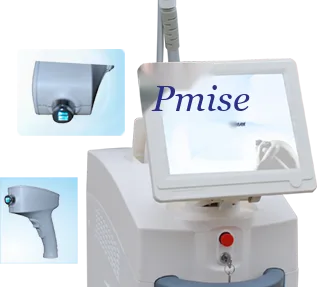
Hardware is what makes the wavelength usable across skin types. Look at the diode laser for hair removal line: the manual in our archive for the Pmise DL-04 lists an 808 nm handpiece with a 12 mm by 12 mm treatment spot, energy density adjustable from 2 to 120 J/cm2, pulse duration from 5 to 300 ms, repetition up to 10 Hz, and up to 600 W of laser output, with a sapphire window chilled to roughly 0 degrees Celsius held against the skin. That pairing is the whole trick. The cooled contact tip protects the epidermis while a long, adjustable pulse heats the follicle from within.
A wide pulse width range matters more than the sticker price, honestly. Short pulses suit fine hair. Long pulses spread the heat over time and treat pigmented skin more gently. Same machine, two very different treatments.
Some diode platforms stack 755, 808 and 1064 nm emitters into one handpiece. Judge each wavelength by its listed power and spot size, not by the front-panel label.
1064 nm Nd:YAG: what you use on Fitzpatrick V and VI
Long-pulsed 1064 nm is the safe wavelength for dark skin, and dermatologists say so plainly. Melanin absorbs 1064 nm relatively weakly, so most of the beam passes through the pigmented epidermis and gives up its energy deeper down at the follicle. It also penetrates furthest, which suits coarse, deep-rooted hair.
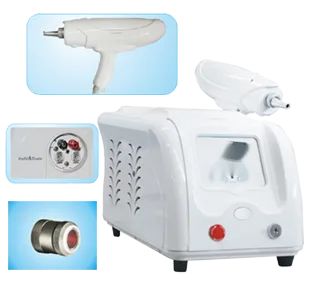
Our device documentation for the Pmise LN-01 long-pulse system describes exactly that behaviour: selective absorption at the follicular bulb and the prominent part of the follicle, with surrounding normal tissue absorbing very little or none, sapphire contact cooling on the handpiece, and an adjustable spot for different areas. The manual names permanent hair reduction on Fitzpatrick IV to VI as its headline application.
Nothing comes free. Weak melanin absorption means you need higher fluence for the same follicular effect, so 1064 nm sessions generally hurt more and reward a careful operator. On fine, light hair it's less efficient than alexandrite. Pricing sits in our note on Nd:YAG hair removal machine price; long-pulse versus Q-switched is covered in long pulse vs Q-switched Nd:YAG.
Diode vs alexandrite vs Nd:YAG side by side
| Feature | Alexandrite 755 nm | Diode 808 nm | Nd:YAG 1064 nm |
|---|---|---|---|
| Melanin absorption | Highest | Moderate | Lowest |
| Penetration depth | Shallowest | Medium | Deepest |
| Best skin types | Fitzpatrick I to III | Fitzpatrick I to VI (V-VI only with strong contact cooling and conservative settings) | Fitzpatrick IV to VI |
| Where it shines | Fine, light hair at speed | Mixed clientele, daily volume | Dark skin, coarse deep hair |
| Main limit | Risky on tanned or dark skin | Slower than 755 nm on fine light hair; needs conservative settings on very dark skin | Higher fluence, more discomfort |
| Typical cooling | Cryogen spray or air | Cooled sapphire contact tip | Cooled sapphire contact tip |
Which wavelength for which skin type?
Match the wavelength to skin tone first. Tune pulse width, fluence and cooling second. That order, not the reverse.
- Fitzpatrick I to III. Alexandrite 755 nm or diode 808 nm. Strong melanin absorption is an asset here, so sessions run fast and settings are forgiving.
- Fitzpatrick IV. Diode 808 nm is the sensible default. Some operators move to 1064 nm for extra margin, especially in summer. Alexandrite gets risky.
- Fitzpatrick V and VI. Long-pulsed 1064 nm, or a well-cooled diode at conservative settings. Leave 755 nm alone.
- A mixed client base. A diode platform, or a verified multi-wavelength system, gives the widest coverage from one cabinet.
Clinical work increasingly favours blending over choosing. Ross and Domankevitz, writing in Lasers in Surgery and Medicine in 2021, found that firing 755 nm and 1064 nm together outperformed either wavelength used alone, and that the combination was particularly helpful for lighter hair on darker skin types. Our own operator guidance is blunter and still holds up: darker skin, lower energy and lower frequency; paler skin, you can push both. Patch test first, every time. For starting parameters by skin type, see Fitzpatrick skin types and laser settings.
A short buying checklist
- Profile your clients before you shortlist machines. Mostly light skin points to alexandrite or diode. A diverse or predominantly dark-skinned base points to diode plus 1064 nm.
- Read the real spec sheet for every wavelength on offer: spot size, fluence range, pulse width range, repetition rate. Not just the number on the badge.
- Check the cooling system. A sapphire contact window held near zero is what lets you run higher fluence without punishing the epidermis.
- Ask about the laser bar's rated shot life and the cost of a replacement. A busy salon running back-to-back sessions will find that out the hard way otherwise.
- Plan for a course of treatments rather than a miracle. The American Academy of Dermatology tells patients that removing unwanted hair can take six sessions or more.
- Be honest about permanence. In US regulatory language for cleared hair removal devices, permanent hair reduction means a long-term, stable reduction in regrowing hairs, measured at 6, 9 and 12 months after a completed regime. Not zero hair forever.
- Ask the supplier to evidence regulatory status for each wavelength you are buying, not for the brand in general. CE marking for the EU, and an FDA clearance where the US market matters. Request the actual documents at quotation stage.
- Get the warranty in writing: how long it runs, and what sits inside it. Laser bar, power supply, chiller and handpiece are often treated differently from the cabinet.
- Confirm the supply chain behind the machine. Spare parts, consumables, replacement handpieces, and operator training in a language your staff reads. A distributor reselling into a region needs all four.
- Pin down lead time and shipping terms before you commit to a clinic opening date. Ask what changes it: configuration, wavelength combination, voltage, order size.
Treatment protocols, device options and room planning sit in our hair removal solution. If your current results disappoint, why laser hair removal fails walks through the usual culprits.
Ready to compare on paper? Request the full technical spec sheet and a quotation for the Pmise DL-04 (808 nm) or the Pmise LN-01 (1064 nm) through our diode laser for hair removal page, and tell us the Fitzpatrick mix you treat so we can propose the right wavelength.
Frequently Asked Questions
Which is better, diode, alexandrite or Nd:YAG?
None wins outright. Each suits a different skin tone. Alexandrite at 755 nm is quickest on light skin, the 808 nm diode is the versatile choice across a broad client mix, and 1064 nm Nd:YAG is safest on dark skin because epidermal melanin absorbs it weakly. Pick by the Fitzpatrick types you actually treat.
What is the best laser for dark skin?
Long-pulsed 1064 nm Nd:YAG is the usual recommendation for Fitzpatrick IV to VI. Its weak melanin absorption lets the beam pass through pigmented epidermis and reach the follicle, which lowers the risk of surface burns and post-treatment pigment change. A well-cooled 808 nm diode at conservative settings is also widely used. The 755 nm alexandrite is generally avoided on dark skin.
Why is the 808 nm diode laser so popular?
It balances the trade-offs better than either extreme. Melanin absorption and penetration depth both land in the middle, so one machine handles a wide span of skin types. Add a large cooled sapphire spot and a pulse width you can stretch from a few milliseconds to a few hundred, and you get a system that copes with high daily volume.
How many sessions does laser hair removal need?
Several, spaced weeks apart, whichever wavelength you use. Hair grows in cycles, and a laser only affects follicles that are in the active growth phase on the day, so repeat visits catch the rest. The American Academy of Dermatology advises patients that six sessions or more may be needed. Area, hair colour and skin type all shift that number, so set expectations honestly.
Pmise Technical Team. We build and export laser and light-based aesthetic systems, and write from our own device manuals and clinical training material rather than from brochure copy.