If you want melasma treatment that holds, the answer is restraint. Low-fluence Q-switched laser toning at 1064nm works because it chips pigment away across many gentle sessions instead of blasting it out in one. Melasma punishes heat. Go light, go often.
Why does melasma fight back so hard?
Melasma resists lasers because it isn't one tidy layer of pigment. It's chronic, hormone-and-sun-driven, and it keeps regenerating. Our technical archive states the histopathology plainly: melanin increases in the epidermis, the dermis, or both.
That "or both" is the whole problem. Settings tuned for surface pigment leave deeper melanin untouched. Settings strong enough to reach the dermis inflame the skin, and inflamed melasma comes back darker. The American Academy of Dermatology notes melasma can last for years or even a lifetime.
You don't delete melasma. You manage it. The laser lowers the pigment load; sun protection keeps it down.
What is low-fluence Q-switched laser toning?
Toning means treating the whole area with a large spot and a deliberately weak 1064nm Q-switched beam, session after session, rather than firing hot shots at individual marks. A Q-switched laser dumps its energy in a nanosecond. Our device manuals describe what follows: pigment absorbs that instant of light, shatters photomechanically, and the fragments are cleared by phagocytes.
The physics is selective photothermolysis, proposed by Anderson and Parrish in Science in 1983: pick the right wavelength and pulse duration and you damage a target chromophore while sparing its neighbours. Our light-tissue notes place representative photostimulation fluences at roughly 1 to 10 J/cm2, usually without a definite temperature rise. That's the register toning works in. Nothing like ablation.
Why 1064nm instead of 532nm?
Use 1064nm because it reaches deep pigment without cooking the epidermis on the way in. Roughly 600 to 1200nm sits in what our technical archive calls the optical window of skin: scatter drops as wavelength rises, so the beam travels deeper.
532nm is a superb tool. Just not here. It's absorbed right at the surface, the exact trigger you're avoiding on a melasma-prone face. Fire it too enthusiastically and you'll be treating post-inflammatory hyperpigmentation next month.
Who should you treat, and who should you defer?
Screening decides more melasma outcomes than settings do. What follows is guidance for trained operators, not patient advice. Our device documentation lists these contraindications for Q-switched work; any one means defer or decline:
- Pregnancy. Lactation is normally deferred too, since the hormonal driver is still running.
- Cardiac pacemakers or implanted defibrillators.
- Severe diabetes, uncontrolled hypertension, heart disease, epilepsy.
- Broken skin, active herpes, malignant lesions or scars in the field.
- Vascular surgery on the area within the past two months.
- Functional cosmetic products used on the area in the past month.
- A scarring tendency; the documentation advises against treating a keloid diathesis.
Routine practice adds more: recent isotretinoin, photosensitising medication, a fresh tan or sunburn, active infection in the field, and any history of PIH after earlier light-based treatment. Our clinic laser safety guide covers intake.
Then establish where the pigment sits. The AAD notes a dermatologist may use a Wood's lamp or a dermatoscope to examine melasma; epidermal pigment stands out more sharply under Wood's light, dermal pigment does not. Our archive is equally blunt that confirming whether pigment lies in the dermis or the epidermis matters before you treat, and that a trial patch with a large spot is how you check. Dermal and mixed patterns respond more slowly and relapse more readily.
Skin type changes the calculation. The 2022 Medicina systematic review by Lee and colleagues reports rebound hyperpigmentation and PIH occurring more often in darker skin types, and our archive's patient-selection guidance agrees: Fitzpatrick I to III tolerate higher fluence, while IV to VI call for caution, longer wavelengths, reduced energy and active cooling. So on a darker face: lower starting dose, longer gaps, mandatory test patch. See Fitzpatrick skin types and laser settings.
What settings does melasma actually need?
Low energy, big spot, patient spacing. Our device documentation gives a specific protocol: 1064nm, spot no smaller than 6mm, 3 to 10Hz, pulse energy starting at 200mJ, stopping when the area turns light red and pigment looks scattered. The same documentation warns against high energy: no oozing, no pigment turning white, or serious pigmentation follows. Sessions run weekly, ten to fifteen of them.
Two units get mixed up here constantly, and that is how people hurt skin. Pulse energy is measured in millijoules (mJ). Fluence, the dose skin receives, is joules per square centimetre (J/cm2): pulse energy divided by spot area. A 6mm spot covers about 0.28cm2, so the manual's 200mJ start delivers roughly 0.7 J/cm2. Open that same 200mJ to a 10mm spot, about 0.79cm2, and the dose falls to roughly 0.25 J/cm2. Same number on the screen. Different treatment.
Published protocols describe a wider band than that starting point. The Medicina review reports low-fluence Q-switched Nd:YAG studies clustering around 0.5 to 3.8 J/cm2, spots of 6 to 10mm, weekly or biweekly intervals, and usually nine to ten sessions. Read that as literature, not as a dial setting. It pools trials run at different spot sizes, so converting the whole range back at one fixed spot invents pulse energies no study in it actually delivered. Your real ceiling is the machine in front of you: at a 6mm spot the Pmise QN-03 reaches about 1.4 J/cm2 and the Pmise QE-01 about 2.8 J/cm2 at their documented maximum pulse energy, and melasma is not the reason to run either one there. The limit that governs a session isn't arithmetic anyway. It's the endpoint our device documentation specifies: faint pink, and stop well before oozing or whitening. Begin at 200mJ, and let the skin say whether it needs more.
Drill one habit into staff: change the spot, recalculate the fluence.
| Setting choice | Pulse energy | Spot diameter | Fluence | Effect on melasma |
|---|---|---|---|---|
| Aggressive spot work | 200mJ | 2mm (0.03cm2) | About 6.4 J/cm2 | Far above the band; PIH, rebound darkening |
| Manual starting point | 200mJ | 6mm (0.28cm2) | About 0.7 J/cm2 | Low end of the band; safe place to judge response |
| Literature-derived mid-band, not a Pmise-documented setting | 400 to 600mJ | 6mm (0.28cm2) | About 1.4 to 2.1 J/cm2 | Reported in published studies, not a Pmise protocol target. Endpoint-governed: justified only if faint pink isn't reached lower, never past oozing or whitening |
| Same energy, wider spot | 200mJ | 10mm (0.79cm2) | About 0.25 J/cm2 | Below the band; little effect, blamed on the machine |
Only one row there comes from our device documentation: the 200mJ start at 6mm. The rest is arithmetic for orientation, not recommended doses.
A session runs like this:
- Screen against the contraindications, photograph, record phototype.
- Assess pigment depth with a Wood's lamp or dermatoscope; set expectations.
- Cleanse and dry the area; surface moisture wastes energy.
- Trial-treat 0.5 to 1cm2 with a large spot, as our archive advises.
- Start low, fire three to five shots, watch, then adjust energy or spot.
- Treat with even, light passes; the endpoint is faint pink, nothing more.
- Reinforce sun protection; rebook a week out.
Fine energy resolution matters more than headline power.
PIH and mottled hypopigmentation: the two ways this goes wrong
Treat too hard and you get rebound pigment. Our archive notes that some patients develop obvious pigmentation after treatment, which is exactly why the trial patch exists, and lists relapse and pigment change among the recognised complications. See oozing or whitening and you've crossed from toning into injury.
The second failure is sneakier, because it takes months to appear. Mottled hypopigmentation, pale patches that can persist, is reported as an adverse event of low-fluence Q-switched treatment in the Medicina review, which pins the risk on excessive cumulative energy: high fluence, short intervals, too many sessions. Nobody notices session six running hot. They notice session fourteen.
The laser is one lever, not the whole solution
Toning alone rarely holds melasma down for long. Our archive lists topical agents and vitamin C alongside the laser rather than instead of it, and the AAD names broad-spectrum sunscreen and prescription hydroquinone as core melasma treatment. So wrap the device in a routine: daily photoprotection, supervised topicals between sessions, a frank talk about triggers, photography every visit.
How do you choose a melasma treatment machine?
Buy for control at the bottom of the energy range, not the number on the brochure. On a serious Q-switched Nd:YAG platform you want small, predictable energy increments, a spot that comfortably reaches 6mm and beyond, a short nanosecond pulse, and both wavelengths so it earns its keep on tattoos. Measured against those criteria:
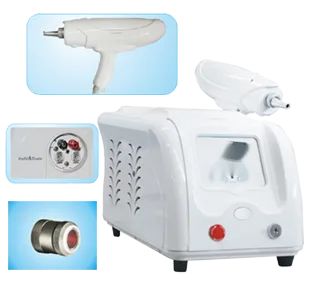
- Pmise QN-03. Documented at up to 400mJ single pulse at 1064nm, 6 to 8ns pulse width, spot continuously adjustable from 1 to 6mm. At 6mm, 400mJ works out to roughly 1.4 J/cm2, mid-band for toning. Note the ceiling: 6mm is exactly the protocol minimum, nothing wider.
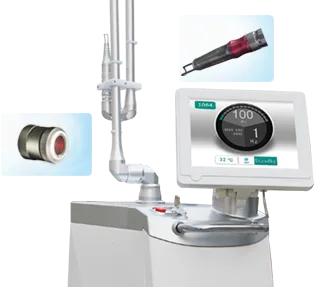
- Pmise QE-01. EO Q-switched, documented spot 1 to 7mm, pulse width around 6ns, up to 800mJ single pulse at 1064nm, delivered through a multi-joint articulated arm. Its interface steps energy in 50mJ increments from 50mJ to 800mJ, so the first step above the manual's 200mJ start is already a 25% jump. Workable, but not fine, so use spot size as your fine adjustment.
- Pmise QN-09. Compact dual-wavelength unit, documented spot 1 to 5mm continuously adjustable, up to 200mJ single pulse. It doesn't reach the 6mm minimum spot the melasma protocol specifies, so treat it as a catalogue reference for tattoo work, not a toning recommendation.
Still comparing classes? Our guides on how to choose a Q-switched Nd:YAG laser and long-pulse versus Q-switched Nd:YAG cover the trade-offs, and the melasma treatment protocol covers session planning. Past the spec sheet: approvals as certificates, warranty and consumable pricing, training, stocked spares. Talk to the Pmise engineering team for a quote.
Frequently Asked Questions
How many laser toning sessions does melasma need?
Plan for a course, not a visit. Our device documentation specifies roughly ten to fifteen sessions at weekly intervals, and the 2022 Medicina review reports protocols clustering around nine to ten sessions at weekly or biweekly spacing. Progress is gradual and easy to underestimate without photos, and melasma relapses, so budget for maintenance.
Who should not have laser toning for melasma?
Our device documentation rules out pregnancy, pacemakers or implanted defibrillators, severe diabetes, uncontrolled hypertension, heart disease, epilepsy, broken skin or active herpes in the field, recent vascular surgery on the area, and a scarring diathesis. Practice also defers recent isotretinoin, photosensitising drugs, fresh tanning, and known PIH responders.
Can laser toning make melasma worse?
Yes, and it's the most common way clinics lose a melasma client. High energy or short intervals inflame the skin and trigger rebound darkening; our manuals warn that oozing or whitening during treatment leads to serious pigmentation afterwards. Excessive cumulative energy carries the opposite risk, mottled hypopigmentation. Test patch first; go gentler on darker skin.
Does laser replace creams and sunscreen?
No. The laser reduces pigment already there; sunscreen and topicals address why it comes back. The AAD treats broad-spectrum sun protection and topicals such as hydroquinone as the foundation of melasma care, with light-based treatment as an addition, and notes results generally take three to twelve months. Skip the topical side and you retreat the same faces next season.
Pmise Technical Team. Pmise manufactures Q-switched Nd:YAG, diode and light-based aesthetic systems for clinics and distributors worldwide, drawing on more than a decade of laser engineering and clinical parameter documentation.