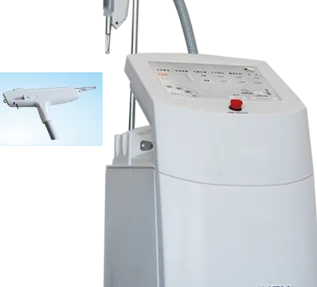
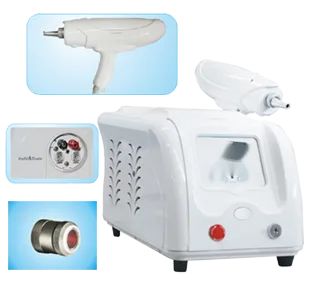
Buyers asking how to choose q-switched nd yag laser equipment for tattoo and pigment work should score six things and ignore the rest: dual 1064/532nm output, pulse energy measured at your working spot size, the spot range itself, pulse width and shot-to-shot consistency, cooling, and whether parts and paperwork can actually reach your country.
The physics, briefly. A Q-switched Nd:YAG fires a pulse so short that ink absorbs the energy before surrounding tissue can carry the heat away, the selective photothermolysis principle Anderson and Parrish set out in Science in 1983. The particle heats, expands, fractures. Our device manuals call that moment an instantaneous blast; the fragments are then cleared by phagocytes through the lymphatic system. Every spec below exists to make it repeatable.
Do you need 1064nm, 532nm, or both?
Both, and this one isn't negotiable if you want a normal clinic case mix. The 1064nm beam goes deeper and does the heavy lifting on dark, dense ink and dermal pigment such as nevus of Ota. The 532nm beam is absorbed far more strongly by red and brown tones and shallow lesions like freckles, but stays near the surface. Buy a single-wavelength unit and you've bought half a business.
Published clinical work splits the same way. A double-center retrospective study by Cannarozzo and colleagues, published in Life in 2021, treated black and blue tattoos at 1064nm and sent colored tattoos to 532nm sessions, with patients typically needing several sessions rather than one. So ask a second question: how is that green light made? Pmise systems produce 532nm by passing the 1064nm beam through a KTP crystal, and our engineering archive is blunt about it: a properly specified KTP stage raises green-light purity, which is what makes red ink respond. Weak frequency doubling looks fine on paper and disappoints on a red rose. Full detail sits on the Q-switched Nd:YAG laser product page.
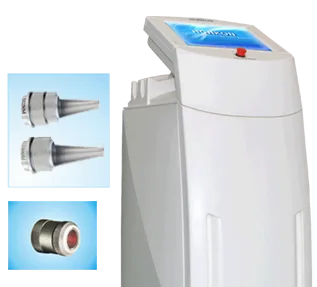
How much pulse energy and spot range do you actually need?
Enough energy to reach a working fluence at the spot size you'll really use, with headroom left over. Fluence is energy divided by spot area, so quoting pulse energy alone is close to meaningless. Published nanosecond Q-switched literature generally reports single-digit J/cm² fluences at 1064nm and lower figures again at 532nm, but the setting belongs to a trained operator, chosen case by case against lesion type, ink depth and skin type. No manufacturer's website is a dosing protocol.
Our documentation sets out the tiers, model by model. The Pmise QN-03 leaflet describes a single-lamp, two-rod resonator that lifts single-pulse output to roughly 400mJ: arm-class energy with no arm to maintain. The portable Pmise QN-05 spec sheet documents that same 400mJ single-pulse ceiling, plus 800mJ double-pulse and 1200mJ triple-pulse. The articulated-arm Pmise QE-01 manual specifies up to 800mJ at 1064nm and up to 400mJ at 532nm. Compact units sit lower: the Pmise QN-06 is documented at up to 200mJ single and 620mJ multi-pulse, fine for surface pigment, thin on heavy black ink.
Spot range matters as much: a fixed spot turns a large tattoo into an afternoon of dot-by-dot work. Our manuals list 1 to 6mm on the QN-05, 1 to 5mm continuously adjustable on the QN-06, and 1 to 7mm on the QE-01 through a dedicated spot adjustor. Small spots concentrate fluence for dense outlines; wide spots clear shading faster and feel less brutal at equal fluence.
One question separates a good vendor from a bad one. What energy do I get at a 4mm spot, not at your best 1mm spot? Get it in writing.
Pulse width and shot-to-shot stability: the spec nobody volunteers
Short pulses are the whole point of a Q-switch, and shorter generally means cleaner fragmentation with less heat bleeding sideways. Our documentation puts the Pmise QN-03 and portable QN-05 at 6 to 8ns and the Pmise QE-01 at around 6ns, while the small-format QN-06 runs longer at 10 to 20ns. Our manuals tie shorter pulses to better pigment shattering with less thermal injury, the same reasoning the literature uses.
Stability is the part vendors skip. If energy wanders shot to shot, some pulses under-treat and others blister. Ask for energy-meter readings across a run of fifty pulses, not one hero measurement, and ask how energy is spread across the spot: a strongly peaked profile runs hot in the middle and weak at the rim. Whatever the vendor claims, make them put it on the quotation. Still weighing pulse regimes? Our comparison of Q-switched versus picosecond covers the trade-off, and long-pulse versus Q-switched Nd:YAG explains why the same crystal behaves differently at millisecond timescales.
Cooling, build and format: portable or articulated arm?
Heat management decides whether the machine holds its numbers through a full day, and it matters more than the sticker price. Lamps and rods dump heat; drift follows. Pmise Q-switched units use combined water and air cooling, and our QN-06 documentation calls out a heat radiation system for long working times, a ceramic-cavity handpiece that survives brief running without water, and an anti-knock handpiece that still works after a drop. Handpieces get dropped. Ask.
- Water safety: a flow switch and a visible water level indicator prevent the classic self-inflicted failure: firing with no coolant.
- Self-check: a malfunction self-check that names the fault beats a blank screen and a WhatsApp guessing game.
- Consumables: flash lamp, Q-switch crystal, protective window, treatment tips. Get prices and lead times.
- Weight: the compact QN-06 is documented at about 7kg net, which genuinely travels; the QE-01 at around 45kg excluding its arm, which does not.
Neither format wins in the abstract.
| Spec (per model) | Portable QN-series | Arm-mounted QE-01 |
|---|---|---|
| Wavelengths | 1064nm and 532nm | 1064nm and 532nm |
| Pulse energy | QN-03, QN-05: up to ~400mJ single; QN-05 also 800mJ double, 1200mJ triple; QN-06: 200mJ single, 620mJ multi | up to 800mJ at 1064nm, up to 400mJ at 532nm |
| Pulse width | 6 to 8ns (QN-03, QN-05); 10 to 20ns (QN-06) | around 6ns |
| Spot range | 1 to 6mm (QN-05); 1 to 5mm (QN-06) | 1 to 7mm via spot adjustor |
| Repetition rate | 1 to 5Hz (QN-05, QN-06) | 1 to 10Hz |
| Delivery | direct handpiece, no arm | 7-joint articulated arm |
- Write down your last hundred cases. Mostly freckles and age spots, or full-color tattoos and dermal lesions like those on our nevus of Ota solution page?
- Decide your headroom. Deep, dense targets need higher single-pulse energy and a faster repetition rate.
- Pick the format. Portable if you move or share rooms, arm-mounted if the machine lives in one room and runs all day.
- Pressure-test the support before you argue about price. Protocol guidance for ink work is on the tattoo removal solution page.
Can you legally import it, and what safety kit is in the crate?
Skip this and the rest of the checklist is academic. Market access rules differ by country and they change, so confirm the current requirement with your own regulator before you pay a deposit. Don't take a supplier's word for it, and don't assume a certificate issued for one model covers another.
- Which route applies. The EU works through CE marking under the Medical Device Regulation. The United States works through FDA clearance or listing, depending on the device and its claims. Many other markets add their own registration on top. Our notes on FDA 510(k) versus CE unpack the difference.
- Who supplies the file. Ask in writing who provides the technical documentation and declaration of conformity, in whose name any certificate is held, and whether your exact configuration is covered.
- Registration in your market. Is the model already registered where you operate, or are you funding that process yourself? The answer can move your go-live date by months.
- Laser class. Request the laser safety classification and its test report, referenced to IEC 60825-1.
- Safety kit. Eyewear rated for both 1064nm and 532nm, door signage, a key switch and an interlock connection. The accessory list in our QE-01 manual ships protective goggles, glasses, an interlock shorting-stub, keys and a foot pedal. Confirm the same for your model and budget eyewear per operator. See our clinic laser safety guide.
Service, warranty and the commercial terms to nail down
A spec sheet with no parts behind it is a liability. Cross-border deals go wrong here, usually when the flash lamp fades and nobody answers the email. Our notes on warranty and spare parts and on Q-switched Nd:YAG pricing go deeper.
- Warranty term in writing, with exclusions stated plainly
- Flash lamp shot rating, replacement price, lead time to your port
- Q-switch crystal and protective window pricing
- Production lead time from deposit to shipment, plus realistic transit time
- Payment terms, Incoterms, crating, and who clears customs at each end
- Installation and commissioning: who performs it, who pays, what counts as acceptance
- Operator training, remote or on-site, and who pays for it
- Voltage configured for your market, 220V or 110V, confirmed on the order
Buy for the hardest case you routinely see, not the easiest one. A single machine covering your whole case mix beats two narrow units that each leave a gap.
Frequently Asked Questions
How many sessions does Q-switched tattoo removal take?
Plan for a course, never a single visit. FDA consumer guidance on tattoo removal is clear that laser removal takes multiple treatments and that complete removal isn't possible in every case. For cafe-au-lait macules, our own device documentation sets a treating interval of 45 to 60 days over six to eight sessions. Depth, color, ink age and skin type all move that number.
Which tattoo colors are hardest to remove?
Dark blue and black respond most readily, while green, red and yellow are the difficult ones, according to FDA consumer guidance on tattoo removal. That's a direct buying argument for dual wavelengths: 1064nm handles the easy dark ink, and a clean 532nm output gives you a chance on reds and warm tones. Multi-colored work may need more than one wavelength and a frank talk about partial clearance.
What single question exposes a weak vendor?
Ask for pulse energy measured at each spot size, with an energy meter trace across a run of shots. Vendors who build their own resonators answer without hesitating. Resellers stapling a badge onto someone else's cabinet resend the peak figure, or go quiet.
Get the numbers this guide told you to demand
Send us your case mix and the market you import into. Our technical team will come back with the model-by-model spec sheet, an energy-per-spot-size measurement report, a consumables price and lead-time list, and the conformity documentation that exists for that configuration. Start from the Q-switched Nd:YAG range, or write to us through the contact page. Bring the awkward questions.
Pmise Technical Team. We manufacture Q-switched and long-pulse Nd:YAG, fractional and light-based aesthetic systems, and these notes come from our own engineering archive and treatment documentation.