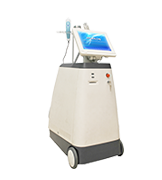
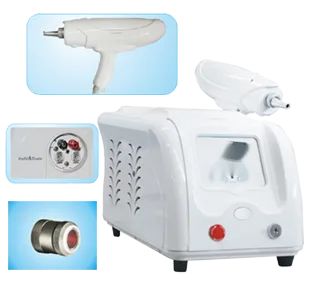
Choosing between portable vs stationary aesthetic machines comes down to one question: how much power and uptime does your room actually need? A portable beauty machine wins for new, mobile, or space-tight clinics. A stationary laser machine wins for high-volume rooms that run all day and need maximum output. Everything below helps you place your clinic on that line.
Both form factors treat the same concerns. The difference is engineering headroom, not marketing. So let's look at what changes when a device shrinks onto a tabletop or grows into a floor-standing tower.
What actually differs between portable and stationary machines?
The short version: stationary units carry bigger power supplies, bigger cooling, and a heavier chassis, so they hold output longer and tolerate back-to-back sessions. Portable units trade some of that peak capacity for a small footprint and the ability to move. Neither is "better." They're built for different days.
| Factor | Portable (tabletop / trolley) | Stationary (floor-standing) |
|---|---|---|
| Peak power & sustained output | Good for most concerns; can taper on very long sessions | Highest peak; holds output across a full day |
| Cooling | Often air or compact semiconductor (TEC) cooling | Larger water-cooled circuit or built-in chiller |
| Duty cycle / throughput | Fine for low-to-moderate volume | Built for continuous, high-volume use |
| Footprint & mobility | Moves between rooms, sites, and shows | Fixed install, dedicated space |
| Upfront price | Usually lower | Usually higher |
| Handpiece / consumable options | Sometimes fewer | Often broader, higher-spec |
Read that table as tendencies, not laws. A well-built portable diode can out-treat a tired old tower. Build quality still decides.
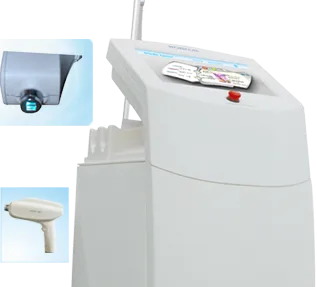
Cooling is the real divider, not the wheels
If you remember one thing, remember this. Cooling capacity is what separates a machine that fades after ten clients from one that doesn't. Laser and light devices dump heat, and that heat has to go somewhere.
Portable systems usually lean on air cooling or a compact semiconductor circuit. That's real cooling, and it works, but it asks for care. Pmise's DL-04 diode manual, for example, runs a semiconductor cooling system and tells operators to change the water at least every 30 days, with sapphire contact cooling at the handpiece to protect the skin surface. Skip that upkeep and you'll feel it in performance.
Stationary machines tend to carry a larger water-cooled loop or an integrated chiller. Our EO Q-switched Nd:YAG (electro-optic Q-switched) manual, for instance, is filled with roughly 1800 mL of purified water and asks for a full water exchange about every two months. More water and a bigger radiator mean the device shrugs off long sessions. That's exactly why floor-standing units suit rooms that never really stop.
A machine's cooling headroom quietly sets its real-world throughput. Check it before you check the price.
Throughput, duty cycle, and durability under volume
Duty cycle is how much of the hour a device can fire without pausing to cool. High-volume clinics live and die by it. If you're booking hair removal back to back through a Saturday, a stationary machine's headroom keeps every client on the same settings the last one got.
Portables handle real workloads too. A single-room studio or a new clinic ramping up its book rarely pushes a good portable to its limit. The honest risk is heat soak on marathon days, when a small cooling circuit needs short breaks. Plan your schedule around that and it's a non-issue.
Durability follows the same logic. Heavier chassis, bigger fans, and roomier internals give stationary units an edge under punishing use. For a fair look at how volume feeds back into payback, our aesthetic laser ROI guide walks through utilisation and revenue per room.
Footprint, mobility, and where each earns its keep
This is where portables shine and it isn't close. A tabletop or trolley unit rolls between treatment rooms, rides to a client's home, travels to a trade show, and fits a rental space you haven't committed to long-term. For a growing practice, that flexibility is worth real money.
- Home visits and mobile services: a mobile aesthetic device is the whole business model, not a bonus.
- Multi-room sharing: one portable can serve two or three rooms on a light schedule.
- Pop-ups, expos, and demos: easy to transport, quick to set up.
- Tight or leased space: no dedicated footprint, no plumbing for a chiller.
Stationary machines ask you to commit a spot on the floor and, sometimes, the wiring around it. In exchange you get a stable, always-ready workhorse. For a clinic anchoring its core services, that trade is usually the right one. If you're still mapping which services to anchor, start with our guide to the must-have machines for an aesthetic clinic.
Does the modality decide for you?
Often, yes. Some technologies squeeze neatly into a portable body. Others really want the room and the power. Here's the rough map.
Diode hair removal, IPL and E-Light, RF, and many Q-switched pigment systems all ship in capable portable and trolley formats. Our MV line in our archive appears in both handheld and floor-standing versions of the same platform, which tells you the modality itself doesn't force one shape. Cooling and target output do.
At the top end, physics pushes toward stationary. High-power fractional CO2 ablates tissue by heating the water inside it, and sustaining that at speed demands serious cooling and power delivery. Top-tier Q-switched and long-pulse platforms that chase maximum peak energy lean the same way. If your plan centres on ablative resurfacing or the most demanding tattoo and pigment work, budget for a floor-standing build.
A quick decision checklist
Run your clinic through this before you shortlist anything. Answer honestly about the next two years, not just today.
- How many sessions per day at peak? Under moderate volume, portable is plenty. Slammed all day, go stationary.
- One fixed room, or several rooms and off-site work? Movement points to portable.
- Which modality leads your revenue? Ablative CO2 or max-power lasers lean stationary; diode, IPL, RF, most Q-switched flex either way.
- Do you have space and, if needed, plumbing for a chiller? No spare footprint favours portable.
- What's your cash position now? A portable beauty machine lowers the entry cost; you can scale to stationary as the book fills.
- Who maintains it? Portables need disciplined water and filter upkeep; stationary units need periodic chiller service.
Most new and mobile clinics should start portable and add a stationary anchor when volume justifies it. Established high-volume medical clinics should default to stationary for uptime, and keep a portable for overflow or satellite rooms. To pressure-test the running-cost side of either choice, see our breakdown of laser machine running costs and consumables. When you're ready to compare specific builds, browse the full Pmise product range or ask us to match a configuration to your room.
Frequently Asked Questions
Is a portable aesthetic machine less powerful than a stationary one?
Not always, but the ceiling is usually lower. Portable units carry smaller power supplies and more compact cooling, so peak output and sustained duty cycle tend to trail floor-standing models. For low-to-moderate volume the difference rarely matters. For all-day, high-throughput rooms or top-power modalities, a stationary machine's headroom is the safer bet.
Can one portable machine cover a small clinic full-time?
For many single-room and early-stage clinics, yes. The catch is heat management on very long days, since compact cooling circuits sometimes need short pauses. Keep up with water changes and filter care, space out marathon sessions, and a quality portable will carry a light-to-moderate book comfortably for years.
Which is cheaper to own over time?
Upfront, portables usually cost less. Total cost depends more on utilisation, consumables, and maintenance than on form factor. A busy stationary unit can earn back its higher price through uptime and throughput, while an underused stationary machine just ties up capital. Match the device to real volume, not aspiration.
Do portable and stationary machines treat the same concerns?
Largely, yes, within a given modality. A portable diode and a stationary diode target the same follicles; the gap is speed, cooling, and how long they hold settings under load. The bigger clinical divide comes from the technology you pick, not whether it sits on a table or the floor.
Pmise Technical Team. We design and manufacture laser and light-based aesthetic systems and support clinics and distributors worldwide with configuration, training, and after-sales service.