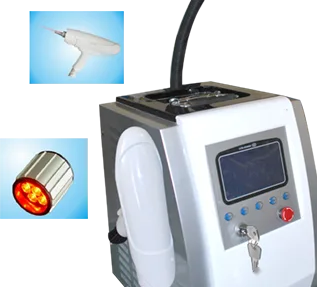
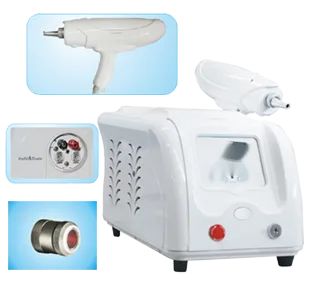
Laser tattoo removal equipment isn’t a one-size-fits-all purchase. If you’re building a tattoo removal business, you’ll almost certainly need a Q-switched Nd:YAG machine. It’s the standard for a reason: dual 1064nm and 532nm wavelengths handle most ink colours. But not every machine stamped “Q-switched” will deliver the same results. Let’s look at what actually matters.
Pmise’s engineering team maintains an active R&D focus on thermal management and laser platform development across our aesthetic and medical laser lines. This ongoing work informs the design choices we recommend to clinics evaluating tattoo removal equipment.
Why a Q-switched Nd:YAG is the Standard for Tattoo Removal
Laser tattoo removal works on a simple principle: ink absorbs light, heats up, and shatters. That’s selective photothermolysis. Most dermatologists agree that this principle—first described in the early 1980s (Anderson & Parrish, 1983)—is the foundation of modern laser tattoo removal. But not every laser can deliver the right pulse. Continuous-wave lasers burn surrounding skin before breaking ink.
A Q-switched Nd:YAG solves that. It packs energy into extremely short nanosecond pulses. Peak power’s high, but the pulse is so brief the skin doesn’t overheat. That’s the key. It lets the laser target ink while sparing the epidermis. For most clinics, a Q-switched Nd:YAG is the first machine you’ll buy.
There’s another reason it’s the workhorse: two wavelengths in one platform. 1064nm reaches deep and treats black and dark blue inks. 532nm handles reds and oranges. Not every ink responds perfectly, but a dual-wavelength machine covers the majority of tattoo removal requests. Read our primer on choosing a tattoo removal machine with Q-switched technology for more background.
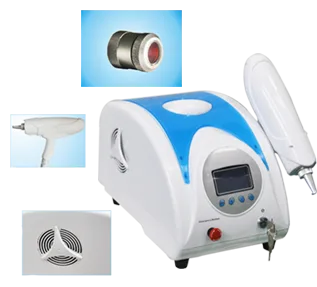
Dual Wavelengths: 1064nm and 532nm by Ink Colour
Two wavelengths won’t treat every ink, but they cover most. Black ink? 1064nm. Dark blue? 1064nm. Red or orange? 532nm. Green and light blue are stubborn — they often need a 755nm alexandrite or a picosecond system. Yellow and white are the hardest; they reflect most wavelengths and may require multiple technologies.
Here’s a quick reference table to keep by your consultation desk:
| Ink Colour | Primary Wavelength | Notes |
|---|---|---|
| Black | 1064 nm | Responds well; often the fastest to clear. |
| Dark blue | 1064 nm | Similar to black, but may need more sessions. |
| Red | 532 nm | Good absorption, but watch darker skin types. |
| Orange | 532 nm | Often fades with red; stubborn cases may need more energy. |
| Green | 755 nm or picosecond | 1064/532 usually insufficient. |
| Light blue | 755 nm or picosecond | Same as green. |
| Yellow | Multiple wavelengths | Hardest colour; often incomplete clearance. |
Be realistic with clients. No single machine removes every colour completely. If your market has high demand for multicoloured tattoos, you may need to add a picosecond or alexandrite handpiece later. But for a starting clinic, a dual-wavelength Q-switched Nd:YAG is the smart foundation. Check current pricing trends on our Q-switched Nd:YAG laser price guide.
Fluence, Spot Size, and Why Stability Beats Peak Numbers
Fluence is energy density — joules per square centimetre. It’s the dose you’re delivering to the skin. Spot size matters more than most buyers realise. A larger spot penetrates deeper for the same fluence. That means you can treat deeper ink with less risk of epidermal damage. But a larger spot needs more total energy, which can overheat the handpiece or the skin if cooling is poor.
Some manufacturers chase peak power specs. That’s a mistake. What you need is stability: the same output pulse after pulse, hour after hour. A machine that claims an impressive peak but drifts noticeably between shots will produce patchy fading — or worse, burns. Ask for a measured stability report. If the seller can’t provide one, walk away.
Spot size adjustability is also critical. You’ll want a small spot for fine lines and a larger spot for broad colour fields. The ability to swap spot sizes lets you treat different tattoos without changing the whole handpiece.
Skin Cooling: The Forgotten Safety Feature
Cooling is not a luxury. It’s a safety system. The epidermis absorbs some of the laser energy, even at 1064nm. Without cooling, that heat builds up and can cause blisters, scarring, or hyperpigmentation. Contact cooling — a chilled sapphire or quartz window — is the most common approach. Some machines use cryogen spray or forced cold air. All work, but they have different maintenance needs.
Don’t ignore the machine’s internal cooling either. A water-cooled laser cavity lasts longer and handles higher repetition rates without overheating. Air-cooled systems are lighter and cheaper, but they may have shorter duty cycles. If you run back-to-back clients, a machine that shuts down after 15 minutes is useless.
Our engineering team has documented cooling designs across several laser platforms, focusing on thermal management in clinic environments. This R&D emphasis is critical for reliable, high-volume tattoo removal sessions.
Throughput and Ergonomics for a Busy Clinic
Repetition rate matters. A Q-switched laser fires in pulses per second — hertz. Higher repetition rates mean faster treatment. But high rep rates also generate heat, so cooling and power supply must keep up. A machine that lists an impressive repetition rate but only sustains it for a minute isn’t worth much.
Look at the delivery system. An articulating arm with a lightweight handpiece reduces operator fatigue. A fibre delivery can be more flexible but may limit peak power. Check the user interface. Preset protocols for different ink colours and skin types speed up training. A footswitch that’s easy to reach saves time.
Think about your clinical flow. A busy salon running back-to-back facials needs a machine that’s ready to go when the client sits down. Warm-up time, daily calibration, and cool-down cycles all eat into your schedule. Ask the manufacturer for a realistic duty cycle — not the marketing number. See our Q-switched Nd:YAG laser product page for technical details on our current platform.
Cost of Ownership: Beyond the Price Tag
The purchase price is only the beginning. Q-switched Nd:YAG machines have consumables. The flashlamp that pumps the laser crystal wears out. Replacement cost and frequency? Depends on usage. Some machines need a new lamp every one to two years in heavy use. Others use diode-pumped designs with longer life but higher upfront cost. Ask for a published maintenance schedule.
Shipping and import duties add up. Training, spare parts, and remote support also matter. A low-cost machine with no local service partner can become an expensive paperweight. Consider the total five-year cost, not just the invoice.
As a rough example, if you charge a typical per-session fee and treat, say, ten clients per week, a reliable machine could pay for itself in under a year. But that’s purely illustrative — your local pricing, rent, staffing, and client volume will determine the real payback. Don’t buy based on a salesperson’s spreadsheet.
Warranty, Training, and What to Verify Before Buying
Warranty terms vary wildly. One year on parts and labour is common. Longer coverage is better. Check what’s covered: laser cavity, power supply, handpiece, cooling system. Ask about exclusions. Flashlamps are often considered consumables and may not be covered.
Training is non-negotiable. You need more than a manual. Look for video tutorials, live remote training, and a responsive technical support team. Ask if they provide treatment protocols for different skin types. Ask for a list of spare parts they keep in stock.
Before you send a deposit, verify these points:
- Request a live video demo of the exact model you’ll receive.
- Ask for safety certifications: IEC 60825-1, CE marking, FDA clearance if you’re in the US market.
- Get a written quote including shipping, customs, and training costs.
- Ask for two or three references from buyers in your region.
- Confirm the availability of the flashlamp or diode pump source for at least three years.
- Check the duty cycle and cooling requirements against your clinic’s power supply.
Pmise offers a dedicated Q-switched Nd:YAG laser system built for clinical tattoo removal. Our technical team can walk you through specs, training, and after-sales support before you commit. Also read our price guide to understand what drives costs in this category.
Frequently Asked Questions
What’s the difference between Q-switched and picosecond lasers?
Both deliver short pulses, but picosecond lasers use even shorter pulses than nanosecond Q-switched systems. That can break ink into smaller particles, sometimes requiring fewer sessions for certain colours. Picosecond machines cost more. A Q-switched Nd:YAG remains the standard entry point for most clinics.
How many sessions are typically needed?
Most tattoos need several sessions, often spaced six to eight weeks apart. Dark, professional tattoos on fair skin may clear faster than colourful amateur tattoos on darker skin. There’s no guarantee. Always set conservative expectations and do a patch test first.
Can a Q-switched laser treat all tattoo colours?
No. 1064nm and 532nm cover black, blue, red, and orange well. Green, light blue, yellow, and white are much harder. Clinics targeting multicolour tattoos may need an additional 755nm alexandrite or picosecond platform. Evaluate your client base before investing.
What cooling system should I look for?
Look for contact cooling, ideally a chilled sapphire window. It’s the most consistent for protecting the epidermis. Internal water cooling for the laser cavity is also important if you plan high-volume sessions. Avoid machines that rely only on room-temperature air flow.
Related reading
Published: 2026-08-09 | Last updated: 2026-08-09
Byline Pmise Technical Team — We help clinics and distributors source reliable laser and light-based aesthetic equipment. The Pmise Technical Team includes engineers with years of experience in laser platform development, thermal management, and clinical support for aesthetic and medical laser devices.