I got asked about a blue light therapy device on the showroom floor last Tuesday. Here's my honest answer. It's a useful adjunct for mild-to-moderate acne, not a standalone cure. Clinics that position it as one more tool in a protocol do fine. Clinics that promise a magic acne fix end up with refund requests.
What a blue light therapy device does at the treatment level
Here's the mechanism without the marketing. Blue light near 415 nm excites porphyrins inside Cutibacterium acnes. That reaction creates singlet oxygen and damages the bacteria. It doesn't peel skin. It doesn't shut down sebaceous glands. It reduces bacterial load enough to help, but the effect is modest and temporary. That's why your acne protocols should still include cleansing, topical actives, and sometimes prescriptions, depending on the client.
Red light near 630 nm penetrates a bit deeper and is used for skin conditioning—calming post-inflammatory redness, supporting barrier recovery, and giving clients that fresh-from-a-facial look. The two wavelengths work differently. Don't conflate them.
One more thing. LED therapy is non-ablative. No downtime. Clients can return to work right after a session, which makes it easy to sell as an add-on to facials, extractions, or chemical peels. We often run the blue or red panel while a client is under a mask or waiting for a serum to absorb.
Blue ~415 nm and red ~630 nm: why wavelength matters
Wavelength accuracy matters more than raw brightness. A panel that claims 'blue' but peaks at 460 nm won't hit the porphyrin absorption peak as cleanly as one centered near 415 nm. The same goes for red around 630 nm versus near-infrared. You don't need a physics degree, but you do need a vendor who can show you the spectral output. Cheap panels drift. Good panels hold a tight band.
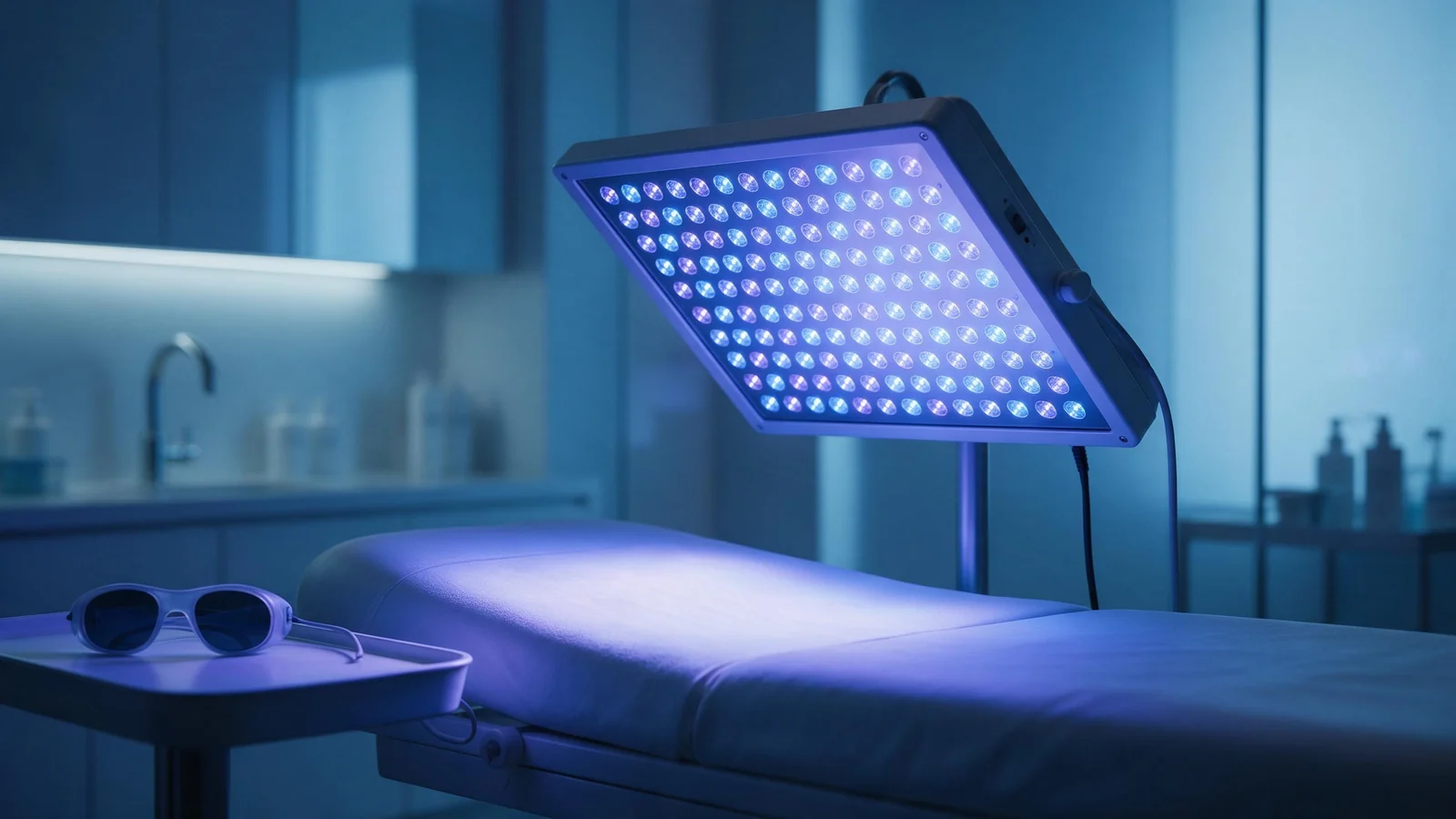
One practical note from our bench: the best professional LED light therapy machines for estheticians combine both wavelengths in one panel or offer interchangeable heads. You'll use blue alone for active acne. You'll use red alone after extractions or chemical peels. Mixed modes are nice for maintenance.
If you're comparing devices, ask how the panel maintains its output over a 20- to 30-minute session. Heat can cause wavelength shift in cheap diodes. That's why build quality matters. A solid panel stays stable. A flimsy one drifts.
Panel vs handheld vs mask: what I'd actually buy
| Format | Best for | Limits |
|---|---|---|
| LED panel | Full-face acne, back/shoulder treatments, combo red+blue protocols | Higher upfront cost; needs floor or wall space |
| Handheld LED device | Spot treatments, small areas, travel or add-on services | Small coverage area; longer session time for full face |
| LED mask | Home maintenance, low-touch services | Low irradiance; inconsistent contact; less professional control |
I'd buy a panel first if you're serious about professional LED light therapy. A handheld is a nice add-on. Masks? Keep them for retail.
Where does that leave a busy clinic? A hybrid approach works well. Use a panel for full-face protocols and a handheld for spot work on shoulders or stubborn lesions. If you have a high-volume facial room, a panel that can be wheeled between treatment beds is worth the floor space.
Realistic outcomes: positioning this honestly in your clinic
Let's be clear about what an LED light therapy machine does not do. It won't clear nodular acne. It won't stop hormonal breakouts. It won't replace isotretinoin or a dermatologist's care. What it does well is support a treatment series—usually several sessions over weeks—for mild to moderate inflammatory acne. Red light can calm post-procedure skin. That's real value, but it's adjunctive.
The American Academy of Dermatology's public guidance positions light therapy as an adjunct for mild-to-moderate acne. That's the framing I use with clients. I position blue light for acne as a support tool, not a cure. The U.S. FDA treats many LED light-therapy skin devices as regulated by intended use. Check the clearance status for the specific device and claim you're making. For most acne LED devices, the cleared use is as an adjunct, not a standalone treatment.
Set expectations before the first session. I tell clients that blue light for acne is not antibiotics. It won't stop new breakouts overnight. What they should notice is calmer skin and fewer active spots after several sessions. Photograph the skin at baseline and every two weeks. Show them the trend.
Eye safety, photosensitising drugs, and patch testing
Eye protection is not negotiable. Even though LED panels are not lasers, high-irradiance panels can be uncomfortable and phototoxic over repeated exposure. Opaque goggles are standard. We keep a drawer of clean goggles at every station. Before you switch on a panel, check for photosensitising medications: certain antibiotics, retinoids, and herbal supplements can make skin unusually reactive. Do a patch test on new clients and document consent. The occupational eye-safety practice we follow draws on IEC 60825-1-style precautions for high-irradiance sources—cover the eyes, time the session, don't let untrained staff wing it.
Train your front desk to ask about new medications and supplements at every visit. Photosensitivity can change between sessions. If a client reports a new antibiotic or a strong retinoid, pause and consult before exposing them. And never skip the patch test for clients with a history of photodermatosis.
Buying checklist without the spec-sheet fog
Here's what I actually check when I evaluate a professional LED light therapy machine for our clients:
- Irradiance and coverage. Look for enough power density to deliver a meaningful dose across the intended treatment area in a realistic session time. No need to obsess over a single number—just confirm the panel covers the full face at working distance with even output.
- Wavelength accuracy. Ask for the spectral graph. Blue should center near 415 nm; red near 630 nm.
- Treatment timer. A digital timer and preset protocols prevent over- or under-dosing.
- Build. Check hinge quality, cooling fans, and cable strain relief. Clinic equipment gets moved.
One more thing: look for a vendor who can support you with protocol cards and staff training, not just a box.
Warranty and after-sales support are part of the buy. Ask how long the diodes are rated for, what the cooling system needs, and whether the vendor has local service. A cheap panel with no support becomes a paperweight.
Session cadence: where LED fits into a facial or acne protocol
For active acne, I usually start clients at two to three sessions a week for four to six weeks. Each session is roughly 10 to 20 minutes, depending on the panel's irradiance and the treatment area. After the active series, we move to once a week or every other week for maintenance. For post-procedure calming, a single red-light session right after microneedling, chemical peel, or IPL works well. The key is consistency. Missing sessions delays visible results, which frustrates clients and hurts retention.
How Pmise platforms compare on the bench
We build light-based platforms for clinics, so we evaluate LED therapy devices the same way we evaluate IPL and laser systems. A blue light therapy device is a good entry point if your clinic does a lot of acne or post-treatment calming. For more aggressive pigment, vascular, or hair-removal work, you'll likely pair it with a platform like our HPT E-Light system, which combines IPL and RF. We also recommend using a skin analyzer system to document baseline redness, bacteria-prone areas, and progress across sessions. If you're building a facial room from scratch, read our professional facial machine guide before you commit to one modality. And if you're comparing LED against other energy-based options, our M40E Plus platform page shows how we think about multi-application ergonomics. For clinics that want LED alongside a broader IPL menu, our EPT100 and C8+ platforms are also worth a bench visit.
Frequently Asked Questions
Will a blue light therapy device work on its own for acne?
No, not for most clients. Blue light near 415 nm reduces Cutibacterium acnes bacteria, but it does not address excess oil, clogged pores, or hormonal drivers. Use it alongside cleansing, exfoliation, and appropriate topicals. For persistent or severe acne, refer to a dermatologist.
How often should clients use LED light therapy?
Several sessions a week initially, then maintenance. In a clinic, a common rhythm is two to three times a week for four to six weeks for active acne, then once weekly or biweekly. Red-light conditioning can be more frequent after procedures. Always follow the device manufacturer's protocol and patch test first.
Do we need special eye protection for LED panels?
Yes. Opaque goggles are standard under high-irradiance LED panels, even though they aren't lasers. The light is bright and cumulative. Clients should keep eyes closed and covered. Staff should also wear protection if they remain in the treatment field.
Can LED light therapy replace laser or IPL treatments?
Not for most indications. LED is gentler and works on different targets. Laser and IPL deliver higher energy for pigment, vessels, and hair. Think of LED as a nurturing adjunct, not a replacement. Many clinics run LED after IPL or microneedling to calm the skin.
Byline: Pmise Technical Team — we build and support light-based aesthetic platforms for clinics and distributors worldwide.