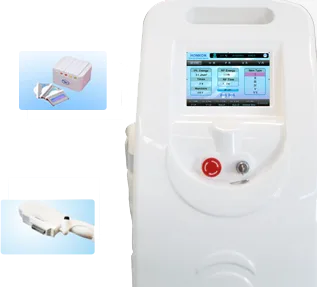
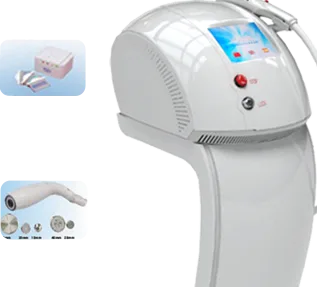
Multifunction beauty equipment makes sense when your treatment menu is wider than your floor space, your budget, or your booking calendar. One platform carrying IPL and radiofrequency lets a small clinic sell hair reduction, pigment work, vascular treatment and skin tightening from a single console. Once any one of those becomes a daily earner, a dedicated device usually wins on speed, output and uptime.
The real question isn't which type is better. It's which service pays your rent, and whether it has earned its own machine yet.
What counts as multifunction beauty equipment?
A multifunction machine is one console hosting two or more treatment technologies, switched by swapping handpieces. The usual pairing is IPL plus RF, sold under the E-light label. Our multifunction series documentation lays out the standard pattern: one or two IPL handles with changeable filters for hair removal, rejuvenation and vascular lesions, plus a cooling RF handle carrying five tips, three mono-polar and two bi-polar, for wrinkle reduction, tightening and body shaping.
The phrase "e-light rf laser" blurs three things. IPL isn't a laser. The IPL review by Babilas and colleagues in Lasers in Surgery and Medicine (2010) describes it as polychromatic, incoherent light defined by spectrum, fluence and pulse duration. E-light stacks RF on top. A true laser module is different technology that only some larger systems carry.
Multifunction machine vs dedicated device: the trade-offs you actually feel
A platform trades peak performance for range. A dedicated device trades range for peak output and simpler failure modes. Any supplier who says one is always right is selling stock.
| Factor | Multifunction platform | Dedicated device |
|---|---|---|
| Cost and floor space per service | Lower, one footprint covers several | Higher, one footprint per service |
| Peak output | Sized for a shared chassis | Higher, purpose-built |
| Downtime and spares risk | One back-ordered lamp stalls the whole menu | A fault stays inside one revenue line |
| Best fit | New, small or generalist clinics | High-volume or specialist clinics |
A platform buys capital efficiency: you test demand across four categories for roughly the price of testing one. A dedicated device buys throughput and isolated downtime, which matters more than the sticker price, since a busy salon loses four services at once when a shared console faults. Compare HPT vs vacuum E-light vs IPL, or, if hair removal is your anchor, diode vs alexandrite vs Nd:YAG.
How one console covers light work and RF work
- Pigment, vascular and hair, via IPL. Filtered light is absorbed by melanin or haemoglobin and turns to heat inside the target while nearby tissue stays cooler. That's selective photothermolysis, set out by Anderson and Parrish in Science in 1983. Swap the cut-off filter and the same lamp chases a different chromophore: our manuals list roughly 610 to 1200 nm for hair, 585 to 1200 nm for vascular, 530 to 1200 nm for rejuvenation. On hair, only actively growing follicles respond well, so a course over several weeks is normal, not one dramatic visit.
- Tightening, via RF. RF excites water molecules in the dermis, and our device manuals describe treated tissue reaching roughly 45 to 65 degrees Celsius, contracting collagen and prompting new collagen over following weeks. Dayan and colleagues, in Plastic and Reconstructive Surgery, Global Open (2020), review the evidence behind RF designs.
Who an IPL-led platform does not suit
IPL lives or dies on contrast between the target and the skin around it. The IPL patient guidance in our archive lists very dark skin among the contraindications, and warns darker skin types carry a higher risk of patchy darkening or lightening afterwards. White, grey and pale blond hair barely responds. Our parameter notes are blunt: clients in markets such as Singapore and Malaysia commonly sit at Fitzpatrick IV to V, so settings get dialled from the Type V column, not the default. That scale, from Fitzpatrick in 1988, is still how you record skin type before treating.
Client mix should drive this decision as hard as budget does. Selling into the Gulf, West Africa or Southeast Asia, where Fitzpatrick IV to VI is common? An IPL-led platform disappoints on hair removal there. A long-pulse Nd:YAG or diode laser makes the better anchor, with the platform kept for rejuvenation and RF. Treatment belongs to trained operators under local rules, always after a patch test, and nobody should promise permanent removal from one visit. See Fitzpatrick skin types and settings.
What the Pmise multifunction lineup covers
All three Pmise platforms pair IPL with cooling RF and run interchangeable handpieces. Figures below come from each model's own manual, and all three carry full specification tables on the Pmise multifunction range page. Tips and filters are often optional.
- Pmise MF-05. Vertical platform. Its manual lists two IPL handles with 8 x 40 mm and 15 x 60 mm spots, energy density of 20 to 50 J/cm2, and a cooling RF handpiece carrying mono-polar and bi-polar tips.
- Pmise MF-06. A filter-changeable IPL handpiece, 8 x 40 mm sapphire-cooled spot, three standard filters, cooling RF handpiece. Its manual gives 2.6 MHz RF, up to 120 W, tips at 25 mm and 45 mm.
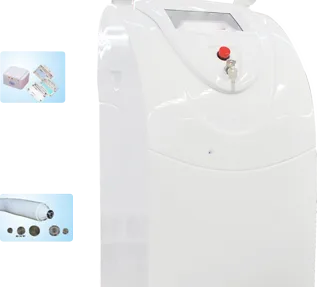
- Pmise MF-07. Same filter-changeable light head, a cooling RF handpiece, and an 8.4 inch TFT touch screen storing parameters. Its handpiece notes list mono-polar tips at 15, 25 and 45 mm for body shaping, bi-polar at 25 and 45 mm for face and neck.
Weigh them against the HPT E-light range if one indication dominates your bookings.
What to check on the quotation before you buy
Cross-border, the spec sheet is the easy part. Paperwork, parts and support decide whether the machine still earns in year two, and on a platform one dead lamp takes four revenue lines offline. Get it in writing.
| Ask for | What to watch |
|---|---|
| Certification for your market | Ask which certificate names your exact model, with issue and expiry dates. EU: light and laser equipment for hair removal or skin treatment without a medical purpose sits in Annex XVI, group 5 of Regulation (EU) 2017/745, with common specifications in Implementing Regulation (EU) 2022/2346. US: the FDA regulates laser products under 21 CFR 1040.10 and 1040.11, importers filing Form FDA 2877. |
| Warranty term and exclusions | Period in months, plus a written list of covered parts. Lamps, tips and filters are usually excluded. Confirm on your quotation. |
| Consumable life and cost | Our service manual for the E-light platform family puts xenon lamp life at about 60,000 flashes, and notes hair removal, running high parameters, usually shows weakened output by around 30,000. Lamp replacement is a service-engineer job. The manual also schedules the cored water filter for replacement roughly every two months. Ask the price of a spare lamp and tip. |
| Spare parts and support | Which parts sit in stock, dispatch time, how remote support works. Get a named contact and a response commitment. |
| Training and installation | Remote or on-site, how many sessions, which language, protocol sheets or not. Four modalities, four protocols. |
| Lead time and MOQ | Production lead time, shipping mode and port, plus any minimum order quantity behind distributor pricing. |
| Power supply and plug | The manual for our vertical platform states AC 220 V 50 Hz or AC 110 V 60 Hz. Give your local voltage and socket standard at quotation stage, not after the crate lands. |
Deeper still: warranty and spare parts and importing laser machines.
Clinic ROI: do the arithmetic before the demo
Clinic ROI isn't about which console costs less. It's which one earns its price back fastest once running costs come out. Dividing machine price by gross revenue is the classic first-time mistake, and it flatters the answer: consumables, labour, power and tax get paid before you keep anything.
- Realistic monthly sessions per service. Be pessimistic about anything unlaunched, then multiply by your local session price for gross monthly revenue per line.
- Subtract the direct cost of each session: consumables amortised per treatment, such as lamp cost spread over its rated shot life, plus gel, disposables, RF tip wear, operator cost for the chair time, and electricity. What's left is contribution margin.
- Divide landed cost by monthly contribution margin. Landed cost is machine price plus freight, duty and clearance, plus installation and training. That gives payback in months on a basis a lender will accept, not a gross figure ignoring real costs.
- Run those sums separately for platform and dedicated device. A platform burns flashlamp life and gel across every light service, while a diode or Nd:YAG unit has its own consumable profile, so a per-session cost comfortable on one looks ugly on the other.
- Stress-test a bad week, then redo it yearly. What happens to margin if the machine sits idle waiting on a part? Once a service outgrows the shared console, buy it a dedicated unit.
The sequence most successful buyers follow is boring and it works: start with one platform, learn what your market books, add a dedicated machine for the top earner once demand is proven. Our note on aesthetic laser ROI works the maths.
Finished the arithmetic? Send it over. Give our technical team your monthly sessions per treatment, the services you'll lead with, your client skin-type mix and target market. Back comes a handpiece, filter and tip configuration matched to that mix, a quotation covering warranty, consumable prices and lead time, plus full specification sheets. If a dedicated device fits you better, we'll say so. Send your figures to the Pmise team, then book a demo.
Frequently Asked Questions
Is multifunction beauty equipment worth it for a new clinic?
For most new or generalist clinics, yes. One platform lets you advertise hair reduction, pigment, vascular and tightening work before you know which sells, at lower upfront cost than three machines. The compromise is a lower ceiling per service and shared downtime risk. Add a dedicated unit once a service becomes a daily earner.
Is an "e-light rf laser" actually a laser?
Usually not. E-light pairs IPL, broadband flashlamp light, with radiofrequency energy. Buyers search that phrase because they're weighing IPL, RF and laser together, but IPL and laser are distinct light sources with different beam properties. Some larger platforms do add a laser module, so ask which source each handpiece uses before you sign.
Does an IPL-based platform suit darker skin tones?
Treat it with caution. IPL depends on contrast between target and surrounding skin, so results are most predictable on lighter Fitzpatrick types, and our archived IPL guidance lists very dark skin as a contraindication, with raised risk of pigment changes afterwards. If your clients skew Fitzpatrick IV to VI, a long-pulse Nd:YAG is usually the better anchor. Patch test first, always.
Pmise Technical Team. We manufacture and export laser and light-based aesthetic equipment, and write these guides from our own device manuals, clinical literature and regulatory texts.