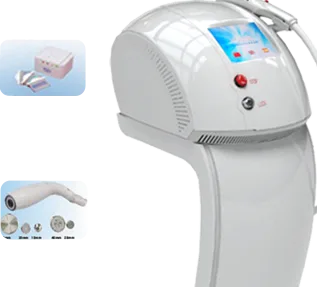
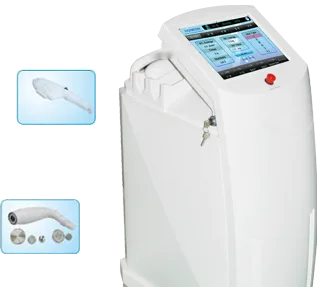
Short answer: in the e-light vs IPL decision, IPL fires filtered light on its own, while E-light pairs that same light with radiofrequency. Plain intense pulsed light is the pigment-and-vascular workhorse. E-light variants stack RF, vacuum suction or homogeneous pulse control on top, and each addition buys something different: depth, comfort, or repeatability.
All three run on the same physics. A xenon flashlamp fires a broadband pulse, melanin and haemoglobin soak it up, and the absorbed light becomes heat inside the target while the surface stays intact. Anderson and Parrish set out the rule in Science in 1983: match the pulse to a target's absorption and its thermal relaxation time, and you destroy that target while sparing the tissue around it. Babilas and colleagues, reviewing IPL for Lasers in Surgery and Medicine in 2010, describe these devices as flashlamps plus bandpass filters with a defined spectrum, fluence and pulse duration. The light isn't the difference. What's built around it is.
What actually separates E-light from IPL?
IPL is light-only selective photothermolysis. Our clinical notes describe it the way any textbook would: melanin and haemoglobin absorb the pulse, the energy turns to heat, and the target takes the damage without the epidermis being broken. Benign pigment, facial vessels, diffuse redness, unwanted hair. The cheapest honest way into a photo business.
E-light adds a second energy channel. Our device manuals call it a non-ablative method harnessing radiofrequency and optical energy at once: light does the pigment and vascular work, RF excites water molecules in the dermis, and that heat tightens skin and smooths texture. The same manual puts the dermal working range at roughly 45 to 65 degrees Celsius, with a practical operator target of 42 to 48 degrees at the skin surface. Why bolt RF onto a perfectly good IPL? It lets you turn the light down. Less stress on the epidermis, and depths a flashlamp alone won't service.
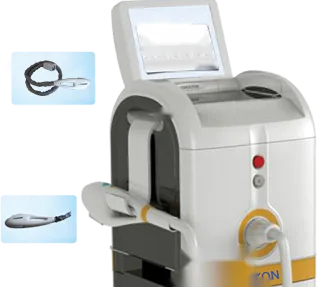
HPT E-light vs vacuum E-light vs IPL: the spec comparison
These are the lines that belong in your enquiry, from our catalogue specifications for the Pmise PE-01 (HPT E-light) and Pmise VE-01 (vacuum E-light). Where the catalogue prints no figure, the cell says so.
| Spec line | Plain IPL | Vacuum E-light (VE-01) | HPT E-light (PE-01) |
|---|---|---|---|
| Energy channels | Filtered light only | IPL + RF + vacuum | IPL + RF, homogeneous pulse shaping |
| Filter wavebands | Same cut-off family: HR 610-1200nm, SR 530-1200nm, VR 585-1200nm; PR 560-1200nm and AR 430-1200nm optional | Filters ship with both handpieces, but bands aren't printed in our catalogue spec: request the parameter sheet | HR 610-1200nm, SR 530-1200nm, VR 585-1200nm; PR 560-1200nm and AR 430-1200nm optional |
| RF channel | None | 5-50W, RF time 1-3s; frequency not printed, so request it | Mono-polar and bi-polar, 2.64MHz, up to 50W, continuous or pulsed |
| Handpieces and tips | Ask per configuration | Two heads, one with vacuum, suction I to VIII | Spot 60x15mm and 40x8mm; mono-polar tips 15/25/45mm, bi-polar 25/45mm |
| Optical energy | Confirm the unit | 10-50J per pulse normal mode; 10-30J sliding mode at 1-5Hz | Energy density 20-50 J/cm² |
| Pulse structure | Ask for the pulse table | 1-5 sub-pulses, first pulse 0.1-10ms, sub-pulse 0.1-20ms, intervals 0.1-25ms | 1-5 sub-pulses, total width under 50ms, first pulse 0.1-25ms, sub-pulse 0.1-10ms |
| Contact cooling | Confirm the holding temperature | Fitted, but holding temperature not printed: request it | Water, air and semiconductor, held at -2 to 0 degrees Celsius |
| Shot interval | Ask, it sets real throughput | 2-4s | 1-5s |
Which spec lines actually decide the result?
The filter cut-off decides the indication. Our catalogue names filters after the job: HR from 610nm for hair, SR from 530nm for rejuvenation, VR from 585nm for vascular, all running out to 1200nm. A lower cut-off passes more short-visible light, which is what surface pigment and fine vessels grab hardest. Raise the cut-off and you skip that competition, pushing more of the pulse toward the follicle. One filter means one job done well and the rest done badly.
Pulse width sits against thermal relaxation time. Fine vessels and small pigment clumps cool fast, so they want short pulses. Terminal follicles are bulky and hold heat far longer. The sub-pulse train exists for the same reason: split the delivery into several sub-pulses with millisecond gaps and the thin epidermis sheds heat between them while a slower-cooling target keeps stacking it. We work the arithmetic in our guide to thermal relaxation time and pulse duration.
RF channel type changes depth. Bi-polar current runs between two electrodes on one tip, so it stays shallow and stays put. Mono-polar returns through a body plate and reaches deeper. Our HPT documentation lists both at 2.64MHz. Plenty of quotes say "with RF" and ship one shallow bi-polar tip, so ask which head carries which mode.
Watch the units. Our vacuum spec quotes joules per pulse; the HPT and multifunction specs quote joules per square centimetre. Never the same number. Make both suppliers state the unit and the spot area.
Why does vacuum-assisted E-light feel gentler?
Suction changes geometry, not pigment. Negative pressure lifts a fold of skin into the applicator, stretching and thinning the tissue over the target, bringing that target nearer the light source and temporarily pushing blood out of the papillary dermis in the light path. Less haemoglobin in front of the target means less competing absorption on the way in.
Worth being precise here, because brochures across this industry are not. Our own vacuum E-light literature words the benefit as "vacuum suction effectively reduces the melanin in epidermis and hemoglobin in dermal papilla". Read that as marketing shorthand. Suction can't remove melanin from a keratinocyte, and epidermal melanin content is identical before and after the handpiece grips the skin. What changes is blood volume in the light path and the geometry between surface, target and applicator. The comfort and safety benefit is real. The mechanism is mechanical displacement and a shorter optical path, not pigment removal.
Two things follow. Less competing surface absorption lets you reach the target without pushing surface fluence up, which helps on medium-toned clients, though only inside the skin types broadband light suits at all. Suction changes the optics, not the physics. Melanin still competes for the same photons, so a vacuum head buys relative forgiveness, never a licence to treat every complexion: our clinical notes list recent sunburn, unprotected sun exposure or solarium use in the four weeks before treatment, and very dark skin among IPL contraindications, and our E-light manual flags Fitzpatrick IV and VI hair removal as needing careful treatment. Someone back from holiday with a tan waits.
Then comfort, because the vacuum grip feels like a massage. That's what brings people back for session four. The Pmise VE-01 sits in this vacuum E-light category. The bill comes due in hardware and pace: a pump, seals, wear parts, slower passes at a 2 to 4 second shot interval.
What does HPT (homogeneous pulse technology) buy you?
HPT is pulse quality, not extra hardware. An ordinary flashlamp train spikes at the front and sags afterwards, so the first pulse punishes the epidermis while later sub-pulses land weaker than the screen suggests. HPT flattens that curve. Our technical archive states it plainly: each pulse energy stays steady and regular, output remains consistent with the LCD display, and a single homogeneous pulse delivers average energy that avoids epidermal burns. The same documentation credits the long pulse duration HPT allows with better efficiency, which is why total pulse width there runs to 50ms while the first pulse alone can be set as long as 25ms.
On the floor that means fewer surprises. Your best technician and your newest one land closer to the same result, because neither is compensating for a lopsided waveform. In a clinic with staff turnover, that matters more than the sticker price. See the HPT E-light platform for how Pmise implements it. Want IPL, RF and other modules on one cart? The multifunction systems cover that, and the Pmise MF-05 there runs the same filter family with energy density up to 50 J/cm² and RF rated to 120W.
How many sessions, and which platform earns more?
E-light wins on breadth; IPL wins on price. One E-light trolley covers pigment, vessels and hair the way IPL does, then adds tightening and texture on top. Vacuum and HPT variants let you sell comfort or consistency instead of price.
Whatever you buy, sell a course and build the calendar around biology. Light only affects hair in its active growth phase, so our clinical notes space facial hair sessions roughly 6 to 8 weeks apart and body areas such as legs, back and underarms at 10 to 12 weeks, because the share of follicles in that phase differs by region. Photo-rejuvenation runs tighter: benign pigmented lesions are typically staged as one to three treatments about 7 to 28 days apart depending on area, while vascular work is usually three to four sessions at weekly intervals so vessels clear progressively. Outcomes vary by lesion and skin type.
- Map your clients. Heavy hair volume on fair skin rewards IPL throughput; mixed skin types reward vacuum.
- Pick your positioning. Budget points to IPL, comfort to vacuum, repeatable output to HPT.
- Model the packages. RF unlocks add-ons pure IPL can't sell, and the intervals above tell you how long a course occupies a chair.
What to check before you sign the order
Run every shortlisted machine through the same questions. Suppliers who answer fast tend to be the ones still answering after the invoice clears.
- Full parameter sheet: filter bands, energy plus its unit, spot area, pulse ranges, RF frequency and power, cooling temperature. A document, not a chat message.
- Handpieces and filters: which are included, which are "optional", and whether the RF head is bi-polar, mono-polar or both.
- Cooling: what contact temperature it holds, and whether it still holds it through a day of back-to-back sessions.
- Pulse behaviour: does energy stay even across the whole train? That separates HPT claims from HPT reality.
- Consumables and terms: cost per shot, lamp lifetime, spares that reach your country, plus CE marking, ISO 13485, MOQ and warranty scope.
Rule of thumb: buy IPL to sell volume, vacuum E-light to sell comfort, HPT E-light to sell consistency. Most growing clinics eventually want the RF.
Want the day-to-day indication list? Our guide to IPL and E-light treatments goes deeper on protocols. Or tell us which skin types walk through your door, and we'll send parameter sheets and a quote.
Frequently Asked Questions
Is E-light better than IPL?
Not automatically. E-light adds radiofrequency, so it does everything IPL does and then offers tightening and texture work, and the RF lets you run the light at lower fluence for a gentler epidermal load. IPL alone is cheaper and quick for pigment and hair on fair skin. Which counts as "better" depends on your client mix, not on the spec sheet.
What does the RF in E-light actually do?
It heats the dermis from the inside. Our device manuals describe RF exciting water molecules, with the resulting heat contracting collagen and prompting a rebuild, and put the dermal working range at roughly 45 to 65 degrees Celsius. IPL can't deliver that alone. The second benefit is indirect: because RF supplies part of the thermal energy, optical energy can be dialled lower.
Which platform is safest for darker or tanned skin?
Ask a narrower question first: is broadband light appropriate at all? Suitability drops as the Fitzpatrick type climbs, because epidermal melanin competes for the photons your target needs, raising burn and post-inflammatory pigmentation risk. Our clinical notes list recent sunburn, unprotected sun exposure or solarium use within four weeks, and very dark skin as IPL contraindications, and our E-light manual flags Fitzpatrick IV and VI hair removal as needing care. Postpone tanned clients. Fitzpatrick V-VI is high-risk ground, usually served by longer-wavelength, longer-pulse devices instead, or at minimum a test patch. Vacuum E-light is only the most forgiving option within the types you can already treat.
How many sessions should clients expect?
Plan a course, never a single visit. Light only reaches follicles in their active growth phase, so our clinical notes space facial sessions around 6 to 8 weeks apart and body areas at 10 to 12 weeks. Those notes also state outright that no IPL system removes all hair. Pigment work is usually staged over one to three sessions, vascular work over three to four weekly ones. Results vary by lesion and skin type.
Pmise Technical Team. We manufacture laser and light-based aesthetic equipment for clinics and distributors worldwide, and write from our own device manuals, catalogue specifications and clinical parameter guidance.