
Pigment Treatment
Melanosis
Dermal melanosis is a stubborn brown to slate-gray discolouration sitting below the epidermis, in the dermis itself. Sound dermal melanosis treatment pairs trigger removal and strict photoprotection with patient, low to mid fluence 1064nm Q-switched Nd:YAG sessions. Written for clinics and distributors choosing equipment. Education, not medical advice.
What dermal melanosis actually is
Our engineering archive files melanosis as tar melanosis, a light-driven lesion tied to coal tar derivatives. That entry is decades old and it shows. What clinicians mean today by facial melanosis is usually Riehl melanosis, or pigmented contact dermatitis: a delayed hypersensitivity reaction to fragrance, cosmetics or textile dyes that darkens under ultraviolet light. Colour runs brown through blue-gray on exposed skin, and women present far more often than men, nearly all with a long cosmetic history.
Histology explains the stubbornness. Vacuolar change in the basal layer, a lymphocytic infiltrate around dermal vessels, pigment leaking through that damaged layer. Melanin-loaded macrophages settle in the papillary dermis and stay. A freckle lifts in a session or two. Dermal pigment doesn't.
Subtypes worth telling apart
Naming here has been a mess. A 2019 global consensus statement in the International Journal of Dermatology, led by Kumarasinghe and colleagues, sorted it out. Several entities now sit under one umbrella term, acquired dermal macular hyperpigmentation.
- Riehl melanosis, or pigmented cosmetic dermatitis. Reticulated brown-gray patches on face and neck. Allergen driven, sun aggravated. Most of your caseload.
- Lichen planus pigmentosus. Dark brown macules on face and flexures, sometimes after an itchy phase.
- Erythema dyschromicum perstans, or ashy dermatosis. Slate-gray patches on trunk and limbs.
- Post-inflammatory dermal pigment. Melanin dropped into the dermis after acne, a burn or a procedure. Our post-inflammatory hyperpigmentation page covers it.
Why bother with subtype? Melasma, lentigines, drug-induced pigmentation and early malignancy wear a similar coat. Patch testing finds the allergen. Biopsy settles an atypical or changing lesion. A laser pointed at the wrong diagnosis burns sessions and goodwill together.
Why 1064nm Q-switched light reaches dermal pigment
The physics traces back to Anderson and Parrish, who set out selective photothermolysis in Science in 1983. Fire a pulse shorter than the target's thermal relaxation time and the energy stays trapped there. Melanosomes are tiny, so that time is short. Nanoseconds, not milliseconds. Pigment cracks mechanically rather than cooking, and phagocytes clear the fragments over weeks.
Wavelength decides depth. Our technical notes record that penetration climbs with wavelength, that 600nm to 1200nm light scatters less in skin, and that 1064nm is strongly absorbed by black, blue and blue-gray chromophores while 532nm chases red and brown targets high in the skin. Melanophages sit below the epidermis. Hence 1064nm, with 532nm held back for a superficial component later. For the full chromophore logic, read our article on treating pigmented lesions with a Q-switched laser.
Treatment protocol and dosimetry
First, the metric. Energy in mJ tells you nothing alone, because dose is fluence: energy divided by spot area, in J/cm2. Halve the spot at fixed energy and you quadruple the fluence. That is how operators scorch skin while believing nothing changed. Numbers below are starting points; the physician titrates, after a test spot.
| Setting | Starting point | Basis |
|---|---|---|
| Low-fluence 1064nm toning | 1 to 3 J/cm2, spot 6mm to 8mm, 5 to 10 Hz, under 5 passes, endpoint faint erythema | Lee et al. systematic review, Medicina 2022 |
| Mid-fluence 1064nm passes | 3.5 to 5 J/cm2, spot 5mm, 10 Hz | Cho and Roh, Riehl series, Lasers Surg Med 2020 |
| Session interval | 1 to 2 weeks at low fluence, roughly 4 to 6 weeks at mid fluence | Same two sources |
| Course length | Plan 6 to 12 sessions, then stop and reassess. An open-ended toning course is itself a risk | Riehl series: about 6 mid-fluence, 10 or more low-fluence |
| Spot, overlap, testing | Spot above 2mm for dermal targets, one third overlap, after 3 to 5 low-energy test shots | Our Q-switched Nd:YAG operator manual |
Two caveats. The low-fluence toning window is best evidenced in melasma, then borrowed for acquired dermal macular hyperpigmentation. And our manual's rule that dermal pigment wants higher fluence assumes inert targets like nevus of Ota. Melanosis is inflamed skin, so the evidence pushes you down, not up. The rest of the plan decides whether it holds: remove the contact agent, enforce daily sun protection. Hydroquinone at 1.5 to 4 percent appears in our archive protocol, prescribing left to the physician.
Recommended Pmise equipment
Our archive sets an admission test: below 250mJ single pulse a device is not recommended for melanosis at all, and 400mJ single pulse at 1064nm is the floor for a usable platform. That floor says whether a machine belongs here. It does not say it covers every row above. A 5mm spot is 0.196 cm2, so 3.5 J/cm2 there needs roughly 690mJ and 5 J/cm2 roughly 980mJ.
- QN series, our Q-switched Nd:YAG laser range. 1064nm and 532nm, 6ns to 8ns, spot 1mm to 6mm, 1Hz to 5Hz, up to 400mJ single pulse at 1064nm. Its widest 6mm spot gives about 1.4 J/cm2: inside the low-fluence toning row, near the bottom, and the 5Hz ceiling rules out the 10Hz half of that row. At 5mm it tops out near 2.0 J/cm2, so the mid-fluence row is out of reach. Sound for gentle toning, wrong for mid-fluence Riehl protocols.
- QE-01 and QE-02, our EO Q-switched Nd:YAG lasers. QE-01: 6ns, up to 800mJ at 1064nm measured at the arm end, spot 1mm to 8mm continuously adjustable, 1Hz to 10Hz, flat-top beam, optional spot regulator. QE-02: 8ns, up to 600mJ, spot 1mm to 7mm, 1Hz to 10Hz. Both reach 10Hz and both cover the mid-fluence row.
One honest detail about wide spots. At 8mm even 800mJ yields only about 1.6 J/cm2, so you reach the top of the toning window by tightening the spot, not by chasing energy: 800mJ gives close to 3 J/cm2 at 5.8mm. QE-01 delivers about 4.1 J/cm2 at 5mm and needs roughly 4.5mm for 5 J/cm2. QE-02 gives about 3.1 J/cm2 at 5mm, reaching 3.5 to 5 J/cm2 between 4.6mm and 3.9mm. Ask for the meter reading at the arm end.
Want measured energy data or distributor terms? Send the indications you plan to treat through our technical consultation form and our engineers will reply with model-specific guidance.
Settle the paperwork before you sign. Certificates expire and their scope is model-specific, so ask for current dated ISO, CE, LVD and EMC copies naming your model. The US needs a separate 510(k), covered in our FDA 510(k) versus CE guide. Get warranty term and spare-part lead time in writing; our warranty and spare parts article lists the clauses that matter.
Aftercare and precautions
Melanosis punishes aggression. This is inflamed skin with a compromised basal layer, and it answers injury with more pigment. Design around post-inflammatory hyperpigmentation, then around the slower risk that builds across a long course.
- Test spot first, reviewed before you treat a whole cosmetic unit.
- Drop fluence and stretch intervals for Fitzpatrick IV to VI. Our guide to skin type and laser settings covers the logic.
- Never treat tanned or recently sun-exposed skin.
- Pinpoint bleeding or heavy frosting means you went too hard. Back off.
- Watch for pigment loss, not only pigment gain. Repeated low-fluence 1064nm toning carries a cumulative risk of mottled hypopigmentation and guttate leukoderma, from melanocyte injury that adds up session after session rather than in any single pass. That risk scales with how long you keep going, so cap the total session count. Finish the planned block, then reassess rather than treating indefinitely. If speckled pale spots appear, stop treatment and refer the patient to a physician. Lost pigment is far harder to bring back than the pigment you set out to clear.
- Epidermal cooling counts for far less with nanosecond pulses, and cryogen over-spray can itself provoke pigmentation. Don't drench the skin.
- Keep the area dry and untouched for two to three days. Let crust separate on its own.
- Remove the offending cosmetic or textile for good. Pigment follows the allergen back.
- Train operators formally and document it.
- The US Food and Drug Administration lists incomplete treatment, pain, infection, bleeding, scarring and skin colour change among laser procedure risks. Consent for those.
Frequently Asked Questions
How many sessions does dermal melanosis usually need?
More than patients hope. Published Riehl melanosis series run from around six mid-fluence sessions to ten or more low-fluence ones, and some cases need more. Plan across months, not weeks. Pigment depth, skin type and whether the trigger was truly removed all shift the answer. Set a session cap at the start, then review.
Why 1064nm rather than 532nm?
Depth and absorption. Longer wavelengths scatter less and reach further, and 1064nm is well absorbed by the black and blue-gray pigment melanophages present. 532nm chases brown and red targets but spends itself in the epidermis. Keep it for a superficial component, never as your opening move.
Can Q-switched treatment make melanosis worse?
Yes, in two directions. Push too hard in one session, with excess fluence, heavy overlap or tanned skin, and you invite post-inflammatory hyperpigmentation, more so in darker phototypes. Keep repeating low-fluence toning with no stop point and the opposite shows up: cumulative melanocyte injury can leave mottled hypopigmentation or guttate leukoderma. Any loss of pigment means stop and get a physician's opinion. Test spot, conservative fluence, a capped course.
Does the patient still need a dermatologist if we own the equipment?
Yes. Melanosis overlaps with melasma, drug-induced pigmentation and lesions needing histology. Patch testing, prescription topicals and biopsy for an atypical picture belong with a physician. The laser is one component of a plan. It isn't the plan.
Recommended Equipment
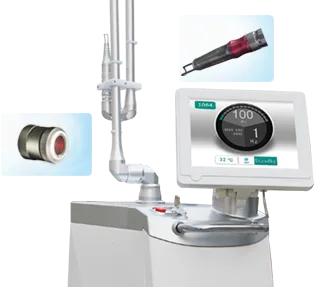
Pmise QE-01
Dual wavelengths (1064nm & 532nm) are convenient to adjust by touching LCD. Multi-spot size (1-7mm) is ideal for a wide…
View details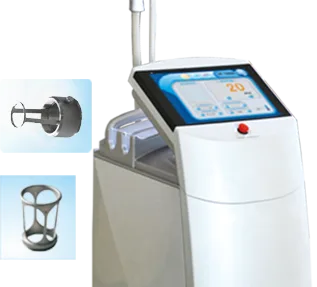
Pmise EF-02
The target tissue is water, no skin type limit (Fitzpatrick I-VI). The output spot diameter is 50-80 um, less thermal ab…
View details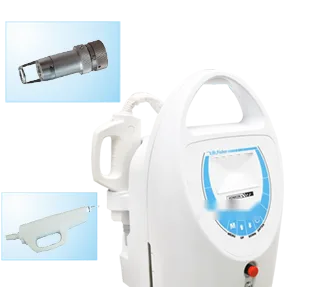
Pmise QN-05
Patented technology of single lamp and dual rods doubles energy output (400mj). Shorter pulse width (6-8ns) than ordina…
View details