
Ask an experienced operator for a Fitzpatrick skin types laser chart and you'll get one, followed by a warning not to trust it blindly. Melanin decides everything else. The more pigment in the epidermis, the more of your beam gets stolen before it reaches the target. As skin phototype climbs from I toward VI, the recipe shifts the same way every time: longer wavelength, lower fluence, longer pulse, more cooling, and a test spot you never skip.
Below: the scale, the physics under it, and the routine our engineers give operators. It isn't a dosing table. No honest one exists.
What does the Fitzpatrick scale actually measure?
It measures how skin reacts to sun, not what shade it looks like in the chair. Fitzpatrick introduced the classification in 1975 with four sun-reactive types, I to IV, to set safe starting ultraviolet A doses for photochemotherapy on lighter skin. Types V and VI, covering brown and black skin, came with his 1988 paper in Archives of Dermatology (Arch Dermatol. 1988;124(6):869-871). Laser work inherited that logic. Both depend on how much melanin a patient carries.
Two people can look alike and burn completely differently, so keep the questions behavioural. What happens after thirty minutes of midday sun, no sunscreen? Check untanned skin. A fresh tan pushes someone up the scale.
| Type | Typical appearance | Reaction to sun | At the handpiece |
|---|---|---|---|
| I | Very fair, red or blond hair, freckles | Always burns, never tans | Widest safe window |
| II | Fair skin, light eyes | Burns easily, tans minimally | Low surface risk |
| III | Medium tone | Burns sometimes, tans gradually | Start low, work up |
| IV | Olive to light brown | Rarely burns, tans easily | Favour longer wavelengths |
| V | Brown skin | Very rarely burns, tans darkly | Real risk of burns and pigment change |
| VI | Deeply pigmented | Never burns, tans darkly | Narrowest window, strongest cooling |
Patient sitting between two types? Treat them as the darker one.
Why does darker skin need different laser settings?
Darker skin needs gentler, longer-wavelength settings because epidermal melanin competes with your target for the same photons. You want absorption in the follicle, not the pigment above it. On Type I most of the beam gets through. On Type V or VI the surface grabs a large share first and can blister.
The framework is selective photothermolysis, described by Anderson and Parrish in Science in 1983: pick wavelength, energy and pulse duration so the target absorbs the light and its surroundings don't. Phototype is the reminder that the epidermis is a chromophore too, and on darker skin a loud one.
- Wavelength. Longer wavelengths scatter less, reach deeper, and are absorbed less strongly by melanin. Our physics archive puts it plainly: light below roughly 800 nm is preferentially soaked up by melanin and scattered in the epidermis.
- Fluence and pulse width. Lower energy density over a longer pulse gives the surface time to dump heat instead of storing it. Our diode operation manual reduces it to one line an operator can hold mid-session: "Darker skin, lower frequency and lower energy; paler skin, high frequency and higher energy."
Name the risk properly, since it changes the consultation. On types V and VI the usual bad outcome isn't a dramatic burn, it's post-inflammatory hyperpigmentation: a darker patch where the heat injury settled, slow to fade, better answered with sun avoidance than with more laser. Our guide to post-inflammatory hyperpigmentation and laser goes deeper. Paradoxical hypertrichosis, where treated skin grows more hair rather than less, is the other one to raise up front.
The American Academy of Dermatology notes that laser hair removal works best on light skin with dark hair, that darker skin must be treated very carefully, and that most patients need two to six sessions.
Which wavelength suits which phototype?
No wavelength is best in general, only best for a phototype and a target depth. Read the table as direction, then confirm on the patient.
| Wavelength | Melanin absorption | Usual fit for hair removal | Practical note |
|---|---|---|---|
| 755 nm alexandrite | High | Types I to III | Fast on fair skin, riskier as types darken |
| 808 nm diode | Moderate | I to IV; V to VI with conservative settings and strong cooling | Workhorse, balances depth against absorption |
| 1064 nm Nd:YAG | Low | Types IV to VI | Deepest reach, safest on the darkest skin |
One demographic, one wavelength is fine. A mixed city usually isn't, the honest reason platforms bundle wavelengths. Compare them in our diode, alexandrite and Nd:YAG head-to-head, or see the hardware on our diode laser for hair removal page, home to the Pmise DL-04 and DL-03.
Cooling matters more with every step up the scale
Cooling lets you deliver enough energy to the follicle without cooking the surface, and it matters more with every phototype. Our laser-physics archive gives it three jobs: protect the epidermis, ease pain, and let high energy density reach a deep target safely.
Contact cooling through a chilled sapphire window is standard on diode platforms. Our operation manual has the operator check that crystal right after startup: cold within seconds means ready; if it stays warm, check water volume and flow. Cold that isn't touching does nothing, so press the window flat.
Here's what busy clinics get wrong: cooling is verified at installation, then assumed forever. In a salon running back-to-back sessions all Saturday, a partly blocked water line shows up as a burn, not as a maintenance ticket.
Pulse duration, thermal relaxation time and what the machine can do
Thermal relaxation time (TRT) is how long a heated target needs to shed roughly 63 percent of its heat, and it scales with target size: a coarse terminal hair holds heat far longer than the thin epidermis above it. The rule that follows: keep the pulse at or below the follicle's TRT so damage stays where you aimed it, yet long enough for the faster-cooling epidermis to offload its share. That's why a longer pulse is kinder to Type V skin. Our physics archive works an example where a melanin-rich follicle coagulates progressively at around a 100 ms pulse, while unprotected epidermis at the same energy density is injured in nearly the same time. Cooling closes that gap.
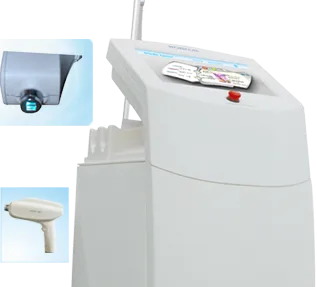
Our own 808 nm diode platform is specified for energy density of 2 to 120 J/cm2, pulse durations of 5 to 300 ms and repetition rates of 1 to 10 Hz, with the interface holding duration multiplied by frequency at or below 300. Machine capability, not a dose recommendation. The spread exists so you can sit low and slow on a Type VI patient. More in our note on thermal relaxation time and pulse duration.
How do you run a laser test spot?
A test spot is a small, low-energy trial in a discreet area, read after a short wait. It shows how this patient's skin behaves, not how a chart says it should. For Types IV to VI it isn't optional.
- Consultation and history first. Screen for what defers or rules out treatment, then build the record, photograph the area, cleanse and shave. Hold off on:
- Photosensitising medication: certain antibiotics, some acne and retinoid drugs, herbal products such as St John's wort.
- Recent isotretinoin.
- Active infection, or recurrent herpes simplex at that site.
- Tattoos and pigmented lesions in the field, shielded or worked around, never fired over.
- Pregnancy.
- Recent sun, self-tanner, or a chemical peel in the previous weeks.
- Goggles on, both of you. Set conservative parameters for the estimated phototype: longer wavelength if you have it, modest fluence, cooling confirmed.
- Fire a shot on your own arm to check the handpiece, as our manual instructs. Then one or two on the client's inner forearm at lower energy.
- Wait, then read the skin. Mild warmth and a flush that settles is fine. Greying, whitening, blistering or lingering pain means stop and drop the energy.
- Climb in small steps. Our manual caps each change at roughly 5 percent on energy and 5 ms on pulse width.
- Only after a clean reaction do you treat the full area. The manual specifies at least 28 days between sessions.
From the operator manual, close to verbatim: if the energy is too high, the pulse too long, or the frequency too high for dark skin, the skin absorbs excess energy and gets burnt.
A pre-treatment checklist by phototype
Use this as a thinking checklist, not a dosing table. Numbers depend on the device, the target and the person in front of you.
- Types I to III: Widest margin. Shorter wavelengths are viable and higher fluence is tolerated, cooling still on. Ask about tanning habits first.
- Type IV: Shift toward 808 nm or 1064 nm, ease the fluence back, confirm cooling, test spot every time.
- Types V and VI: Prefer 1064 nm where you have it. Lower fluence, longer pulse, strongest cooling, mandatory test spot. Postpone on freshly tanned skin.
- Every type: Log the settings and the reaction. That record makes session two safer than session one.
To match a clinical goal to a platform, browse our hair removal solutions, or see what drives cost in our Nd:YAG machine pricing overview.
Frequently Asked Questions
Can laser hair removal be done safely on Fitzpatrick V and VI skin?
Yes, when wavelength, settings and cooling suit the phototype and the operator is trained. The 1064 nm Nd:YAG is preferred for the darkest skin: surface melanin absorbs it weakly, so more energy reaches the follicle. Conservative fluence, longer pulses, reliable cooling and a test spot all belong in the protocol. The American Academy of Dermatology stresses that darker skin needs great care.
How do I work out a patient's Fitzpatrick skin type?
Ask how their skin behaves in sun rather than judging colour on sight. The scale is built on burning and tanning: Type I always burns and never tans, Type VI never burns and tans darkly. Check untanned skin, ask about recent sun, and remember that a holiday tan raises the effective phototype for weeks.
Why is melanin the deciding factor in laser safety?
Melanin in the epidermis absorbs laser light, and in hair and pigment work that's unwanted competition. The more melanin the skin carries, the more energy gets captured before it reaches the target, turning to heat that can cause burns or lasting pigment change. One fact, and it explains the pattern: longer wavelength, lower energy, longer pulse, better cooling.
Next step: send us the phototype mix you actually treat and we'll come back with a wavelength recommendation, not a generic quote. Ask in the same message what operator training and phototype parameter guidance come with the 808 nm diode platform, which sapphire and water-circuit spares to stock for cooling maintenance, and whether one wavelength or a multi-wavelength platform fits a mixed-phototype patient base.
Pmise Technical Team. We build and export laser and light-based aesthetic systems, and we write from our own operation manuals and physics training material.