
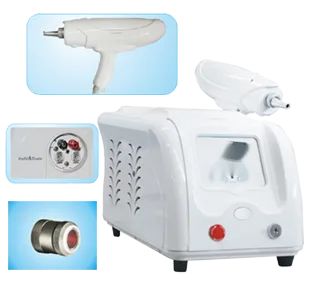
Straight answer: an Nd YAG laser hair removal machine price is driven mostly by usable laser power, cooling quality, handpiece design, and whether you buy a single-wavelength box or a multi-application platform. Indicative tiers are below. The badge on the front panel matters far less than most buyers expect.
One piece of vocabulary first, because getting it wrong is expensive. Hair removal uses long-pulse 1064nm Nd:YAG, which pours energy into the follicle over milliseconds. A Q-switched Nd:YAG system fires nanosecond pulses to shatter tattoo ink instead. Same wavelength on the brochure. Completely different job. We unpack both in our guide to long-pulse versus Q-switched Nd:YAG.
What actually drives the price of an Nd:YAG hair removal machine?
Price tracks the parts you cannot see in a product photo: laser source, chiller, power supply, handpiece. Two units can both print 1064nm on the panel and sit a large multiple apart on the invoice. One was built to run a full clinic day. The other to survive a trade show.
In rough order of how much they move the number:
- Usable power and fluence. Not peak marketing power, usable power at the spot size you treat with. Long-pulse manuals in our engineering archive spec fluence up to 360 J/cm² with pulse widths reaching 50 ms. That headroom costs money to build.
- Cooling. Contact sapphire cooling on the handpiece plus a chiller rated for continuous operation. It lets you push high fluence without cooking the epidermis, and it is the first thing cheap builds sacrifice.
- Duty cycle and build quality. Holding output through a forty-client day costs more than needing a rest after twelve.
- Warranty, spares and consumables. Lamp or bar life, handpiece cost, parts lead time. Boring stuff. It decides your five-year spend.
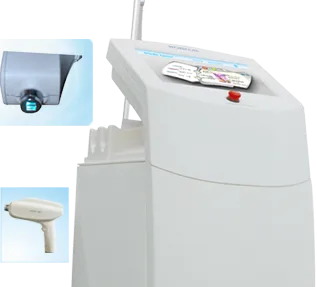
What should you budget? Indicative price tiers
We publish bands, not a fixed price list, because a real number moves with configuration, order quantity, currency and Incoterms. The bands below reflect how our own hair removal quotations typically fall. They are not third-party market data. To stay usable in any currency, each tier is a multiple of one baseline: a mainstream professional 808nm diode hair removal system, quoted FOB China, counts as 1.0x. Take the diode quotation already in your inbox, call it 1.0x, and the rest scales.
| Tier | What it is | Indicative price vs baseline diode (1.0x) |
|---|---|---|
| Entry long-pulse 1064nm | Compact single-wavelength unit, modest average power, light-duty cooling | about 0.7x to 1.2x |
| Professional long-pulse 1064nm | Floor-standing hair system, high fluence, sustained duty cycle | about 1.5x to 2.5x |
| Combined diode plus Nd:YAG | Both wavelengths in one chassis, shared chiller | about 2x to 3.5x |
| Multi-application platform | Hair plus pigment or vascular handpieces on one console | about 3x to 6x |
What those bands cover: the machine, its standard handpiece, goggles and starter items, priced FOB. What they exclude, every time: freight, import duty and VAT, customs clearance, on-site installation, in-person training, spare handpieces, extended warranty, and local registration fees. Buyers who forget the second list feel ambushed at the port. Check the Incoterm too, because an EXW number and a CIF number are not the same animal.
Where does 1064 nm Nd:YAG fit versus diode?
For general volume, 808nm diode is the workhorse. 1064nm Nd:YAG is the specialist you reach for on darker skin and deep, coarse hair. Clinics that can fund only one system usually start with diode and add Nd:YAG later.
The reason sits in the physics. Training material in our technical archive notes that penetration depth rises with wavelength while scattering falls, and that 600 to 1200 nm forms an optical window into skin. A 1064nm beam reaches deeper toward the follicular bulb, and epidermal melanin grabs less of it on the way through.
| Factor | 808nm diode | 1064nm Nd:YAG (long pulse) |
|---|---|---|
| Best fit | High-volume general hair removal | Darker skin, deep or coarse hair |
| Surface melanin absorption | Higher | Lower |
| Typical spot | Large square spot, fast passes | Smaller spot, more energy per pulse |
| Throughput on legs and backs | Faster | Slower |
| Relative machine price | Baseline | Higher, or folded into a platform |
Spec sheets in our archive make the contrast concrete. Our 808 series diode hair removal system is documented with a 12 x 12 mm square spot, 5 to 200 ms adjustable pulse width, 1 to 10 Hz repetition and sapphire contact cooling, rated across Fitzpatrick I to VI. Long-pulse 1064nm handpiece documentation lists adjustable spot sizes of 1 to 10 mm. Bigger spot, faster coverage. Smaller spot, deeper and more selective work.
Is Nd:YAG the right choice for dark skin hair removal?
Yes, and this is usually the strongest single reason to own one. Because 1064nm is absorbed less by epidermal melanin, it widens the safety margin on Fitzpatrick V and VI skin, where shorter wavelengths carry a higher risk of burns, blistering and pigment change. Our long-pulse manuals list permanent hair reduction on Fitzpatrick IV to VI as a primary indication.
The underlying principle is selective photothermolysis, described by Anderson and Parrish in Science in 1983: pick a wavelength your target absorbs preferentially, pick a pulse duration matched to that target, and you damage it while sparing the tissue around it. Neat theory. In the treatment room it still comes down to the operator. Our 808 series operation manual puts it bluntly: darker skin, lower frequency and lower energy, working up from a test shot on the inner forearm.
The American Academy of Dermatology notes that laser hair removal works best on light skin with dark hair, and that patients with dark skin must be treated very carefully. Fine control over energy, pulse width and repetition rate therefore beats headline power. A machine with coarse energy steps is a liability, whatever it costs.
If Fitzpatrick V and VI patients are a real share of your book, treat 1064nm as a requirement, not an upgrade. It is often the line between a good outcome and a complaint.
How throughput decides your real cost per treatment
The cheapest machine rarely wins on cost per treatment. What wins is how many clients you can safely put through per hour, and for how many years. A dearer system with a bigger spot, better cooling and a repetition rate it can sustain often pays back that premium inside the first year in a busy room.
- Count weekly volume by area and skin type. Upper lips are not the same business as full legs and backs.
- Match spot size and repetition rate to that mix. Large areas reward a large spot; stubborn small areas reward fine control.
- Add running costs. Handpieces, diode bars or flashlamps, chiller servicing, engineer visits. Our breakdown of laser machine running costs covers what to ask for.
- Divide the five-year total by expected sessions. That is your real number.
Run that arithmetic on two or three quotes and the cheapest machine usually slides down the list. Underpowered units drag sessions out and push clients into extra visits. That quietly eats margin.
When should a clinic pair Nd:YAG with a diode platform?
Pair them when neither wavelength covers your patient mix alone. Diode carries the general appointment book. Nd:YAG covers your darkest-skinned clients and the coarse, deep hair diode struggles to finish. Between them you stop turning people away.
A sensible sequence for a clinic starting out: buy a strong 808nm diode for volume, tally how often you decline or under-treat a dark-skin case, then add long-pulse 1064nm when that tally justifies it. Both sources in one chassis costs less than two machines and saves floor space, though a single service event can take both offline. Our hair removal solutions overview maps devices to patient profiles.
Checklist, then what to send us for a quote
Settle these before you ask any supplier for an Nd:YAG laser hair removal machine price, so you are comparing like with like:
- Long-pulse 1064nm confirmed for hair, not Q-switched for tattoo?
- Average power and fluence at a stated spot size, not just a maximum?
- Contact sapphire cooling, and a chiller rated for full clinic days?
- Single wavelength, or diode plus Nd:YAG in one platform?
- Lamp or diode-bar life, and replacement handpiece cost?
- Warranty length, spare-parts lead time, support response?
- Training and written protocols for Fitzpatrick V and VI?
- Regulatory documentation valid for your market, and the Incoterm?
Want a band narrowed into a real number? Send us these four items and our engineers come back with a configured offer, a spec sheet and the documents your market needs:
- Weekly treatment volume, split by area (faces, underarms, legs, backs).
- The dominant Fitzpatrick range in your patient book.
- Your target market, so we prepare the right regulatory documents.
- Dedicated 1064nm unit, or a combined diode plus Nd:YAG platform?
Send them through the Pmise contact and quotation page, or email [email protected]. You get a proposal built on your actual case mix, not a generic list. Remember what you are buying: the right machine for your clinic budget is the one with the lowest safe cost per treatment across its working life, not the smallest number on the invoice.
Frequently Asked Questions
Is a 1064nm Nd:YAG machine more expensive than a diode?
Usually, yes. A dedicated long-pulse 1064nm unit prices above a comparable single-wavelength diode, mainly because of the laser source and the cooling needed to run high fluence safely. In our own quoting practice, a professional dedicated 1064nm system lands around one and a half to two and a half times a baseline diode. Combination platforms cost more than either alone, less than two machines.
Can one machine treat every skin type?
A well-specified 808nm diode covers a wide range, and our archive documentation rates the 808 series diode handpiece across Fitzpatrick I to VI. For the darkest skin and coarse deep hair, 1064nm Nd:YAG stays the safer tool. The American Academy of Dermatology cautions that treating dark skin requires particular care, so clinics with a diverse patient base often keep both wavelengths on hand.
Why long-pulse rather than Q-switched for hair?
Follicle destruction needs heat delivered over milliseconds, and long-pulse systems do that. Q-switched Nd:YAG fires nanosecond pulses built to fracture ink and pigment, far too brief to heat a follicle properly. They share a wavelength and almost nothing else. Confirm long-pulse operation in writing before you sign anything for hair removal.
How many sessions should clinics tell patients to expect?
Plan for a course, not a single visit. The American Academy of Dermatology reports that most patients need two to six treatments, that maintenance sessions may be needed afterwards, and that regrowth tends to return finer and lighter rather than never at all. Say so up front and you avoid the refund conversations that damage a reputation.
Pmise Technical Team. We manufacture laser and light-based aesthetic systems for clinics and distributors worldwide; this guidance reflects our device documentation and applications experience, and does not replace hands-on operator training.