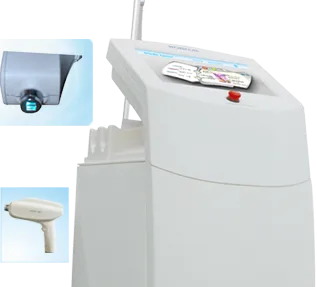
Here's the blunt answer up front. FDA 510(k) vs CE isn't two roads to the same place. They're two separate gates for two separate markets. Your CE mark clears an aesthetic laser for Europe. It does nothing at the US border. To sell most lasers and IPL systems in America you need FDA clearance, and for a Class II device that almost always means a 510(k) premarket notification. If you already hold CE marking and you're eyeing the US market, this walks you through what's actually different and what medical device registration in the States really asks of you.
One caveat before we go further. This is general educational information, not legal or regulatory advice. Bring in a qualified regulatory consultant who files US submissions for a living before you commit to anything below.
Does a CE mark let me sell an aesthetic laser in the US?
No. Full stop. A CE mark proves conformity with European Union rules and buys you access to the EU and EEA. The US Food and Drug Administration doesn't accept it as a stand-in for FDA authorization. Different law, different filing, different reviewer. You can have a flawless CE technical file and still get your shipment held at customs because the device was never cleared by FDA. That catches a lot of first-time exporters off guard. So treat FDA and CE as two parallel projects, not a relay race where one hands off to the other.
Why so strict? The two systems were built on different logic. We covered the European side of this in our guide on medical CE vs standard CE for aesthetic devices, which is worth a read if the CE half still feels fuzzy.
FDA 510(k) vs CE marking: the side-by-side
The quickest way to feel the gap is to line the two up. CE marking is a conformity route: self-declared for the lowest-risk devices, and audited by a Notified Body for higher classes under the EU Medical Device Regulation. FDA clearance for an aesthetic laser is a government review of substantial equivalence that happens before you're allowed to market. Same goal on paper, very different mechanics.
| Aspect | CE marking (EU) | FDA 510(k) (US) |
|---|---|---|
| Who signs off | The manufacturer's own Declaration of Conformity; a Notified Body audits the higher classes | FDA issues a clearance letter after reviewing your submission |
| Legal basis | EU Medical Device Regulation 2017/745 (MDR) | Federal Food, Drug & Cosmetic Act and 21 CFR device rules |
| Core test | Meets the EU General Safety and Performance Requirements | Substantially equivalent to a legally marketed predicate device |
| Risk classes | Class I can self-declare; Class IIa, IIb and III need a Notified Body | Most aesthetic lasers and IPL fall in Class II and need a 510(k) |
| What it permits | Placing the device on the EU / EEA market | Marketing the device in the United States |
| Rough process | Build technical documentation, run conformity assessment, affix CE | Find a predicate, prove equivalence, register the establishment, list the device |
Read the table twice. The columns don't map onto each other cleanly, and that's the whole point. A Notified Body certificate isn't a predicate, and a Declaration of Conformity isn't a 510(k) clearance letter.
What is a 510(k), and why substantial equivalence matters
A 510(k) is a premarket notification. You're telling FDA, before you sell anything, that your device is substantially equivalent to a product already legally on the US market. That older product is your predicate. According to FDA's Premarket Notification 510(k) program, substantial equivalence means the same intended use as the predicate, plus either the same technological characteristics or differences that don't raise new questions of safety and effectiveness.
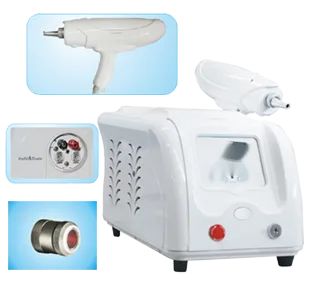
Think about what that means for a Q-switched Nd:YAG system like our QN-09, which runs dual 1064nm and 532nm wavelengths for pigment and tattoo work. You don't get to argue it's a good machine in the abstract. You have to point at a legally marketed predicate with a matching intended use and show your device is no less safe or effective. The physics behind these lasers is old and well understood, going back to Anderson and Parrish's 1983 work on selective photothermolysis in Science, but FDA doesn't clear physics. It clears a specific device against a specific predicate for a specific indication.
The FDA also publishes device-type guidance. For low level laser systems used aesthetically, FDA's Class II special controls guidance spells out the risks you must address and confirms these sit in Class II. A handful of very low-risk device types can be 510(k)-exempt, but don't assume yours is. Check the classification first.
Indications for use: every cleared claim is separate
This trips people up more than anything else. FDA clears indications, not machines. Hair removal is one indication. Wrinkle reduction is another. Pigmented lesions, vascular lesions, acne, tattoo removal, skin resurfacing: each is its own claim, and each needs support in your submission.
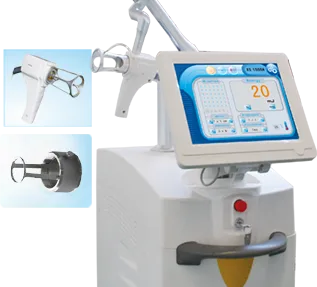
So a fractional CO2 platform like the CF-01, at a 10600nm wavelength for resurfacing and scar work, gets cleared for the indications you prove up. Not the ones you'd like to print on the brochure. If your marketing team wants to advertise a treatment the clearance doesn't cover, that's a compliance problem waiting to happen. Match your claims to your clearance, word for word. A diode hair-removal system such as the DL-04 at 808nm is cleared for hair removal, and stretching that into other promises on your US label is exactly the kind of thing that draws an FDA warning letter.
Beyond the 510(k): registration, listing, and a US Agent
Clearance is necessary. It isn't the whole job. Even after FDA clears your 510(k), you can't legally ship until a few more pieces are in place. Here's the checklist most foreign manufacturers work through:
- FDA establishment registration. Your manufacturing site registers with FDA and renews annually.
- Device listing. You list each device you intend to market, tied to its product code.
- US Agent. Every foreign manufacturer must name a US Agent who acts as FDA's point of contact inside the country. This is mandatory, not optional.
- Compliant labeling. Your labels and instructions for use have to meet US requirements and reflect the cleared indications exactly.
- Radiation performance rules. Lasers are radiation-emitting products, so there are electronic product radiation control obligations on top of the device rules.
Miss the US Agent step and your registration simply won't stand. It's a small requirement with a big consequence.
A practical path from CE to FDA clearance
You've got CE. Good. That means your technical documentation, testing, and risk files already exist, and a fair amount of that work is reusable. It is not a shortcut through FDA, but it's a head start. A sensible order of operations looks like this:
- Classify the device. Run your device type through FDA's Product Classification database to confirm the class and product code. This decides whether you even need a 510(k).
- Search for a predicate. Mine the FDA 510(k) database for a legally marketed device with a matching intended use and comparable technology. No predicate, no standard 510(k) route.
- Map the gaps. Compare your CE technical file against what FDA and any special controls guidance expect. Extra bench testing or biocompatibility data is common here.
- Assemble and submit the 510(k). Build the equivalence argument, compile the file, and submit. Budget for FDA questions during review.
- Register, list, and appoint your US Agent. Do this so you're ready to ship the moment clearance lands.
Want the logistics side too, once clearance is in hand? Our guide to importing laser beauty machines covers what happens after the regulator says yes. And if you're still comparing hardware, the full Pmise product range lists the platforms we build with export documentation in mind.
One fake shortcut costs more than the whole submission. Distributors who "assume CE is enough" and ship anyway can lose the goods at customs and burn a client relationship in one move. Do it once, do it properly.
Frequently Asked Questions
Is FDA clearance the same as FDA approval?
No, and the words matter. Most aesthetic lasers go through 510(k) clearance, where you show substantial equivalence to a predicate device. "Approval" is a stricter premarket approval (PMA) pathway used for higher-risk devices. If a supplier tells you their aesthetic laser is "FDA approved," ask which pathway they actually mean. For a Class II device the honest term is almost always cleared.
Can I reuse my CE technical file for the 510(k)?
Partly. A lot of your engineering, safety, and risk data transfers, so the CE work isn't wasted. But FDA structures its review around substantial equivalence to a US predicate, which is a different frame than the EU's General Safety and Performance Requirements. Expect to reorganise the file and, often, to add bench testing FDA specifically wants. Treat it as a strong starting point, not a finished submission.
Do I really need a US Agent if I have a US distributor?
Yes. A distributor sells your product. A US Agent is a formal role required of every foreign manufacturer, serving as FDA's direct contact for communications, questions, and inspection scheduling. The two can be the same company if that entity agrees to act in both roles, but the US Agent obligation doesn't disappear just because you have a sales partner on the ground.
Which aesthetic lasers might be 510(k)-exempt?
Very few in this category, and you shouldn't guess. Exemption depends on the specific product code and classification, not on how low-powered the device feels. The safe move is to confirm the device's classification in FDA's Product Classification database before assuming any exemption. When the database and the special controls guidance disagree with your assumption, believe the database.
Pmise Technical Team. We design and export laser and light-based aesthetic systems for clinics and distributors worldwide, and we prepare our platforms with international regulatory documentation in mind. Always confirm current requirements with a qualified regulatory consultant before you file.