
Pigment Treatment
Post-inflammatory Hyperpigmentation
Post-inflammatory hyperpigmentation (PIH) is the flat brown, grey or near-black mark left behind after acne, eczema, a burn or a procedure has inflamed the skin. Sound post-inflammatory hyperpigmentation treatment settles that inflammation first, then adds sun protection, topical lighteners and cautious low-fluence laser work. Written for clinics and distributors comparing equipment. Educational, not medical advice.
What PIH actually is
Inflammation wakes up the pigment factory. Our engineering archive states the histology plainly: PIH comes from strengthened melanocyte activity in the basal layer of the epidermis. Those cells push extra melanin into neighbouring keratinocytes, and where the basal layer is damaged, pigment drops into the dermis too. Depth drives colour. Epidermal pigment reads brown and rides the skin's escalator out, roughly 28 days from basal layer to shedding by our archive's count. Dermal pigment reads slate grey and lingers.
The lesion is unremarkable: flat, no itch, no scale, shaped by whatever inflamed the area. Melasma, solar lentigines and dermal melanocytic lesions all mimic it, so when the history doesn't match the mark, refer. DermNet notes diagnosis is sometimes settled only by biopsy.
Why darker skin carries more risk
Anyone can get PIH. It just hits skin of colour harder. DermNet reports the colour is often more intense and longer-lasting in darker skin, and the American Academy of Dermatology warns that darker tones carry a higher risk of pigment driven by ultraviolet and visible light. The same reactivity that made the mark will answer your laser pulse.
- More baseline melanin means more epidermal absorption, so surface heating climbs fast at any fluence.
- Reactive melanocytes answer minor insult by making pigment, and a recent tan raises that risk further.
- Cooling can bite back: our archive warns that continuous cryogen over-spray erodes the surface and triggers PIH by itself.
- For Fitzpatrick IV to VI the archive is blunt: longer wavelength, longer pulse, lower energy, active cooling.
How laser and light lift the pigment
The physics goes back to Anderson and Parrish, who set out selective photothermolysis in Science in 1983. Keep the pulse shorter than the target's thermal relaxation time and energy stays trapped in the pigment. Q-switching takes that to the extreme: nanosecond pulses push peak power up by orders of magnitude, so the effect turns photomechanical rather than thermal. Melanosomes shatter, and phagocytes clear the debris.
Wavelength choice is where most PIH mistakes get made. Our archive is specific: 532 nm is absorbed strongly by red and brown chromophores and poorly by black and blue-black ones, 1064 nm the other way round, and dermal melanin needs above 800 nm because shorter beams scatter in the epidermis first. So use 1064 nm for dermal pigment and darker skin. Hold 532 nm back for superficial pigment on lighter skin.
The archive's PIH chapter names the complication in four words: increased pigmentation after treatment.
Conservative settings and what a course looks like
Start with the things that aren't the laser. Control the inflammation, keep the area out of ultraviolet light, get a topical lightener working; our archive recommends 1 to 4 percent hydroquinone cream twice daily under medical supervision. Only then does a handpiece come out, after a test spot.
| Parameter | Conservative approach | What sets the starting point |
|---|---|---|
| Wavelength | 1064 nm for dermal pigment and darker skin; 532 nm only for superficial pigment, lighter skin | Lesion depth plus Fitzpatrick type |
| Pulse regime | Q-switched nanosecond output | Fixed by platform: 10 to 20 ns (QN-06 class), 6 to 8 ns (QN-05 class) |
| Fluence | Low. Sit under the visible endpoint, titrate up | Your machine's own manual, then the test spot |
| Spot size | Largest spot that still covers the lesion cleanly | 1 to 5 mm adjustable on QN-06 class; open it before raising energy |
| Session spacing | Several weeks, stretched if pigment appeared | Recovery from the last pass, not the calendar |
| Cooling | Active epidermal cooling, no continuous cryogen over-spray | Archive complication notes |
| Endpoint | Faint even erythema. Stop before frosting or blistering | Watched live |
Here's how you get there, since no published number can set your starting fluence.
- Take the starting band from the manual. Use the PIH and dark-skin range printed in the manual for your machine, at the spot size you intend to use. Another brand's settings sheet doesn't transfer; pulse width, beam profile and calibration all differ.
- Fire a test spot, then wait. One pass, one setting, on a small piece of the lesion or its margin. Read it twice. At 24 to 48 hours check for blistering, crusting or unsettled redness, since our archive records swelling and post-inflammatory pigment within roughly 48 hours of a non-ablative pass. Read it again near the end of your planned interval, because delayed darkening builds over weeks as the epidermis turns over.
- Set the full-area dose from what the test spot showed. A clean fade with no crust and no new pigment means you can treat at that setting. Darkening, crusting or blistering means drop back inside the manual's range, or stop.
- Step up in small increments, on evidence only. Raise energy one step at a time, judged on the last session's response rather than a schedule. Where pigment appeared, the archive's answer is sun protection, continued treatment until it clears, and a longer interval. Not a bigger dose.
One rule sits underneath all four. Energy density is pulse energy spread across the spot area, so at fixed energy a smaller spot means higher fluence. Trade area for gentleness: open the spot a step to bring fluence down, and raise pulse energy only once the wider spot has proved safe. Higher fluence doesn't buy speed. It buys a rebound that leaves the patient darker than when they walked in.
Recommended Pmise equipment
For this indication Pmise points buyers at the dual-wavelength Q-switched Nd:YAG laser range. Per our device manuals, the QN-06 system outputs 1064 nm and 532 nm at a 10 to 20 ns pulse width, with a continuously adjustable 1 to 5 mm spot. That spot range matters most here.
Headroom matters even when you plan to stay gentle. Our archive puts roughly 350 to 400 mJ single-pulse output in the useful range for pigment work, and the QN-05 unit reaches 400 mJ at 6 to 8 ns. A machine with reserve holds a large spot at modest energy density; an underpowered one runs near its ceiling all day.
Comparing platforms for a pigment-heavy caseload? Send the Fitzpatrick range and lesion types you see most, and we'll return the QN series specification sheet, spot and pulse-width options and pricing for your market. Request QN series specs and a quote. Distributors can also ask for a walkthrough of the operator interface before choosing a model.
For deeper dosing logic, see our guide to treating post-inflammatory hyperpigmentation with laser, our melasma treatment page and our notes on Fitzpatrick skin types and laser settings.
Aftercare, adjuncts and patient selection
Aftercare is half the treatment, because anything that re-inflames the area feeds the loop that made the mark. Our archive ranks what shifts melanin metabolism: inflammation and sun first, then endocrine status, trauma and photosensitising foods or drugs.
- Broad-spectrum sunscreen daily and reapplied, with sun and tanning off the table all course.
- Keep the area clean and moisturised. No picking, no scrubbing, no aggressive exfoliation.
- Continue the prescribed topical lightener between sessions, and report darkening, blistering or lasting redness so settings drop before the next pass.
- Wavelength-rated eyewear on everyone in the room, patient included.
Patient selection quietly decides most outcomes. Run this screen before booking, and leave each flag for the treating physician to judge.
- Photosensitising drugs, supplements or foods in use. Postpone; ask the prescriber to review.
- Recent systemic retinoid therapy. Defer. The treating physician sets the wait.
- Active infection, herpes outbreak or broken skin in the field. Heal it first, then reassess.
- Keloid or hypertrophic scar history. Refer for specialist assessment before any energy.
- Pregnancy or breastfeeding. Defer elective pigment work.
- Recent sun, a tanning bed or self-tanner. Wait for the tan to fade, then reassess skin type.
- Irritant topicals on the area: strong acids, harsh exfoliants, unsupervised bleaching creams. Pause before the course starts.
A patient who won't use sunscreen isn't a candidate either. Where a lesion looks atypical, refer.
Frequently asked questions
Can laser treatment make PIH worse?
It can, and that's the risk you design around. The complication our archive lists for this work is increased pigmentation afterwards, and Fitzpatrick IV to VI skin is most exposed. Dose low, favour 1064 nm, open the spot, cool the epidermis, test first. Handled that way, laser fades pigment gradually. Handled harshly, it deepens it.
How many sessions will a patient need?
There's no honest fixed number. PIH generally takes several sessions a few weeks apart, because lesion depth and skin type drive the pace. Epidermal pigment clears faster than dermal. Set the expectation of gradual, cumulative fading at consultation, then adjust as sessions respond.
Is 1064 nm or 532 nm better for darker skin?
Use 1064 nm. It penetrates deeper and epidermal melanin absorbs it weakly, which keeps surface injury risk down in skin of colour. The 532 nm beam is strongly absorbed by superficial red and brown pigment: useful on epidermal spots in lighter skin, risky in darker skin. A dual-wavelength platform lets you match beam to case.
Next step: send the skin and lesion types you plan to treat to our engineering and clinical support team, and have them confirm model, spot range and configuration before ordering.
Educational information for equipment buyers and clinical staff. It does not replace professional diagnosis, in-person examination, the manual supplied with a device, or your market's regulations.
Recommended Equipment
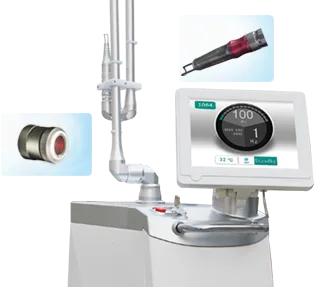
Pmise QE-01
Dual wavelengths (1064nm & 532nm) are convenient to adjust by touching LCD. Multi-spot size (1-7mm) is ideal for a wide…
View details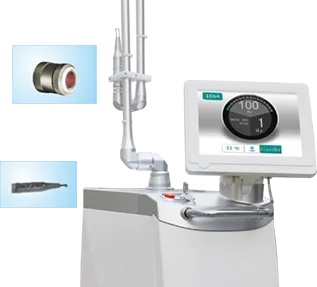
Pmise QE-02
Dual wavelengths (1064nm & 532nm) are convenient to adjust by touching LCD. Multi-spot size (1-7mm) is ideal for a wide…
View details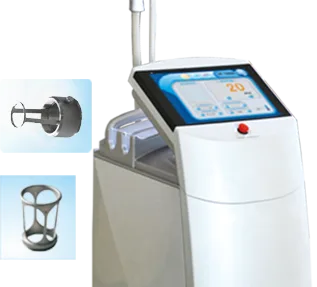
Pmise EF-02
The target tissue is water, no skin type limit (Fitzpatrick I-VI). The output spot diameter is 50-80 um, less thermal ab…
View details