
Good post-inflammatory hyperpigmentation treatment starts with restraint, not power. PIH is the brown or slate-grey mark left behind after acne, a burn, or a laser pass that ran too hot. Heat and inflammation created it. More heat rarely fixes it. Sun protection, topical melanin control, then low-fluence 1064nm toning if the mark is still there: that order keeps you out of trouble.
Last reviewed: June 2026.
What actually causes post-inflammatory hyperpigmentation?
PIH is melanin dumped into skin that has just been through something. Our clinical training archive puts it plainly: pigmentation appears during or after acute or chronic inflammation, runs from brown to almost black, and copies the shape of whatever inflamed the area. A round acne lesion leaves a round mark. The surface stays flat and the patient feels nothing. Only the colour bothers them.
The mechanism is simple. Melanocyte activity in the basal layer strengthens and keeps producing after the original trigger has gone. Two details in that archive entry should shape your plan: PIH has a self-healing tendency, and it swings with sunshine and season. Time and shade are on your side. Anything that re-inflames the skin is not.
The two-part PIH review published in the Journal of the American Academy of Dermatology in 2017 ties severity to inherent skin colour, to the depth and ferocity of the inflammation, and to disruption of the dermoepidermal junction. Deeper insult, deeper pigment, slower clearance.
Why do aggressive laser settings make PIH worse?
Because your device and the condition share a mechanism. PIH is an inflammatory response; a hot laser pass is an inflammatory event. Our device manuals put the complication bluntly: pigmentation can increase after treatment. Set the energy too high and you don't just fail to clear the mark. You feed it.
Think about where the heat is meant to go. Selective photothermolysis, the framework Anderson and Parrish described in Science in 1983, confines damage to the target by matching wavelength and pulse duration to it. Nanosecond Q-switched pulses do that well for melanin. But confinement is only half the job. Total delivered energy still has to stay low enough that surrounding tissue never mounts an inflammatory reply.
One conservative session too few costs a few weeks. One aggressive session too many can turn a fading mark into a stubborn one.
Cooling cuts both ways. Our archive's cooling notes warn that a cryogen spray left running past its intended burst damages the skin instead of protecting it, with PIH the listed consequence.
What do safe laser settings for PIH look like?
The defensible approach is low-fluence Q-switched 1064nm toning across several light sessions instead of a few strong ones. That wavelength travels deeper and surface melanin absorbs it less greedily than 532nm, so it's more forgiving in the medium and dark skin where PIH shows up most. Our device documentation recommends Q-switched Nd:YAG at 1064nm here, alone or paired with 532nm, with the operator choosing energy density and spot for the lesion.
Exact fluence, spot size, and pass count belong to your machine's manual and your own cautious titration. No number is safe on every platform. The habits are what travel:
- Pick 1064nm for anything but very fair skin. Keep 532nm for superficial epidermal pigment in light skin types.
- Begin at the bottom of the energy range. Treat to mild warmth or faint erythema, never to frosting or pinpoint bleeding.
- Use a larger spot and keep passes even. Stacked pulses concentrate heat exactly where you don't want it.
- Space sessions generously so subclinical inflammation settles before the next pass.
- If the area is darker at follow-up than at the last visit, stop and reassess before firing anything.
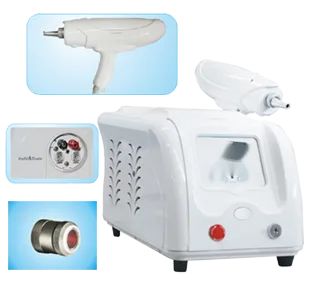
Our Q-switched Nd:YAG laser family uses this dual 1064nm and 532nm layout with adjustable spot size, so an operator can drop energy density without changing anything else. The compact Pmise QN-09 and Pmise QN-03 come up most for cautious pigment work. For the physics, see our explainer on selective photothermolysis.
Which patients should you treat, and which should you wait on?
Skin type drives the decision. More melanin means more fuel, and the patients most likely to walk in with PIH are the ones most likely to punish you for over-treating. Our archive's guidance: Fitzpatrick I to III tolerate higher energy density, while IV to VI need a longer wavelength, longer pulse width with output reduced to match, and active cooling.
| Fitzpatrick type | Rebound pigment risk | How to approach it |
|---|---|---|
| I to II | Lower | Wider energy tolerance, but topicals still come first |
| III | Moderate; very common | 1064nm at low fluence, slow titration, strict photoprotection |
| IV to VI | High | Longer wavelength, reduced output, active cooling, devices used sparingly |
Epidermal or dermal PIH? Settle that before you promise anything
Colour and edge tell you most of it. Epidermal PIH reads tan to brown with a reasonably sharp border. Dermal PIH reads blue-grey or slate, edge hazy. The 2017 JAAD overview of PIH presentation and noninvasive assessment describes the bedside step that separates them: examine the mark under a Wood's lamp. Epidermal pigment accentuates. Dermal pigment barely changes. Do that check before quoting anyone a course, because the outlooks differ sharply.
| Type | Bedside cues | What it means for the plan |
|---|---|---|
| Epidermal PIH | Tan to brown, fairly well defined; accentuates under Wood's lamp | The workable case. Photoprotection and topicals often carry it; low-fluence toning can help what's left |
| Dermal PIH | Blue-grey or slate, ill-defined; little or no accentuation | Slow, stubborn, per the same review sometimes permanent. Set expectations low, say plainly a device may add little, and think hard before treating |
Most disappointing PIH courses trace back to that skipped step: a dermal mark treated on an epidermal timetable. The patient counts sessions, sees nothing shift, blames the machine.
One more screen: is the original inflammation still running? If the acne is still flaring, you're treating yesterday's marks while tomorrow's are made. Calm the source first. Our post-inflammatory pigmentation solution page details the assessment, and our guide to Fitzpatrick skin types and laser settings covers typing.
What order should the treatment plan follow?
Our archive is explicit: the key treatment for PIH is controlling the inflammation. Not firing a laser. Devices sit at the end of the queue, and plenty of cases never reach them.
- Fix the cause. Get acne, eczema, or dermatitis under control so no fresh pigment is generated.
- Lock in sun protection. The archive lists avoiding solarisation as a core step and records that PIH varies with sunshine and season. Daily cover is not optional.
- Start topical melanin control. The archive's protocol references hydroquinone cream twice daily, but that entry is dated. The US FDA has stated there are no legally marketed over-the-counter skin lightening products containing hydroquinone, and warns of side effects including rashes and ochronosis. Check your market's rules; consider azelaic acid, retinoids, or niacinamide.
- Give it real time. PIH tends to resolve on its own; topical care plus shade often clears it with no device.
- Only then consider low-fluence toning, for residual pigment, at conservative settings.
The treatment half of the 2017 JAAD review lands in the same place: treat the inflammatory condition, pair that with topical depigmenting agents and photoprotection, consider procedures afterward. When a patient pushes for the laser on visit one, that ordering is your script.
Which adjuncts actually carry the result?
The laser gets the credit. The adjuncts do the work. Unprotected sun can undo weeks of careful progress in a single holiday.
- Daily broad-spectrum sunscreen, properly reapplied. Foundation, not footnote.
- Topical depigmenting agents suited to your market, run well past the course.
- Barrier repair and gentle cleansing. Harsh actives and over-exfoliation trigger fresh PIH.
- Generous session spacing, so inflammation never stacks visit to visit.
- Photographs every visit, same lighting and angle. PIH fades slowly, and patients forget where they started.
Melasma and PIH often sit on the same face and follow different rules, so read our piece on laser treatment for melasma before assuming one protocol covers both.
What should a clinic or distributor check before buying a platform for PIH work?
Cautious pigment work makes demands the brochure headline won't show. A machine that only feels comfortable near the top of its range is the wrong machine here. Before committing to a platform, verify:
- Both wavelengths on one platform. 1064nm for most PIH work, 532nm for superficial pigment in fair skin.
- Adjustable spot size and a usable low end on energy. Ask for the smallest energy increment, not just maximum output. Fine low-end control is what makes toning possible.
- Cooling, integrated or compatible. Confirm what ships and what the operator supplies.
- CE, FDA and RoHS documentation. Ask for the certificates and check their scope against your market's rules.
- Operator and clinical training. Who delivers it, in what format, and whether refreshers cover staff turnover.
- Warranty and spare-parts availability. Laser rods, flash lamps, handpieces, optics: what's stocked, and how replacements reach you.
- Service documentation and parameter guidance in your team's language. A manual your operators can't read is a safety problem.
- Lead time, plus OEM and MOQ terms if you're reselling, branding included.
Tell us the skin types you see and the concerns you treat most, and the Pmise engineering team will come back with a configuration quote and full spec sheet.
Frequently Asked Questions
Can a laser make post-inflammatory hyperpigmentation worse?
Yes, and it happens often. Our device documentation lists increased pigmentation as a recognised complication of laser treatment for pigment. PIH forms in response to inflammation, so excess heat re-triggers the process you want shut down. Low-fluence toning across gentle sessions is safer, and that matters most in darker skin.
How many sessions does PIH usually need?
There's no fixed number, and anyone quoting you one is guessing. Many cases clear with sun protection and topical care alone. Where toning is used, improvement builds gradually rather than after one visit. Skin type, whether the pigment sits in the epidermis or the dermis, and sunscreen discipline all move the total.
Is 1064nm or 532nm better for PIH?
For most PIH cases, 1064nm. It penetrates deeper and surface melanin absorbs it less aggressively, lowering the odds of provoking more pigment in medium to dark skin. The 532nm wavelength suits superficial epidermal pigment in fair skin. A dual-wavelength platform lets you match wavelength to patient.
Should I treat PIH while the acne is still active?
No. Control the inflammation first, every time. Active acne means new pigment is still being laid down, so clearing existing marks is wasted effort and treatment may add to them. Settle the condition, protect from sun, start topical care, then reassess what pigment is genuinely left.
Written by the Pmise Technical Team. Pmise manufactures laser and light-based aesthetic systems and draws on device manuals and clinical training material for Q-switched Nd:YAG, fractional, and IPL platforms. Educational only; not clinical advice.