Shopping a slimming machine for sale comes down to three questions: which modalities you need, whether the result claims are honest, and who answers the phone when a handpiece dies. Published 2026 guides put a credible professional platform between roughly US$3,000 and US$20,000. Here's where the money goes.
Which modalities are you actually buying?
Four technologies do the job: ultrasonic cavitation, radiofrequency, vacuum with rollers, cryolipolysis. They solve different complaints. Buy for the bodies that walk into your room, not for the longest spec sheet.
| Modality | What it does | Main job | Client it suits |
|---|---|---|---|
| Ultrasonic cavitation | Sound stresses the fat-cell wall until it gives way | Fat volume, cellulite feel | Abdomen, flanks, thighs |
| Radiofrequency | Heats dermis and subcutis for a collagen response | Firming and tone | Mild laxity, post-fat-loss slack |
| Vacuum plus rollers | Suction and rolling move tissue and lymph | Circulation, drainage, texture | Orange-peel texture |
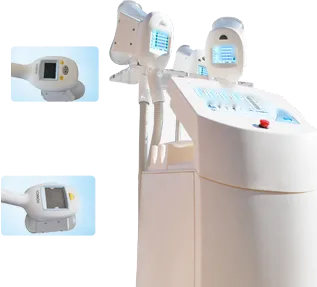
| Cryolipolysis | Cooling injures fat cells so the body clears them | One stubborn pocket | Love handles, lower belly |
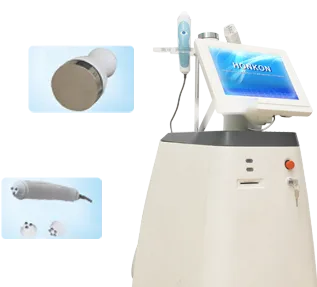
For big soft areas, a cavitation machine is the workhorse. Our engineering archive describes ultrasonic tips emitting a 40 kHz wave, chosen because that frequency couples most strongly into the hypodermis fat layer; each cycle alternates positive and negative pressure until the lipocyte wall fails and the fat emulsifies for metabolic clearance. The same manuals list numbers any supplier should quote without hesitating: 60 W ultrasonic output, an RF handpiece rated 330 W input and 50 W output, RF duration 0.5 to 5 seconds. That's the Pmise CA-01 cavitation platform.
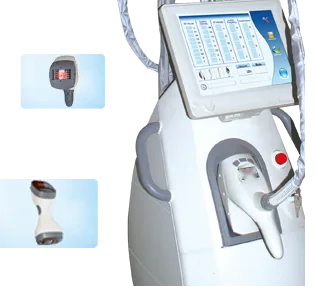
Cavitation removes volume. It doesn't tighten anything. That's why most buyers land on a multi-handle console. Our manuals for the RF, vacuum, infrared and roller systems describe vacuum drawing tissue between the RF tips, monopolar RF at 2.6 MHz, and infrared across roughly 700 to 2000 nm; infrared warms tissue to about 5 mm deep while RF reaches 5 to 15 mm. Two depths, one pass. Compare consoles in the Pmise slimming range; applicator units sit on the cryolipolysis page.
What can you honestly promise a client?
Sell contouring. Never sell weight loss. The U.S. FDA is blunt in its guidance on non-invasive body contouring: these procedures do not treat obesity and will not produce weight loss. Not everyone responds, results can be temporary, more than one treatment may be needed. Put that in your consultation script.
The mechanisms are documented. Manstein and colleagues established selective cryolysis in Lasers in Surgery and Medicine in 2008, showing controlled cooling can cause selective loss of subcutaneous fat while the skin above stays intact. A 2022 study by da Silva and colleagues in the Journal of Clinical and Aesthetic Dermatology found ultracavitation plus radiofrequency reduced abdominal adiposity and flaccidity more than cavitation alone. A purchasing signal: pairing modalities beats stacking sessions of one.
How long does a slimming course actually run?
Body contouring sells as a course, because fat clears through metabolism over weeks. Price it that way from day one.
- Screen properly. Confirm the goal is an area, not the scale. Rule out pregnancy, pacemakers, metal implants in the field and active skin conditions.
- Book the course, not the session. Our treatment documentation for RF, vacuum and infrared slimming sets 20 to 40 minutes per area, intervals of 3 to 7 days, and 10 to 12 treatments as one course. Whole-body work runs 60 to 90 minutes.
- Watch the endpoint, not the clock. Warmth, mild transient redness and a tightened feel during RF and vacuum work are common expected reactions, not a promise of results, and response varies. Section 4.3 of our slimming operating guide for that console describes it, asks for even handpiece contact and stepwise energy, and names an epidermal temperature near 40 degrees Celsius, checked with an infrared thermometer, as the working indicator. Run to the parameter sheet for your own model.
- Space cryolipolysis differently. A placed applicator, a cycle, then patience. Change builds over weeks to a few months as treated cells clear.
- Reassess and photograph. Same lighting, pose and distance. Offer maintenance, not permanence.
What does a slimming machine cost, and what else lands on the invoice?
Price splits by handle count and modality, not by marketing tier. Use the published 2026 guides below to sanity-check any quote. Your figure moves with configuration, applicator count, certification and volume.
| Configuration | Published range (USD) | Source |
|---|---|---|
| Desktop cavitation, or cavitation plus RF | From about US$1,000 | Ultrasonic Cavitation Cost 2026 |
| Multi-handle RF, vacuum, infrared console | US$3,000 to US$15,000 | PZLASER 2026 |
| Cryolipolysis, single applicator | US$2,000 to US$6,000 | Uangelcare 2026 |
| Cryolipolysis, dual to quad applicator | US$6,500 to US$16,000 | Uangelcare 2026 |
| Premium multi-technology platform | Above US$30,000 | PZLASER 2026 |
Our archive agrees: a four-handle RF, vacuum, infrared and roller console was quoted at US$6,000 ex-works, payment by T/T, in an export quotation from 2010 to 2014. Dated: an ordering signal, not a live price. And watch the Incoterm. Ex-works means freight, insurance, duty and clearance are yours. Uangelcare's guide puts freight to the USA at US$300 to US$800 per machine, in-person training at US$500 to US$1,500 where it isn't free, and consumables at US$2 to US$9 per session. Duty and VAT sit on top; see our import guide.
Order quantity and lead time get forgotten. Single units are normal here: our archived export offers were priced per unit, and Uangelcare's OEM and ODM guide reports typical MOQs of 1 to 10 units for ODM work, 5 to 50 for full OEM programmes, usually on a 30 per cent deposit and 70 per cent before shipment. A stock configuration should carry a dispatch date in weeks, written on the proforma; customised builds run to months, and that guide puts ODM delivery at 3 to 6 months after sample approval, OEM at 9 to 18. No dispatch clause, no delivery date.
Warranty and parts close the picture. Pmise machines carry a one-year warranty from the day of receipt and acceptance, covering free repair of the whole unit against invoice and warranty card, then lifetime maintenance and free operator training from our instructors; terms sit on our service page. Handpieces deserve their own contract line. As a magnitude check, an archived parts list for one of our laser platforms priced a control board at US$400 and a screen at US$150, while a high-power handpiece ran US$3,400 to US$5,000. Dated, and a different product class. The lesson holds: boards cost hundreds, handpieces hurt.
Where does the return actually come from?
Repeat courses and cheap consumables. A course of 10 to 12 visits turns one closed sale into ten booked appointments, and most of these modalities need little beyond gel. A console treating fat and laxity covers more of the complaints already walking through your door, so the room stays utilised. Our clinic ROI breakdown runs the arithmetic, and our cavitation vs cryolipolysis vs RF comparison weighs the technologies head to head.
Nothing that removes fat tightens skin, and nothing that tightens skin removes fat. A console doing both, explained honestly, protects your before-and-after photos.
Red flags when the price looks too good
The risk in a budget import isn't the price. It's missing certification, unverifiable specs, nobody to call in month seven.
- Specs the supplier can't state. Ultrasonic frequency, output power, RF frequency, vacuum range, cooling range. In the brochure but not the manual? Walk.
- Guaranteed loss per session. Fixed centimetres is a claim the published evidence does not support.
- Certification you can't verify. Documents must carry the manufacturer's legal name and the number must check out with the issuing body. A screenshot is not a certificate.
- No parameter sheet, no training. Without contraindication lists and per-area settings, staff improvise on a client's abdomen.
Checklist before you sign the proforma
- Match the machine to your client mix. Broad soft fat points to cavitation, one pinchable bulge to cryolipolysis, loose skin to RF.
- Favour multi-handle consoles. Cavitation plus RF covers volume and firming from one footprint.
- Fix the commercial terms in writing. Unit price and inclusions (about US$1,000 for a desktop cavitation unit up to US$16,000 for a quad-applicator cryo system), Incoterm, MOQ (1 to 10 units is typical here, single units are normal), a dated dispatch clause (weeks for a stock configuration, 3 to 6 months for a customised build), payment split, warranty length (one year from receipt and acceptance on Pmise machines, then lifetime maintenance) and handpiece replacement prices.
- Read the manual before you pay. Specs, contraindications and protocols on paper, in English.
- Think about staffing. Cryolipolysis is hands-free once placed; cavitation, RF and vacuum tie up an operator, which changes cost per treatment.
Want those documents for a specific model? Send the model code and your market. We'll return the parameter sheet, copies of our CE and ISO certificates so you can check them with the issuing body, and a quotation itemising Incoterm, dispatch date, warranty scope and handpiece replacement prices. Email [email protected], message +86 133 2121 6666, or use the contact form. Our service terms commit to a 30-minute response on technical questions and a quotation within 12 to 24 hours. Want to watch the handles work first? Ask for an online demo on the same thread.
Frequently Asked Questions
What should I budget for a slimming machine?
Published 2026 guides put a desktop cavitation or cavitation plus RF unit from about US$1,000 up, a multi-handle RF, vacuum and infrared console at US$3,000 to US$15,000, and cryolipolysis from roughly US$2,000 for a single applicator to US$16,000 for quad-applicator systems. Add freight (US$300 to US$800 to the USA), duty and any paid training. Then check the warranty: one year is our baseline, and across five years warranty scope and handpiece prices move your total more than the sticker gap.
Does a slimming machine really reduce fat?
It reduces localised fat and can improve skin tone, within limits. The FDA is explicit that non-invasive body contouring does not treat obesity and will not produce weight loss. These are shaping tools for one area, over a course. Screen out anyone whose goal is the number on the scale.
Cavitation or cryolipolysis for my clinic?
Different clients, and plenty of clinics run both. Cavitation covers larger, fleshier zones and ties up an operator. Cryolipolysis targets one pinchable pocket and runs hands-free once placed, which lifts throughput. Mostly abdomen and thigh bookings? Start with cavitation. Love handles? Start with cryo.
Are non-invasive slimming treatments safe?
They're non-invasive with minimal downtime, and clients usually return to normal activity right away. The FDA does note any body contouring device can cause complications, most short-lived but some lasting. Screen carefully, stay inside the manufacturer's parameters, and build the consent form around regulatory guidance, not marketing copy.
Pmise Technical Team. We manufacture and export laser and light-based aesthetic equipment, write from device manuals, parameter sheets and current regulatory and peer-reviewed sources, and will send the spec sheet, certificates and an itemised quotation for any model on request.