Port wine stain treatment works by driving light that oxyhaemoglobin absorbs strongly into malformed dermal capillaries, heating each vessel until its wall fails. That mechanism decides every equipment choice for a nevus flammeus caseload.
What is a port wine stain, and why won't it fade?
It's a congenital malformation of the capillaries in the dermal papillae. Not a tumour, not something the body corrects. Our skin-condition atlas is blunt: born with it, a deformity of capillary, no regression, most often on head and neck, with more than half of facial lesions along the trigeminal nerve distribution.
Time works against it. Childhood pink deepens toward purple and can turn cobblestoned or nodular, and once vessels turn proliferative our archive records that the lesion stops responding well to laser and IPL. Waiting is poor advice. This isn't an infantile haemangioma, so the parameters for haemangiomas differ.
Where the stain sits changes what you owe the patient. The British Association of Dermatologists notes that a stain on the upper face or scalp can be linked to abnormalities within the brain, called Sturge-Weber syndrome, and that a stain may rarely lead to glaucoma, in which case referral to an eye specialist may be required. So a lesion in the first trigeminal branch, the forehead and upper eyelid territory, gets an ophthalmic assessment before the laser course starts, plus neurology where seizures or developmental concerns are in the picture. That gate doesn't contradict treating early. It sits in front of it.
Why oxyhaemoglobin is the target
Pick a wavelength your target absorbs better than its neighbours, deliver it in a pulse short enough to hold heat inside that target, and the vessel takes the damage while the dermis around it doesn't. Anderson and Parrish set that principle out in Science in 1983. Haemoglobin's absorption peaks sit at 418, 542 and 577 nm according to our technical archive, which is why vascular devices cluster in green and yellow. Depth is the trade-off, and it's why selective photothermolysis pushes you toward 1064 nm on thicker lesions.
Which laser and light options treat port wine stains?
Pulsed dye laser is the technical reference standard. The standard guidelines of care for vascular lesions in the Indian Journal of Dermatology, Venereology and Leprology (IJDVL) report PDL as carrying the best efficacy and safety data among vascular lasers, with Nd:YAG and IPL the other widely available options.
| Option | Wavelength | Typical parameters | Suits which lesion |
|---|---|---|---|
| Pulsed dye laser | 585 to 595 nm | Per IJDVL: pulse 0.45 to 40 ms (usually 0.45 to 1.5 ms), spot 5 to 10 mm, fluence 4.5 to 8.0 J/cm2, cryogen spray cooling | Flat pink to red stains |
| KTP laser | 532 nm | Variable pulse width, small spots, contact or air cooling | Superficial red patches, fine vessels |
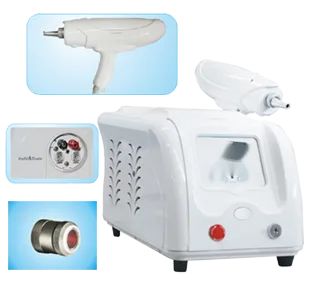
| Long-pulse Nd:YAG | 1064 nm | Adjustable pulse width, larger spot for depth, sapphire contact cooling | Thick or resistant stains, darker skin |
| IPL and E-light | Filtered broadband | Vascular filter 585 to 1200 nm, long pulse width, three or more pulses, spots 10 x 10 mm, 8 x 40 mm and 15 x 60 mm | Diffuse or lighter lesions, large areas |
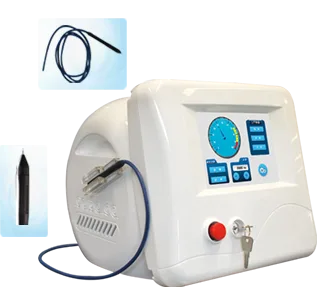
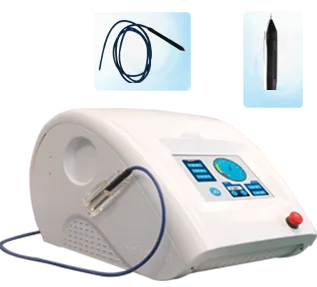
| High frequency unit | Not light-based | 13.56 MHz output, 0.01 mm tip, continuous and pulse modes, power 0 to 100 percent | Fine residual vessels, discrete spots |
Filter and spot data above come from our documentation. No table hands you a working fluence. That 4.5 to 8.0 J/cm2 belongs to a 595 nm dye laser at a 5 to 10 mm spot; it won't transfer to 1064 nm or a 15 x 60 mm IPL window. Fluence follows spot size, pulse width, skin type and lesion thickness, confirmed by patch test.
Where does high frequency equipment fit?
Think scalpel, not paintbrush. Our high frequency systems for vessel diseases work through a 0.01 mm treatment tip at 13.56 MHz, with continuous and pulse output modes and power adjustable across the full 0 to 100 percent range. Our documentation describes that tip coagulating haemoglobin and the endothelial cells of the dilated capillary, with treated tissue sloughing off within three to seven days. On a diffuse birthmark it's the wrong instrument. It pays afterwards, on stubborn single vessels and on facial telangiectasia.
How many sessions should you plan for?
Plan on roughly 2 to 12 or more sessions spaced 6 to 8 weeks apart, and tell the patient complete clearance is uncommon. Count and interval both come from the IJDVL standard guidelines of care. The British Association of Dermatologists puts it plainly: a course is usually needed, and the aim is a paler mark because complete fading often isn't achievable.
- Document colour, thickness, site and skin type, with photographs at fixed lighting and settings.
- Patch test discreetly. Wavelength follows depth: yellow or green for flat pink, 1064 nm for thick or dark.
- Review at 6 to 8 weeks. Raise energy only if the last session healed cleanly and response was weak; otherwise move resistant areas to 1064 nm.
- Finish residual vessels with a high frequency tip, then re-photograph.
Cooling and skin type: where clinics go wrong
Cooling matters more than the sticker price, and its job is narrow: protect the epidermis while high fluence passes through. Telangiectasia sits close to the surface and needs little cooling, since over-protecting it can render treatment ineffective. A port wine stain demands higher fluence, so epidermal cooling is mandatory. Cooled handpieces in our documentation hold 0 to 4 degrees Celsius.
Skin type sets the ceiling. In Fitzpatrick IV to VI skin the melanin above your target competes for energy, so our archive steers those cases to a longer wavelength, larger spot and sapphire contact cooling. Our guide to Fitzpatrick skin types goes deeper.
Side effects, screening and aftercare
Adverse effects to consent for. IJDVL names hyperpigmentation as the commonest, followed by hypopigmentation, hypertrophic scarring and atrophy. The British Association of Dermatologists adds dark bruising, blistering and crusting, and notes that scarring is rare.
- Purpura is a dose- and pulse-duration-dependent endpoint, not an accident. Work in Lasers in Surgery and Medicine found the purpuric threshold rises as pulse duration is stretched, so pulse width, not cooling, moves it.
- Blistering and crusting point to excess fluence, weak cooling, or stacked pulses on one spot. Drop energy next time.
- Pigment change is likeliest in Fitzpatrick IV to VI skin and in anyone recently sun-exposed; our archive notes that sun exposure around a treated area can leave it hypopigmented.
Screen before you book. IJDVL lists active local infection and photo-aggravated skin disease as absolute contraindications, with unstable vitiligo, keloid tendency and isotretinoin use as relative ones. Our own pre-treatment notes add these.
- Facial lesions in the first trigeminal branch, or on the eyelids. Refer for ophthalmic assessment before the course begins, following the guidance on glaucoma and Sturge-Weber above, and add neurology where there are seizures or developmental concerns. Book sessions once that assessment clears.
- Periorbital protection at every session. Our device manuals specify metal eye shields over the globe for treatment around the eye. Everyone else in the room wears goggles rated for the wavelength in use.
- Recent sun exposure or an active tan in the field. Postpone.
- Recent hormone therapy, or a herpes simplex history near the site.
- Vitiligo or psoriasis, where a Koebner response needs discussing first.
- Tattoo pigment in the field, or photosensitising drugs.
Aftercare, written down and handed over. The British Association of Dermatologists tells patients treated on face or hands to use high-factor sunscreen throughout the course, not only after the last session.
- Cold compress for around 20 minutes, to carry off residual heat.
- Let crusts fall off by themselves. Picking them is the commonest avoidable cause of a scar.
- No sauna, steam or hot water for three days, no harsh cleansers for a week, no injectables for two weeks.
This assumes a trained physician assesses and treats; none of it is individual medical advice.
How should a clinic or distributor choose equipment?
Buy for the lesions you actually see, then interrogate the commercial side just as hard. Our nevus flammeus solution page has the condition-level overview, and distributors may want our notes on buying from a Chinese manufacturer.
- A yellow or green wavelength for superficial stains, 1064 nm for deep ones, adjustable pulse width and fluence, and cooling that holds through a long session.
- Regulatory status and market access. Check it model by model, market by market, and ask for paperwork rather than a slogan. In the United States the route is 510(k) clearance for a named device: if a model is cleared, ask for the K-number and read its indications. CE marking applies under the EU MDR and rests on a declaration of conformity. RoHS is substance compliance. SGS is a testing house, so what exists is a test report, not a standard. Get copies for your own regulator. Our comparison of FDA 510(k) versus CE explains why the routes differ.
- Warranty, parts and consumables. Get the term in writing, then confirm lead time for handpieces, filters and lamps. Tips and lamps are finite, so ask for expected lifetime and unit pricing before you model margin.
- Training and support. How is operator training delivered, in which language, and what's the support response window?
Building a port wine stain service? Pmise manufactures long-pulse 1064 nm Nd:YAG systems, IPL and E-light platforms with the 585 to 1200 nm vascular filter, and high frequency units for vessel work. Pulsed dye laser isn't in our range, and we'd rather say so than sell you the wrong box. Tell us which lesions dominate your caseload, then ask for specification sheets or a demo.
Frequently Asked Questions
Can a port wine stain be removed completely?
Rarely. The British Association of Dermatologists tells patients the aim is a paler mark, because complete fading often isn't achievable, and adds that remaining areas may darken again later in life. Treat durable lightening as the goal, and say so at consultation, not after session four.
Does the treatment hurt, and will there be bruising?
Patients describe a brief snap with each pulse, and contact or spray cooling makes most sessions tolerable. Expect redness, swelling and purpura, meaning purple bruising, for several days when short pulse durations are used. That's a normal endpoint at those settings, and longer pulses reduce it. Cooling protects the epidermis; it doesn't prevent bruising.
What age should treatment start?
Earlier is generally better. Our clinical archive and the American Academy of Dermatology agree that early treatment tends to be more effective, because younger lesions are thinner and lighter. Where the stain involves the forehead or eyelid, the ophthalmic assessment comes first. Timing then belongs to the physician and family, weighing anaesthesia against a visible birthmark.
Pmise Technical Team. Pmise designs and manufactures laser, IPL, RF and high frequency aesthetic systems, and writes from hands-on device engineering and clinical application work.