Vascular Treatment
Venous Malformation Treatment with Long-Pulse 1064 nm Nd:YAG
A venous malformation is a slow-flow tangle of badly built veins, present from birth even when it only shows up years later. Venous malformation treatment with light usually means a long-pulse Nd:YAG laser at 1064 nm, heating the hemoglobin trapped in those dilated channels until they collapse. Bulky lesions need more than a laser.
Written for clinics, dermatologists and distributors comparing equipment. It's educational material about the technology, not medical advice.
What a venous malformation actually is
The International Society for the Study of Vascular Anomalies files these lesions under simple vascular malformations, on the slow-flow side. That label does real work. A malformation is a construction error in the vessel wall, not a tumour, so it won't involute the way an infantile hemangioma does. Referral letters still say cavernous hemangioma. Same lesion, obsolete name.
The clinical picture is set out in the Phlebology review by Dompmartin, Vikkula and Boon. Slow-flow anomalies, they write, occurring in sporadic and familial forms, including cutaneomucosal and glomuvenous malformations, and in syndromes such as Klippel-Trenaunay, blue rubber bleb naevus and Maffucci. That review reports genetic causes identified for familial forms and for 40% of sporadic cases, and warns about coagulopathy around intervention. None of that is a laser setting. It's a reason to know who's in your chair.
So diagnosis comes first. Ultrasound characterises the flow, MRI maps depth and extent on anything sizeable, and an atypical, firm or fast-changing lesion goes to a specialist, sometimes for biopsy, before a handpiece comes near it. Treating an undiagnosed vascular mass is a risk no machine offsets.
Why long-pulse 1064 nm Nd:YAG reaches a venous lesion
Selective photothermolysis is the whole basis, as Anderson and Parrish framed it in 1983. Pick a wavelength the target absorbs more strongly than its neighbours. Pick a pulse long enough to heat the whole vessel, short enough to keep the heat inside it. Get both right and the vein cooks while the epidermis survives.
Hemoglobin absorbs hard in the green and yellow range, which is why 532 nm is so good on fine surface vessels. It just doesn't travel. A channel sitting in the deep dermis is out of reach. At 1064 nm absorption is weaker, penetration is far better, and melanin interferes much less, so you get useful energy to a deeper target and darker skin tolerates the pass. That trade made long-pulse Nd:YAG the standard tool for deeper vascular work.
Calibre then drives pulse width. A wider vein holds more blood and cools more slowly, so it needs a longer pulse to heat through instead of flash-boiling the surface. The device-selection criteria in our long-pulse platform documentation are blunt: the beam must clear the epidermis, fluence has to wreck the vessel without burning skin, the spot must hold penetration depth, pulse width and count have to be adjustable, vessels under roughly 3 mm are the sensible target, and epidermal cooling is not optional. For published evidence, the 2025 systematic review in Vascular covers long-pulsed 1064 nm Nd:YAG on leg veins.
Want the physics in depth? Our guide to treating vascular conditions with Nd:YAG lasers covers wavelength choice and settings logic, and thermal relaxation time and pulse duration handles the timing side.
Treatment protocol and what to expect
Be honest in the consultation. Clearance is gradual, partial improvement is a normal result, and the lesion can refill. Photograph everything before session one.
| Planning point | Realistic expectation |
|---|---|
| Sessions | Usually several. Superficial, small-calibre components respond faster. |
| Interval | Weeks between passes, so swelling settles and the real response declares itself. |
| Spot size | Our LN-01 parameter sheet lists a 1 mm spot for vascular work, 3 mm for varicose-type vessels. |
| Pulse width | Longer for wider vessels. The long-pulse platform manual specifies a maximum of 50 ms. |
| Skin type | Settings step down as Fitzpatrick type rises. The same sheet lists 3 to 4 pulses per pass on types I and II, roughly 2 on types V and VI. |
| Comfort | Moderate pain. Topical anesthetic and contact cooling help. |
| Downtime | Redness, swelling and often bruising for days. Crusting at higher fluences. |
| Outcome | Gradual fading and softening. Results vary with depth, calibre and skin type. |
Test spot first, always. Wait, review, then commit to a full pass. Under-treat at session one and you keep the option to escalate. Go hard on a type V patient and you can buy a scar.
When referral beats treatment
Plenty of these lesions are not laser cases at all, and an equipment maker should say so. The recognised mainstays for significant lesions are sclerotherapy, surgical resection and endovascular radiofrequency therapy, delivered by a vascular anomalies team rather than an aesthetic clinic.
- Bulky, deep or multi-compartment lesions, where light never reaches the bulk of it.
- Involvement of muscle, joint, airway or any functional structure.
- Pain, limb swelling, ulceration or progressive loss of function.
- Extensive lesions, where localised clotting disturbance is a documented concern.
- Any suspected syndromic association, or any diagnosis the clinician isn't confident about.
- Children, who belong with a specialist team from the start.
Laser fits inside a multidisciplinary plan: surface work on the visible component, often alongside sclerotherapy for the deeper volume. Position it that way and you'll sell fewer disappointments.
Recommended Pmise equipment
Match the tool to the lesion. For focal vessel work, see our high-frequency systems for vessel diseases, the VF-05, VF-06 and VF-07, which treat fine surface vessels and telangiectatic components with localised delivery. For the deeper venous target the workhorse is the long-pulse Pmise LN-01 1064 nm Nd:YAG platform and its LN-03 sibling.
- Long-pulse Nd:YAG (LN-01, LN-03): the platform manual specifies 1064 nm output, adjustable spot from 1 to 10 mm, pulse width to 50 ms, energy density to 360 J/cm², a sapphire-cooled handle and compressor cooling for continuous operation.
- IPL and E-light platforms: broad-spectrum output with filter selection. Useful on diffuse superficial redness, not on discrete deep channels.
- Multifunction systems: sensible when you want vascular capability alongside pigment, hair and resurfacing on one footprint.
What to check before you commit
- Certification: our compliance file holds EMC and LVD test certificates for the Nd:YAG line plus ISO 9001 and ISO 13485. Ask for the pack that applies to your market and confirm national registration before quoting. Medical CE versus standard CE explains why that distinction matters.
- Training: our service standards commit to a technical instructor training operators at delivery, with phone follow-up afterwards. Confirm language, duration and who signs your operators off.
- Warranty and after-sales: one year from receipt and acceptance, free repair against the invoice and warranty card, lifetime maintenance after that. Read the exclusion list. Impact, drops, misoperation and unauthorised repair sit outside it.
- Consumables and handpiece life: handle, treatment tube, power cord and foot switch are chargeable when user-damaged, so budget for them. Warranty and spare parts lists what to ask before the deposit goes out.
Next step: message our sales team for the LN-01 and LN-03 specification sheets, to book a technical consultation on your case mix, or to apply for distribution in your territory. Tell us which Fitzpatrick types dominate your list and we'll send the matching parameter sheets.
Choose on case mix, skin types and throughput. For a commoner indication on the same physics, see single telangiectasis, and read Fitzpatrick skin types and laser settings before writing clinic protocols.
Aftercare and precautions
Case selection and aftercare decide outcomes as much as the machine. Give patients a short written list.
- Strict sun protection. UV exposure after a vascular pass is the quickest route to pigment change.
- Expect redness, swelling and bruising. No saunas, no heat, no hard exercise for a few days.
- Don't pick, scrub or shave a crust. Let it separate.
- Compression is often advised for lower-limb work. Follow the treating clinician there.
- Report increasing pain, blistering or spreading redness the same day.
- Lower energies, longer pulses and reliable cooling on higher Fitzpatrick types.
Complications listed for this indication in our device documentation are pigment change and occasional burns. Post-inflammatory hyperpigmentation is the one you'll meet most, and darker skin carries the higher risk. Scarring stays uncommon, though it's real at excessive fluence. Anticoagulation, active infection and pregnancy need clinical review first.
Frequently Asked Questions
Can a laser cure a venous malformation?
No. It's a structural abnormality of vessel development, so it doesn't vanish and it can refill. What long-pulse 1064 nm Nd:YAG does well is destroy accessible superficial channels, which improves colour, contour and often symptoms. Set that expectation at the consultation. Patients who understand they're buying improvement, not cure, end up far happier.
Why 1064 nm instead of 532 nm for a venous lesion?
Depth, mostly. Hemoglobin absorbs 532 nm strongly, but that light barely clears the upper dermis, so it suits fine surface vessels only. At 1064 nm absorption is weaker while penetration is much better, and melanin interference drops too. That combination reaches deeper channels and gives a wider safety margin on darker skin.
How many sessions should a clinic quote?
Several, spaced weeks apart, with the number driven by depth, vessel calibre and skin type. Don't quote a fixed figure. A small superficial component can respond quickly, while a thicker lesion may need repeated passes and still leave residual colour. Photograph before every session instead of selling a package up front.
Which patients should we refer rather than treat?
Anyone with a deep, bulky or extensive lesion, involvement of muscle, joint or airway, significant pain or ulceration, an uncertain diagnosis, a suspected syndrome, or a child. Those belong with a vascular anomalies team, where sclerotherapy, surgery or endovascular radiofrequency get weighed properly. Laser then plays a supporting role on the visible surface part.
Recommended Equipment
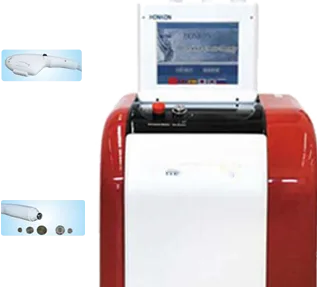
Pmise MF-04
One RF treatment handpiece(Cooling RW-VI with both Mono-polar and Bi-polar functions) and one E-light treatment handpiec…
View details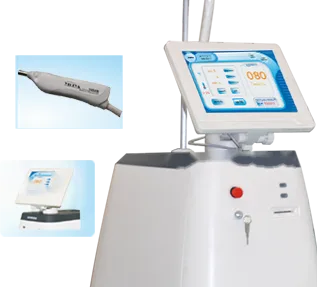
Pmise LN-01
Super compressor cooling system ensures long working time User-friendly operation interface.Direct energy output, less e…
View details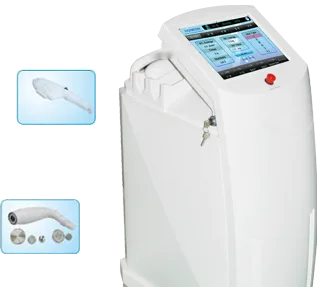
Pmise PE-01
Safe:Single pulse of HPT (Homogeneous Pulse Technology) delivers average energy and avoids the epidermis burns.Efficient…
View details