When laser hair removal fails, look at the protocol before you blame the machine. Five causes explain most disappointing courses: the wrong wavelength for the skin type, under-fluence, session spacing that fights the hair cycle, hormonal regrowth, and cooling too weak to let you treat properly. All five are fixable in the room. A sixth cause is not fixable at all, and you need to catch it at consultation.
Written for clinic owners, distributors and med-spa operators. Every section opens with the fix.
What actually makes laser hair removal fail?
Hair removal rests on selective photothermolysis, the principle Anderson and Parrish published in Science in 1983. Pick a wavelength the target absorbs better than its neighbours, deliver it in a pulse short enough to keep the heat where you put it, and the target cooks while surrounding skin survives. Melanin is the target here. Our technical archive is precise about the geometry: what you want to destroy is the follicle's isthmus and dermal papilla, yet the parts that soak up light are the matrix and shaft. Heat has to travel. Break that chain and the follicle lives.
Reason 1: Wrong wavelength for the skin in your chair
Fix: pick wavelength by Fitzpatrick type instead of running one setting all day. Shorter wavelengths and broadband light are absorbed hard by melanin. Fine on pale skin with dark hair. On tanned or dark skin the epidermis is stuffed with competing pigment and takes the hit. Our light-tissue interaction training material explains why longer is safer: scattering weakens as wavelength rises, so longer wavelengths travel deeper toward the follicle, and the 600 to 1200nm band is described as the optical window into skin. The same archive tells operators to reach for a longer filter on darker patients.
Which is why an 808nm diode laser for hair removal earns its keep. It sits inside that window. Our device manuals rate the 808nm diode platform for Fitzpatrick I to VI, with a 12mm by 12mm spot, 5 to 200ms pulse width and 1 to 10Hz. If your only platform is broadband and it keeps burning or under-clearing darker clients, that's a mismatch. Not bad luck.
| Skin type | Competing melanin in the epidermis | Sensible choice |
|---|---|---|
| Fitzpatrick I to III | Low | 808nm diode or shorter wavelengths; higher fluence tolerated |
| Fitzpatrick IV | Moderate | 808nm diode, strong contact cooling, moderate fluence |
| Fitzpatrick V to VI | High | 808nm diode at reduced fluence, or long-pulse Nd:YAG |
Two companion reads: Fitzpatrick skin types and laser settings, and the head-to-head on diode vs alexandrite vs Nd:YAG.
Reason 2: Under-fluence, and the under-treatment that follows
Fix: treat to a visible endpoint, not to a number that feels comfortable. Under-fluence is the quiet killer of results. Energy that warms a follicle without disabling it gives you a client whose hair keeps returning and an operator who swears the settings were fine. Our engineering archive puts it plainly: once epidermal safety is protected, higher fluence means better clearance. It also names the tell for energy set too low, which is no sting during the pass and no redness afterwards.
Our diode parameter sheet names the endpoint: small papules around each follicle, skin turning red and hot. No reaction means you were too gentle. The sequence that gets you there:
- Shave first. The parameter sheet is blunt about it: light spent burning surface hair never reaches the follicle.
- Start at the documented opening value for that skin type and site. Under arm on Fitzpatrick I to II begins around 10J in our documentation; type V begins around 5J.
- Fire a test patch. Wait. Read the skin, not the screen.
- Step the energy up until perifollicular papules appear with mild redness and warmth. Stop there.
- Write the parameters into the client file. The next session shouldn't start from zero.
Darker skin costs you sessions. Starting energy for type V is roughly half what type I or II tolerates on the same site, which is correct practice, and it means a longer course rather than one heroic pass. Say so at consultation.
Reason 3: Session spacing that fights the hair cycle
Fix: book to the biology, not the client's diary. A laser only disables a follicle that's actively growing. At any moment a large share are resting and effectively invisible to the light, which is why a course exists at all. The American Academy of Dermatology states most patients need 2 to 6 treatments, can be treated once every 4 to 6 weeks, and see a 10% to 25% reduction after the first session.
Timelines stretch further than most sales scripts admit. The permanent hair reduction definition used across FDA 510(k) clearance summaries measures stable reduction in regrowing hairs at 6, 9 and 12 months after a regimen ends, because a full follicle cycle runs roughly 4 to 12 months by site. Legs are not lips.
- Sell a course, not a session, and say so before money changes hands.
- Hold the AAD's 4 to 6 week interval, and stretch it on slower-cycling areas.
- Expect progressive thinning. Total clearance after one visit isn't a promise you can keep.
- Photograph regrowth between visits, to prove the plan works or catch that it doesn't.
A customer who runs two rushed sessions a fortnight apart and reports failure has a calendar problem.
Reason 4: Hormones keep switching follicles back on
Fix: spot hormonal regrowth early, then plan maintenance instead of promising permanence. Some clients, particularly those with conditions such as polycystic ovary syndrome, have follicles repeatedly pushed back into growth. You can disable individual follicles perfectly well and still watch new activity appear. From the client's chair that looks like failure.
Honest framing is your best tool here. The AAD notes most patients stay hair free for months or even years, that some hair regrows finer and lighter, and that maintenance treatments may be needed. Regulatory language matches: devices are cleared for permanent hair reduction, not permanent removal. Document baseline density on the chin and jawline, budget for top-ups, and keep the word permanent out of your marketing. Sudden coarse growth with no obvious cause needs a physician referral, not a bigger fluence.
Reason 5: Cooling that cannot keep up
Fix: repair the cooling and the fluence problem often solves itself. Cooling isn't a comfort feature. A worked example in our engineering archive shows how thin the margin gets: at a given fluence a melanin-rich follicle needs around 100ms of exposure to reach progressive thermal coagulation, while the epidermis is damaged at roughly 99ms. One millisecond of daylight between the result you want and the burn you don't. Our archive gives epidermal cooling three jobs: protect the epidermis, ease pain, and make high fluence into deep targets possible. Weak cooling forces operators to back off, and Reason 2 walks in the side door.
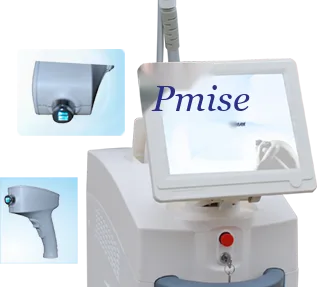
Pmise diode systems use a sapphire contact-cooling window in the handpiece. Our operation manual is specific: switch the chiller on first, give it 5 to 8 minutes to reach 18 degrees Celsius before treating anyone, and keep the handpiece moving at higher repetition rates. When a room both burns clients and under-clears hair, check cooling first.
- Power up the chiller before the first client, not while they're on the couch.
- Keep firm, even contact so the sapphire chills skin, not air.
- Move fast at high frequency, as the manual instructs.
- Service the cooling loop on schedule. A warm handpiece breeds timid operators.
The physics behind that 100ms figure sits in our explainer on thermal relaxation time and pulse duration, and the wider planning view in our hair removal solutions overview.
The failure no setting can fix: pale, gray or very fine hair
Fix: screen for this at consultation, before anyone pays for a course. Our light-tissue interaction material names melanin as a primary target chromophore, the thing that absorbs the pulse and turns it into heat. Blonde, white, gray, red and very fine vellus hair carry little of it.
No pigment in the hair means no chromophore to absorb the pulse. No wavelength, no fluence and no brand of machine changes that.
The AAD's account of how the technique evolved makes the dependence clear: originally only people with dark hair and light skin could be treated safely, and while careful technique has opened the door to darker skin, the reliance on pigment in the hair hasn't gone. Assess hair colour and calibre at the first appointment. A client with gray hair who hears the truth up front is a client you keep. Electrolysis needs no pigment, so for low-melanin hair it beats an argument at reception.
Frequently Asked Questions
How many sessions before laser hair removal actually works?
Plan a course. The American Academy of Dermatology states most patients need 2 to 6 laser treatments, with roughly a 10% to 25% reduction after the first. Only follicles in active growth respond, so several passes are needed to catch each one while it's treatable. Judge the outcome across the course, not one visit.
Is an 808nm diode suitable for dark skin?
Yes, with discipline. An 808nm diode sits inside the 600 to 1200nm optical window where light scatters less, and our device manuals rate the platform for Fitzpatrick I to VI. On deeply pigmented skin, run reduced fluence with strong contact cooling; for the darkest tones a long-pulse Nd:YAG pulls absorption further from the epidermis. Wavelength plus cooling drives safety, not the badge on the cabinet.
Why does hair grow back after laser treatment?
Three usual suspects. Under-fluence heats a follicle without disabling it. Hormones reactivate follicles faster than you clear them. Pale or gray hair may never respond, lacking the melanin the laser needs. Fix the first by treating to a visible perifollicular endpoint with proper cooling; the second needs a maintenance plan. The AAD frames results as long-term reduction, not permanent removal.
How far apart should laser hair removal sessions be?
The AAD notes most patients can be treated once every 4 to 6 weeks. Book tighter and you waste visits on resting follicles. Leave it too long and treatable follicles slip back into dormancy. The right interval shifts by body area, since a full follicle cycle can run 4 to 12 months by site. Track regrowth and adjust.
Most of what looks like device failure is a settings problem, a calendar problem or a cooling problem. The rest is a mismatch between the machine you bought and the skin you treat. Send us your wavelength choice, starting fluences and cooling routine and we'll say honestly whether the answer is training or hardware. Ask about the Pmise DL-04 and the wider diode range.
Pmise Technical Team. Pmise builds 808nm diode, Nd:YAG and light-based aesthetic systems in Beijing, supporting clinics and distributors in over 160 countries with device selection and operator training.