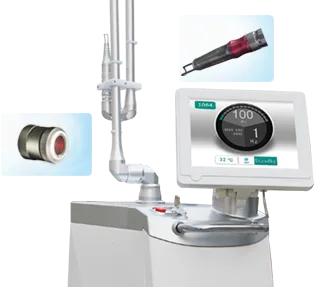
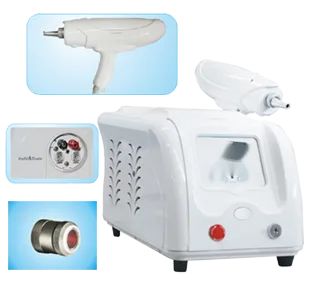
The standard nevus of ota treatment is a 1064nm Q-switched Nd:YAG laser, run as a course of sessions weeks to months apart. The pigment sits deep, inside dermal melanocytes, so you need a wavelength that reaches that depth and a pulse short enough to shatter it. Creams do nothing.
What is nevus of Ota, and why is it so stubborn?
Nevus of Ota is a benign blue-grey to brown patch, usually one-sided, following the ophthalmic and maxillary branches of the trigeminal nerve. Eye area, temple, cheek. It sits flat and never fades.
Depth is the whole story. This is a dermal melanocytosis: pigment living in melanocytes scattered through the dermis, not the epidermis. The atlas in our engineering archive says it "is caused by abnormally increased dermal melanocyte." That's why serums and peels disappoint. They never reach it.
Check the eye, rule out the look-alikes
- Ocular involvement means an ophthalmologist, not a laser. Pigment can reach the sclera, iris or retina, and DermNet is explicit that where the eye is affected, regular examinations should be arranged to detect glaucoma.
- Rare malignancy: refer, don't treat. DermNet notes melanoma very rarely develops within dermal melanocytosis. Anything nodular or changing gets referred, never lasered.
- Look-alikes. Hori nevus (ABNOM) is acquired, symmetrical, no scleral involvement: see our cheekbone pigment solution. Nevus of Ito is the same histology over the shoulder: see our nevus of Ito page.
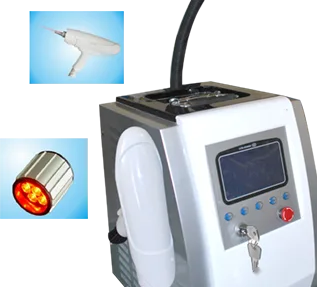
Why 1064nm Q-switched Nd:YAG?
Depth and speed. Longer wavelengths scatter less and travel further, so 1064nm reaches the mid-to-deep dermis where these melanocytes live. The frequency-doubled 532nm beam stops much closer to the surface, right for freckles and wrong for this.
The Q-switch handles speed, compressing output into nanosecond pulses that hit the pigment granule faster than heat can bleed into surrounding tissue. That's selective photothermolysis, the framework Anderson and Parrish set out in Science in 1983. Our manuals call it an "instantaneous blast" that fragments pigment, which phagocytes engulf and the lymphatics clear. The laser doesn't remove pigment. It breaks it into pieces the body carries away over weeks, so one heroic session never works.
Q-switched laser settings for nevus of Ota
Any table you read is a starting point, not a recipe. Settings get titrated to the lesion and above all to skin type. Kar and Gupta's series (Indian Journal of Dermatology, Venereology and Leprology, 2011), run on Fitzpatrick phototypes IV and V, is a useful anchor: 1064nm, 3mm spot, under 7ns, 2Hz, fluence from 2.5 J/cm2 escalated to a maximum of 8.5 J/cm2.
| Parameter | Typical approach | Why |
|---|---|---|
| Wavelength and pulse | 1064nm, nanosecond | Reaches deep dermal pigment and fragments it photoacoustically; 532nm stops far too superficially |
| Spot size | 3mm and up; our manuals say no smaller | A small spot raises fluence but loses more beam sideways to scattering, so effective depth drops. Our archive: larger spot, deeper and more even |
| Fluence | Start conservative, step up across the course | 2.5 to 8.5 J/cm2 at 3mm is roughly 180 to 600 mJ per pulse |
| Fitzpatrick skin type | Types IV to VI: bottom of the fluence range, slow escalation, long-end intervals, pigment reviewed before every session. Types I to III: faster escalation, treat nearer monthly | Epidermal melanin absorbs 1064nm on the way in, so at equal fluence darker skin takes more epidermal load and more PIH risk. Sharma and Patel's StatPearls reference recommends lower fluences in darker skin |
| Endpoint | Immediate greyish-white whitening | Stop short of pinpoint bleeding; in types IV to VI, at the first faint hint of it |
Fluence and pulse energy are one measurement seen from two sides, and mixing them up is how buyers get burned. Our clinical archive advises against treating nevus of Ota with single-pulse output below 200mj, citing weak effect, longer courses and higher scarring risk. That's a spec for the machine, not a floor for your first pass. A laser topping out near 200 mJ gives only about 1.6 J/cm2 across a 4mm spot.
Our electro-optic documentation is blunter: 1064nm, a spot of at least 3mm, energy from around 400 mJ, 60 to 90 day intervals, six to eight sessions. One caveat: that older text treats to pinpoint bleeding. Stop at whitening instead.
How to adjust the protocol for Fitzpatrick skin type
Skin tone moves your settings more than the lesion does, and it's the variable most parameter tables skip. Nevus of Ota is commonest in Asian populations, so your patient usually sits around phototype III to V, where post-inflammatory hyperpigmentation stops being a rarity. Grade the type at consultation and let it drive three things: where you start, how long you wait, how hard you read the endpoint.
- Types IV to VI, first pass. Open at the bottom of your fluence range, stop the test spot at the faintest greyish-white the skin gives you. Why: more epidermal melanin absorbs more of the beam before it reaches the dermal target, so the same fluence buys extra epidermal injury and less treatment. Sharma and Patel's StatPearls reference recommends lower fluences in darker skin for that reason, adding that cooling and bleaching agents reduce pigmentary complications. Our technical archive agrees: longer pulses, less delivered energy, active cooling.
- Types IV to VI, between sessions. Sit at the long end, nearer the 60 to 90 days in our device documentation than the monthly rhythm of the published series. Why: short intervals plus rising cumulative fluence is the known pattern behind pigmentary complications, and last time's PIH must settle first. Treat over it and you're grading a false baseline.
- Types IV to VI, follow-up. Photograph and review before every session, and postpone if the area is still darker than baseline. Daily broad-spectrum sunscreen is a condition of continuing, not a suggestion. Kar and Gupta's PIH cases, all phototype IV and V, cleared with sunscreens and bleaching agents in roughly two months. Patience and topicals, not more laser.
- Types I to III. Climb the fluence ladder faster and work nearer monthly spacing, because less competing pigment sits above your target. DermNet notes treatment is more effective in light-skinned people than in dark skin, so expect a shorter course. The endpoint never changes. Skin tone only changes how fast you reach it.
What a session actually looks like
- Confirm the diagnosis, screen for ocular involvement, grade Fitzpatrick type and set starting fluence and interval from it using the rules above, then photograph under fixed light.
- Cleanse, having confirmed the patient stopped active topicals.
- Protect the eyes. Our manuals specify 200 to 1080nm rated eyewear; near the orbital rim, corneal or metal shields, not goggles.
- Test a small area, raising fluence only until greyish-white frost appears. In types IV to VI, stop at the first hint and wait.
- One even pass, no stacked pulses, then cool and apply a bland ointment.
Mapping and workflow sit on our nevus of Ota solution page.
How many sessions, and how far apart?
Plan in years, not weeks. Kar and Gupta treated fifty patients monthly, averaging around five sessions over two years, and most reached partial clearing.
- Sessions sit one to three months apart, and skin type decides where in that window you land: types IV to VI toward 60 to 90 days, lighter skin nearer monthly. The gap isn't padding, it's the clearance window.
- Improvement is cumulative, and bilateral or long-standing lesions respond slowly.
- Recurrence is documented, and DermNet notes it can return darker.
Set expectations at the consultation, not at session four.
Aftercare and what tends to go wrong
Post-inflammatory hyperpigmentation is the complication you'll meet most, and it's usually transient. In the Kar and Gupta series, all phototypes IV and V, it hit a small minority and settled in about two months with sunscreens and bleaching agents, no scarring reported. Tighten every point below as the phototype rises.
- Expect whitening, mild swelling and sometimes pinpoint crusting for a few days. Keep it clean, leave crusts alone.
- Strict broad-spectrum sun protection between sessions, non-negotiable in types IV to VI. The biggest lever on PIH risk.
- No actives, no exfoliation, no heat until it heals.
- If pigment darkens in a darker phototype, push the next appointment back and treat the PIH first. Staying on schedule is how a good result becomes a two-year argument.
Contraindications in our manuals: pregnancy, active herpes or infection in the field, malignant lesions, recent local surgery. If PIH appears, our guide to treating PIH after laser covers it.
Which machine should a clinic buy for this?
Single-pulse energy at 1064nm, a short nanosecond pulse, a spot you can control. In that order. Pmise builds two lines for this work, the Q-switched Nd:YAG range and the EO Q-switched range.
- Pmise QE-01: electro-optic Q-switched, articulated arm, dual 1064nm and 532nm. Our manual rates it up to 800 mJ single-pulse at 1064nm, around 6ns, spot adjustable 1 to 7mm. That headroom holds fluence at 4 or 5mm instead of a pinhole.
- Pmise QN-10 and Pmise QN-09: dual-wavelength, water plus air cooling, adjustable spot, compact enough for a clinic adding a pigment line.
Get three things in writing: the certificate for your market and the model it names (see medical CE versus standard CE), applications training in your language on the skin types you see, and flashlamp price and lead time (see warranty and spare parts).
Next step: ask for the 1064nm spec sheet showing measured single-pulse energy at each spot size. Send us your caseload and we'll run the fluence maths.
Frequently Asked Questions
How many Q-switched sessions does nevus of Ota need?
Several, over one to two years. Kar and Gupta (2011) reported an average near five monthly sessions across a two-year study; our documentation suggests six to eight at 60 to 90 day intervals. Deeper or bilateral lesions need more, and darker phototypes run longer intervals.
How do settings change for darker skin?
Start lower, move slower. In Fitzpatrick IV to VI, open at the bottom of your fluence range, stop the test spot at the faintest whitening, and space sessions toward 60 to 90 days rather than monthly. StatPearls' laser skin-type reference recommends lower fluences in darker skin to limit epidermal thermal injury, with cooling and topical lightening agents against pigmentary trouble.
Can the laser clear nevus of Ota completely?
Some reach near-total clearing, many only partial improvement, and outcomes vary with lesion depth, skin type and course length. DermNet notes treatment is more effective in light-skinned people than in dark skin, and that recurrence can return darker. Promise improvement, not a cure.
Written by the Pmise Technical Team and reviewed by our Clinical Applications Lead, a laser applications trainer and Class 4 laser safety officer. Applications guidance for equipment buyers, drawn from our device manuals and published dermatology literature, not a substitute for a clinician's judgement.