
Pigment Treatment
Zygomatic Melanosis Treatment (ABNOM / Hori Nevus) with a 1064 Q-Switched Nd:YAG Laser
Zygomatic melanosis, listed in older catalogues as Zygomatices or nevus fusco-caeruleus zygomaticus (NFZ), is what dermatologists now call acquired bilateral nevus of Ota-like macules (ABNOM) or Hori nevus. Zygomatic melanosis treatment means a 1064 Q-switched Nd:YAG laser run across several sessions. The pigment sits in the dermis. Creams do nothing here.
Educational material for clinics, dermatologists and distributors evaluating equipment. Not medical advice, and no substitute for clinical assessment.
What zygomatic melanosis actually is
Hori and colleagues described it in 1984. Same condition under every name: dermal melanocytes where they shouldn't be, showing through as a bruise-like haze on the cheekbones.
The skin disease atlas in our engineering archive gives the picture plainly. Macules run roughly 1 to 5mm across, round, oval or irregular, but well demarcated. Colour runs black-grey, black-brown or grey-brown. Patients carry several to several dozen, ten to twenty being typical. They sit flat, cause no symptoms, and spread symmetrically over the zygomatic areas, sometimes onto eyelids and nose.
Who gets it? Overwhelmingly women. Our archive puts the male-to-female ratio between 1:13 and 1:18, onset between 16 and 40, familial in some cases. It records no link with season or sunshine, and DermNet explains why: UV barely reaches deep dermal melanocytes. Tell patients that early, because most arrive assuming they caused it.
Telling it apart from the conditions it mimics
- Nevus of Ota. Usually one-sided, follows trigeminal branches, often involves the sclera. Scleral pigment means nevus of Ota, and needs ophthalmology review first.
- Melasma. Blotchy ill-defined patches, not discrete speckled macules. The two coexist often, and lower energy is safer where they overlap so the melasma is not aggravated.
- Solar lentigines and post-inflammatory pigment. Both sit shallower, so parameters differ.
Dermoscopy and Wood's lamp help. If a lesion is asymmetric, changing, nodular or ulcerating, stop and refer for biopsy. Lasering an undiagnosed pigmented lesion has no recovery path.
Why a laser is the only thing that reaches it
The histopathology explains everything. Our engineering archive describes melanocytes that never finished migrating from the neural crest to the epidermis in embryonic life, and stayed in the dermis. That pigment sits out of reach of peels, hydroquinone and every topical brightener sold.
Light gets down there. Anderson and Parrish set out the principle in Science in 1983 as selective photothermolysis: pick a wavelength the target absorbs strongly, then deliver it in a pulse shorter than the target's thermal relaxation time. Longer wavelengths scatter less, so 1064nm reaches dermal depth while 532nm stops in the epidermis.
Q-switching supplies the rest. Nanosecond pulses concentrate huge peak power into an instant, shattering melanin granules before heat bleeds into collagen. Macrophages clear the debris over weeks. Hence sessions months apart, not days.
Treatment protocol and what to expect
Test patch first, every time. Treat a small area, let it heal, then decide. The table gives the starting framework in our device manuals. Final parameters belong to the clinician.
| Parameter | Starting point in our device manuals | Why |
|---|---|---|
| Wavelength | 1064nm | Reaches dermal depth; 532nm does not |
| Pulse width | 6 to 8ns on our platforms | Confines the effect to the granule |
| Spot size | Larger than 2mm for dermal pigment | At equal fluence, a bigger spot goes deeper |
| Repetition rate | 1 to 5Hz passive, up to 10Hz electro-optic | Slower rates place pulses better |
| Energy | Start low, 3 to 5 shots, read response, titrate | Chasing a number damages skin |
| Endpoint | Pigment visibly lightening | Our manuals call this energy density enough |
| Avoid | Immediate blood oozing | Our manuals warn it drives hyperpigmentation |
| Sessions | Several, months apart | Clearance is slow and cumulative |
Set expectations honestly. This is gradual clearance across a course, not one dramatic result, and outcomes vary with lesion depth, size, age and skin type. A retrospective series of 110 ABNOM patients in Skin Research and Technology (2023) reported better response with repeated sessions, younger age at first treatment, smaller lesions and lighter skin type. DermNet agrees that multiple treatments are often needed and recurrence is common.
What does the patient feel? A snapping sting on each pass, redness and mild swelling for a day or two, sometimes fine crusting that lifts within a week. Many lesions darken briefly before fading.
The PIH problem, and darker skin
Post-inflammatory hyperpigmentation is the complication that defines this indication. Common, stubborn, hard to prevent. The 2023 series found PIH clustered in older patients, darker lesions and darker skin. That shapes how you run the machine on Fitzpatrick IV to VI:
- Conservative fluence, longer course. More sessions at lower energy beats a year of PIH
- Lengthen the interval between sessions, never compress it
- Strict photoprotection before, during and after the course
- Where melasma coexists, drop energy further and treat it separately
- Photograph under fixed lighting every visit. Gradual change is invisible from memory
Contraindications from our manuals apply: pacemakers or implanted defibrillators, active herpes or broken skin over the field, suspected malignancy, keloid tendency, pregnancy, and uncontrolled diabetes, hypertension, cardiac disease or epilepsy. Operators and assistants need eyewear rated for 1064nm at the correct optical density, per ANSI Z136.1. Goggles for one wavelength are not goggles for another, and the patient needs shielding too.
Recommended Pmise equipment
Dermal targets demand more of a machine than superficial work. Three things decide it.
- Real single-pulse energy at 1064nm. Our archive is blunt about underpowered systems on dermal lesions: too little energy means poor results and longer courses, not less risk
- A short, stable nanosecond pulse. Our platforms run 6 to 8ns. Shorter pulses mean higher peak power, less thermal spread
- Flat-top beam and an accurate spot adjustor. Fluence is energy divided by spot area, so spot accuracy is fluence accuracy
Our Q-switched Nd:YAG laser range covers this at several build levels. The QN-05 gives around 400mJ single-pulse output at 1064nm with a 1 to 6mm adjustable spot. Higher-output builds such as the QN-07 and QN-12 push headroom toward 800mJ. The QE-01 uses an electro-optic Q-switch, and its panel energy is stepped from 40 to 560mJ in 40mJ increments, with a repetition rate adjustable to 10Hz. Those fine low-end steps are what let you hold a conservative fluence on darker skin. For parameter choices across pigment types, read our guide to treating pigmented lesions with Q-switched lasers.
Certification, warranty and support terms
Clinical fit is half the decision. The rest is paperwork, running cost, and who answers when the lamp fades. The table below is our stated position on each, and the numbers, dates and scope arrive with the documentation pack.
| Item | Position |
|---|---|
| Certification | EN ISO 13485 medical device quality system plus ISO 9001; CE declarations of conformity for the Nd:YAG line, backed by separate EMC and Low Voltage Directive test certificates. Numbers, dates and scope on request |
| Market registration | Device class and route differ by country, and we make no US clearance claim here. Ask for a model's current status in your market |
| Warranty | One year against defects in materials or workmanship under normal use. Wear parts such as handpiece, cable and footswitch, plus misuse or unauthorised disassembly, sit outside it |
| Consumables | The xenon flashlamp is the main wear item. Our manuals put its life near 1000 hours and advise replacement once output drops. A panel shot counter tracks usage |
| Training and support | Handpiece, arm and footswitch installation is documented in the manual, which also carries a troubleshooting guide for first-line checks. Spare parts and technical help come through our service department. Operator training and response terms on request |
| Distributor terms | Lead time, minimum order quantity and territory quoted per order |
Aftercare and precautions
- Soothing gel straight after the pass, and keep the field moist. Thick dry crusting is the enemy
- Let any crust separate by itself. Picking is the shortest route to a scar
- Once the surface heals, a barrier repair essence for a week helps
- Broad spectrum sun protection daily, whole course and beyond. UV on healing skin drives hyperpigmentation hard
- Adjust energy each visit on the previous response, not the plan you wrote in month one
Frequently Asked Questions
How many sessions does zygomatic melanosis need?
Several, and nobody can promise a number at consultation. Published series describe courses from a handful of sessions into high single digits, with response improving as sessions accumulate. Depth, lesion size, age and skin type shift the total. Spacing sits in months because fragmented pigment clears slowly.
Can a 532nm handpiece treat it?
No. The pigment sits in the dermis and 532nm is absorbed in the epidermis, so it never arrives. You buy epidermal injury with no benefit underneath, and that injury triggers PIH. Use 1064nm here, and keep 532nm for superficial pigment.
Will the pigment come back?
Sometimes. DermNet notes that recurrence after apparent clearance is common in dermal melanocytosis, occasionally darker than before. Long-term review belongs in the plan, not a discharge at the end of the course. Sun protection and melasma management reduce the odds.
Is this safe on Fitzpatrick IV to VI skin?
It can be, with conservative parameters and a patient who understands the trade-off. Darker skin carries higher PIH risk, and published data show weaker response in type IV than type III. Lower fluence, longer intervals, a test patch, strict photoprotection.
Your next step
- Comparing platforms. Ask for the 1064nm spec sheet and ABNOM protocol, then check single-pulse energy and spot range against the table above
- Ready to buy. Request CE and ISO 13485 documentation for your market, plus warranty and training terms in writing
- Distributor. Send territory and volume, and ask for lead time, MOQ and parts terms
Send your enquiry with the model and market and our team replies with documentation, not a brochure.
Recommended Equipment
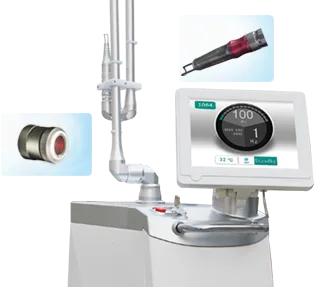
Pmise QE-01
Dual wavelengths (1064nm & 532nm) are convenient to adjust by touching LCD. Multi-spot size (1-7mm) is ideal for a wide…
View details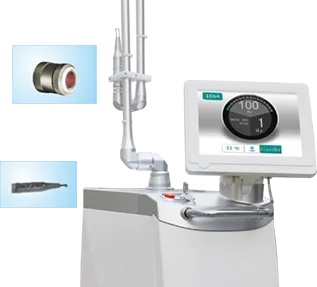
Pmise QE-02
Dual wavelengths (1064nm & 532nm) are convenient to adjust by touching LCD. Multi-spot size (1-7mm) is ideal for a wide…
View details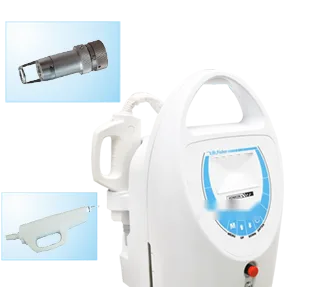
Pmise QN-05
Patented technology of single lamp and dual rods doubles energy output (400mj). Shorter pulse width (6-8ns) than ordina…
View details