
Laser wavelengths and chromophores decide everything an aesthetic laser can and can't treat. Wavelength is simply the colour of the light, measured in nanometres. A chromophore is whatever in the skin drinks that light up. Three of them matter clinically: melanin, haemoglobin, and water. Pair them badly and an expensive machine either does nothing visible or burns someone.
Which is why 1064nm, 755nm and 532nm aren't interchangeable settings on a dial. Each sits at a different point on every absorption curve, and each stops at a different depth. This guide walks through melanin absorption, haemoglobin absorption and water absorption, then what that means when you're reading a supplier's spec sheet.
What does a chromophore actually do?
It absorbs. That's the whole job. A photon meets a chromophore, hands over its energy, stops existing, and the target heats up. Light that misses gets scattered sideways or passes straight through. Our technical archive puts it bluntly: without absorption of light energy, there is no effect on tissue.
Three targets in skin get most of the attention: water, haemoglobin, melanin. Pick a wavelength your target absorbs strongly while the tissue around it absorbs weakly, keep the pulse short enough that heat can't wander, and you damage the target while sparing its neighbours. R. Rox Anderson and John Parrish set that rule out in Science in 1983, and the industry has built machines around it ever since. More on the mechanism in our piece on selective photothermolysis.
Absorption decides which target gets hot. Pulse duration decides whether the heat stays put. Both have to be right.
Melanin, haemoglobin and water absorb light in completely different ways
Each chromophore has its own signature across the spectrum, which is why one wavelength can't do every job. From our light-tissue interaction training material:
- Melanin absorption runs high at short wavelengths and tails off as wavelength grows. Below roughly 800nm, any wavelength will preferentially heat melanin, and it scatters heavily in the epidermis. That's why our archive recommends going above 800nm for pigment sitting down in the dermis: the light needs to arrive, not get eaten on the way.
- Haemoglobin absorbs in peaks rather than a smooth slope. Our archive lists them at 418nm, 542nm and 577nm. Green and yellow light therefore hits vessels hard. A second effect matters: heat oxidises haemoglobin into methaemoglobin, which soaks up 1064nm roughly 13 times more than deoxygenated haemoglobin, per the same material. Treatment changes its own target as it goes.
- Water absorption is almost nothing across the visible band, then climbs steeply into the infrared, with peaks noted near 980nm, 1480nm and a very large one at 2940nm. Since water is everywhere in skin, wavelengths it loves are spent at the surface. Useful for ablative resurfacing. Useless for chasing pigment two millimetres down.
Between about 600 and 1200nm there's a gap where scattering is low and pigments absorb comparatively little. Our archive calls it the optical window into skin, and it's why follicles and deeper vessels are reachable at all. Anderson and Parrish mapped this behaviour back in 1981 in "The Optics of Human Skin".
So why do 1064, 755 and 532nm treat different things?
Short version: different absorption, different depth. Longer wavelengths push further and scatter less; shorter ones stay shallow and get grabbed by surface pigment and blood. Our archive keeps a colour-preference chart listing which wavelength clinicians reach for against each target colour, and it matches what clinics see daily.
| Wavelength | Relative depth | Clinical colour preference | Typical clinical use |
|---|---|---|---|
| 532nm (green) | Shallow | Preferred for red, orange and brown targets and for pigment lying close to the surface. Black targets do absorb green light strongly, but 532nm is stopped so near the surface that deeper black pigment never receives much of it. Sits near a haemoglobin peak. | Superficial pigmented spots, fine facial vessels, warm-coloured lesions |
| 755nm (near-infrared) | Medium | Well absorbed by melanin with more reach than 532nm. Our archive also credits it with some effect on superficial red and green chromophores. | Pigment and hair where 532nm is too shallow; certain ink colours |
| 1064nm (near-infrared) | Deep | The usual pick for black and blue-black targets, mainly because it reaches them. Less absorbed by red and green chromophores, and low melanin absorption spares the epidermis on the way down. | Deep or dark pigment, deeper vessels, coarse hair, darker skin types |
Be precise about this, because sales material garbles it. The 532nm-versus-1064nm split is a depth rule, not an absorption ranking. Carbon-based black ink and eumelanin are broad absorbers; they take up green light very readily. Green light simply doesn't survive the trip down. So 1064nm wins on deep black and blue-black targets by arriving, not by being better absorbed, while 532nm earns its place on shallow red, orange and brown work where its energy lands exactly where the target is.
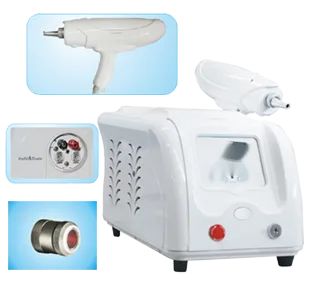
The two cover opposite ends of the colour range. Our archive notes that running them together works well on coffee and tan-brown targets, because neither handles that middle ground alone. That's the practical argument for a dual-wavelength platform such as our Q-switched Nd:YAG laser, where 532nm comes from frequency-doubling the native 1064nm beam. One resonator, two clinical jobs.
How deep does each wavelength reach?
Penetration depth has a formal definition: the distance light travels before it falls to about 37% of the intensity that entered. The trend holds across the spectrum. Longer wavelength, deeper reach, less scattering.
- 532nm stays near the surface. Good for a freckle or a thread vein in the upper dermis. Don't ask it to reach deeper; it won't get there in useful strength.
- 755nm lands in between. Deeper than green light, still strongly absorbed by melanin. That combination earned it a place in pigment and hair work.
- 1064nm goes deepest of the three. It can reach follicle bulbs, deeper vessels and dermal pigment. Because melanin grabs less of it, the epidermis takes less of a beating. That's why it's favoured on darker skin.
For contrast, our archive notes that 300 to 400nm light scatters so hard it barely penetrates a tenth of a millimetre. Colour isn't a cosmetic detail on a laser. It's the depth control.
Where hair removal fits into all this
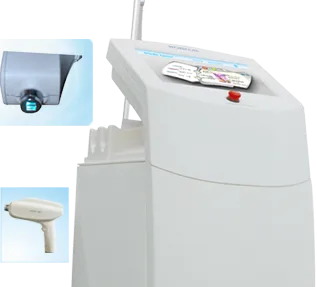
Follicles are a depth problem and a pigment problem at once. The target is melanin in the shaft and bulb, and the bulb sits well below the epidermis. That's why 808nm diode systems became the workhorse: they sit inside the optical window, so the light travels, and melanin still absorbs them well. Our device documentation describes 808nm as penetrating deep and being absorbed by the target chromophore, with pulse duration set to match. Our diode laser for hair removal is built on that logic.
Epidermal cooling isn't optional here. The archive gives a telling example: at a given fluence, a pigmented follicle coagulates over a pulse near 100 milliseconds, and the epidermis reaches damage in a comparable time. The margin between treating and burning is thin. Cooling widens it. Weighing platforms against each other? Our comparison of diode vs alexandrite vs Nd:YAG hair removal goes wavelength by wavelength.
What this should change about how you buy
Wavelength isn't a feature you can trade away for a better price. It's set by the laser medium itself and fixes what the machine can treat. A few things worth checking before money moves:
- Match wavelength to the target, not to the brochure. Superficial red asks for green or yellow light near a haemoglobin peak. Deep or black targets ask for 1064nm. A device pitched at deep vessels with only 532nm available is mismatched.
- Test that dual-wavelength claims are real. A genuine Nd:YAG platform gives you 1064nm natively and 532nm through a doubling crystal. Both should run independently, with their own handpieces and parameters.
- Ask how the vendor handles skin type. Longer wavelengths reduce epidermal melanin absorption. If the answer is one setting for every patient, walk.
- Treat beam-quality claims as unverified until you see them in the manual. Energy profile, optics, component sourcing. Ask for documentation, not adjectives.
Wavelength sets what a machine can target. Pulse duration, spot size and cooling decide whether it does the job safely.
Then there's the commercial side, which decides what the machine costs over five years, not on day one. Ask the manufacturer for the compliance file and the safety standards the platform was built and tested against, such as IEC 60601-2-22, the IEC standard covering surgical, cosmetic, therapeutic and diagnostic laser equipment. Get warranty terms in writing. Confirm spare-parts and consumable supply, handpiece service, engineer training for your operators, and whether OEM or ODM support is on the table if you distribute under your own label.
Practical next step: send Pmise the lesion types you treat most and the skin-type mix of your patients, and our engineers will come back with a wavelength and configuration recommendation rather than a generic quote. You can also request the technical manual for the platforms named here, including the Q-switched Nd:YAG and the diode hair-removal system, through the contact form on this site.
Frequently Asked Questions
Why can one Nd:YAG machine produce both 1064nm and 532nm?
The crystal emits 1064nm natively. Send that beam through a frequency-doubling crystal, usually KTP, and you halve the wavelength to 532nm. You get one deep-reaching infrared beam for dark and dermal targets, plus a shallow green beam for surface red and brown lesions. Those two sit at opposite ends of the colour-preference chart, so the pairing covers far more lesion types than either could alone.
Which wavelength is best for blood vessels?
Depends how deep the vessel sits. Haemoglobin peaks around 542nm and 577nm, so green and yellow light is efficient on fine surface telangiectasia. Larger or deeper vessels are usually better served by 1064nm, which travels further and gets absorbed more readily once heating converts haemoglobin to methaemoglobin. Vessel depth and calibre make the call.
Is a longer wavelength always deeper and safer?
Deeper, yes. Safer, not automatically. Longer wavelengths scatter less and are absorbed less by epidermal melanin, which is genuinely helpful on Fitzpatrick IV to VI skin. But energy delivered deep still needs the right pulse duration, fluence, spot size and cooling. Wrong parameters at 1064nm will still injure tissue.
Where does water absorption come into aesthetic lasers?
Water is the target for ablative and fractional resurfacing rather than for pigment or vessels. Wavelengths water absorbs hard, including the 2940nm region and the far-infrared CO2 band, deposit energy right at the surface and vaporise tissue in a controlled layer. Pigment and vascular lasers deliberately sit where water absorption is low, so their energy survives the trip to melanin or haemoglobin.
Written by the Pmise Technical Team. Pmise designs and manufactures laser and light-based aesthetic systems for clinics and distributors worldwide; our engineers work with these wavelength and chromophore principles daily.