Eight laser safety essentials keep a clinic out of trouble: wavelength-matched eyewear, a controlled treatment area, patch testing, screening with signed consent, plume control, scheduled maintenance, operator training, and emergency controls that work. Sort all eight before your first paying client walks in. When something goes wrong, many incidents involve a skipped basic control rather than a broken machine.
Your kit probably spans wildly different physics. An 808nm diode for hair removal behaves nothing like a Class 4 CO2 platform at 10600nm, so one poster on the wall won't cover both. This turns the ANSI Z136 framework, which OSHA calls voluntary consensus standards, into clinic-floor practice.
What are the 8 laser safety essentials every clinic needs?
Every safe laser program rests on the same eight controls. Pin this up, re-audit quarterly. A blank row means stop treating.
| # | Essential | What it protects against |
|---|---|---|
| 1 | Wavelength-matched eyewear | Retinal or corneal injury |
| 2 | Laser-controlled area | Exposure of staff and bystanders |
| 3 | Pre-treatment patch test | Burns, blistering, pigment change |
| 4 | Screening and written consent | Adverse reactions, disputes |
| 5 | Plume and smoke management | Inhaled vapour and particles |
| 6 | Maintenance and pre-session checks | Misfires, overheating, uneven output |
| 7 | Operator training and credentialing | Wrong parameters, poor technique |
| 8 | Emergency controls and records | Slow response, no audit trail |
Why does wavelength-specific eyewear come first?
Eyewear tops the list because it fails silently. Nobody notices the wrong glasses until an eye is hurt. Protection works only if the optical density covers the exact wavelength you're firing, and OSHA's laser hazards page names ANSI Z136.7 as the standard covering testing and labelling of protective eyewear. Any pair worth using carries its optical density and wavelength range on the frame. No marking, no use.
Mixed fleets are where this bites:
| Platform | Working wavelength | What it means for eyewear |
|---|---|---|
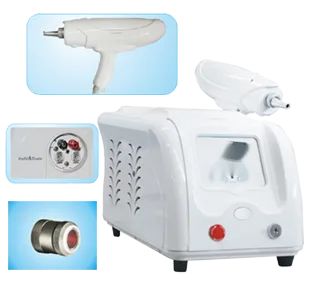
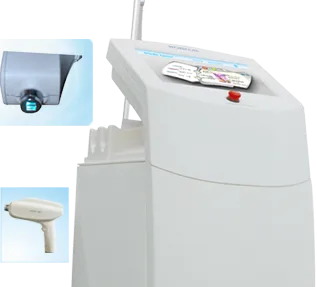
| Diode hair removal (Pmise DL-04) | 808nm, near-infrared | Near-IR rated OD; the beam is invisible |
| Q-switched Nd:YAG (Pmise QN-09) | 1064nm plus 532nm | Must protect at both, not just one |
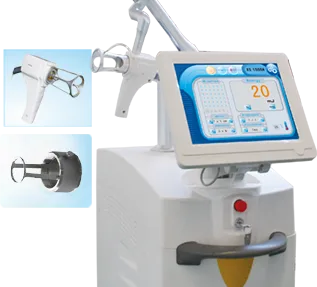
| Fractional CO2 (Pmise CF-01) | 10600nm, far-infrared, Class 4 | Different eyewear again; separate aiming beam |
See the problem? Two of the three emit light nobody in the room can see, so risk can't be judged by looking. Keep a labelled pair beside each machine and never let a "universal" pair drift between rooms. Our manuals are blunt: goggles and eye-patches on, then parameters.
How do you set up a laser-controlled area?
A laser-controlled area is a room where the door, the mirrors and the beam path are under someone's control. The ANSI Z136 series and the OSHA laser hazards eTool treat this as a floor, not an aspiration:
- A door that latches, windows out of the beam line, nothing polished enough to bounce light.
- A sign at every entrance whenever the device has power, door shut while firing.
- Spare eyewear on a hook for anyone who must enter.
- Pull the key when the machine is idle. Our CO2 documentation says the same: remove the key switch and kill the emergency stop when the device sits unused.
- A nominal hazard zone, where direct or reflected light could exceed safe limits, with bystanders kept outside.
Power level sets how strict you must be. The Pmise CF-01 carries a Class 4 laser product label and warns of invisible radiation at the handpiece aperture, with only a low-power aiming beam showing where you point. Treat the room as hazardous once armed. Where that boundary sits legally is your national regulator's call.
What has to happen before you fire a single shot?
Burns and pigment problems are cheaper to prevent at the consultation desk than to fix at the handpiece. Our device manuals build the order in: consult, observe, open a photo record, clean the skin, fit eye protection, set parameters, test on the operator's own arm first.
- Screen properly. Pregnancy, photosensitising medication, recent tanning, infection, keloid or pigment history. Write it down.
- Record the skin type. Log the Fitzpatrick type and the lesion, then start conservative. That's selective photothermolysis in practice, the principle Anderson and Parrish set out in 1983. Our guide to skin types and laser settings goes deeper.
- Patch test with a defined observation window. One or two shots at reduced energy on a discreet area; the inner forearm works well. Our diode manual has you leave it several seconds and read the immediate reaction. Re-check before treating a full zone: our light-based system documentation notes that on reactive or darker skin, redness or stinging can surface 24 to 48 hours later, and treats one to three clear days with no unusual reaction as the green light. Follow the interval in your own device manual, and log the reading.
- Get consent in writing. Realistic outcomes, a course of sessions as the norm, the side effects. Keep the before photos.
A test spot is only worth firing if you can read it:
| What the test spot shows | Reading | Do this |
|---|---|---|
| Faint pinkness settling in minutes; expected warmth or pins-and-needles | Normal endpoint | Proceed, opening at low energy |
| Lingering redness, stinging, puffiness, or a flare at the 24 to 48 hour re-check | Over-treated or reactive skin | Reduce fluence, lengthen the interval, retest |
| Blistering, greying or whitening, weals, spreading itch | Thermal injury or photosensitivity | Do not treat. Our diode manual rules the client out |
| Almost no visible reaction | Under-dosed or a slow responder | Don't jump the energy. Our documentation warns against randomly increasing it for an unconspicuous reaction. Step up gradually, retest |
Is laser plume actually a hazard to your staff?
Yes, and plume control is often the least consistently applied of the eight. Ablative resurfacing and hair removal both vaporise tissue, and the plume carries fine particulate and vapour nobody should breathe all day. OSHA's surgical smoke plume guidance recommends portable local smoke evacuators or room suction with in-line filters, running whenever airborne particles are produced, with the nozzle held within about two inches of the site and filters replaced on the manufacturer's schedule.
- Ventilate well. Our CO2 documentation calls for good ventilation and clean, low-dust air, for the operator and because dust degrades the optics.
- Keep extraction close to the site, diary the filter changes, and angle facial work so the plume rises away from the airway.
- Put the operator in a respirator and gloves. Our diode manual specifies a respirator, not a thin surgical mask.
What safety documentation should you demand from a supplier?
Safety starts before the crate is opened. For an importer or distributor, the paperwork you accept decides what you can legally sell and what your insurer honours. Get it in writing before you pay a deposit.
| Ask your supplier for | Why a buyer needs it |
|---|---|
| Declaration of Conformity naming current EU law, plus the notified body certificate number | Medical device CE marking now runs under Regulation (EU) 2017/745, which repealed Directive 93/42/EEC and applies since 26 May 2021. A declaration naming only the old directive tells you the file is dated. The certificate number shows who assessed the device |
| EMC and low-voltage reports, listed separately | Electrical safety and interference, not medical device conformity. Watch for one being passed off as the other |
| Laser class statement and matching label | IEC 60825-1:2014 covers 180nm to 1mm and sets the class system plus labelling duties. The Class 4 wording and aperture warning come from it |
| FDA status, if the US is a target market | US imports must meet 21 CFR 1040.10, and radiation-emitting products are declared on FDA Form 2877. Clearance for a medical indication is separate. Ask what the supplier holds; never infer it |
| ISO 13485 certificate, eyewear data, local-language manual | Read scope and expiry, not the logo. Filters need optical density and wavelength markings plus test data |
Three questions no supplier answers for you: who must be appointed laser safety officer, whether your room legally counts as a controlled area, and who may hold the handpiece. National and regional regulation fixes those, and they differ sharply. ANSI Z136.3, the health-care volume of the US consensus standards, is the usual reference for appointing a laser safety officer where Class 3B and Class 4 devices are used. A clinic in Spain, Brazil or the UAE answers to its own regulator. Check locally, and see our comparison of FDA 510(k) and CE routes.
What keeps a laser program safe after the first month?
Maintenance and pre-session checks
Ninety seconds before each session: cooling running, handpiece and connectors intact, aiming beam where it belongs. Diode handpieces run a cooled sapphire tip, and our manual is specific. If it hasn't gone cold within seconds of power-up, the water flow is at fault and you don't treat. Log every check. Our service and training team covers the routine at commissioning.
Training, emergency controls and records
Only credentialed operators touch the device, and training covers light-tissue interaction, parameter selection by skin type, the emergency stop and this checklist. Retrain when you add a platform: being excellent on IPL qualifies nobody on a Class 4 CO2 laser. Can your newest therapist stop the beam in one second? Rehearse a shutdown until it's muscle memory, then keep records: maintenance, training, consent, adverse events. To compare platforms with these controls built in, browse the Pmise range or our guide on choosing a fractional CO2 laser.
Frequently Asked Questions
Do we need a controlled area for one small treatment room?
Yes. Room size doesn't change the physics, and a reflected beam injures an eye as easily in ten square metres as in fifty. The minimum: a door that closes, a warning sign while the device is powered, controlled entry with spare eyewear, a key you pull when the machine sits idle. Your national regulator sets what's legally required on top.
Why patch test a returning client who tolerated treatment before?
Skin isn't static. Sun exposure, new medication and hormonal change shift how skin responds, so last year's settings can be too aggressive now. Fire a low-energy test shot at your intended parameters, read it after several seconds, then follow the delayed interval in your device manual. Ours notes reactive or darker skin can flare 24 to 48 hours later, and treats one to three clear days as the go-ahead. Faint pinkness that fades is fine. Lingering redness or swelling, drop the fluence. Blistering or whitening, stop.
Who is responsible for laser safety in a small clinic?
Someone owns it by name, even in a two-room practice. Appoint a laser safety officer with authority over eyewear stock, controlled area rules, maintenance logs and training records. Shared responsibility becomes nobody's fast. Confirm the appointment rules with your regulator, put the role in writing, review quarterly.
Written by the Pmise Technical Team, who build laser and light-based aesthetic equipment and support clinics worldwide with installation, operator training and after-sales service. General guidance only, not a replacement for your device manual or local regulations.