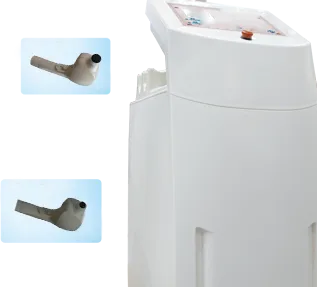
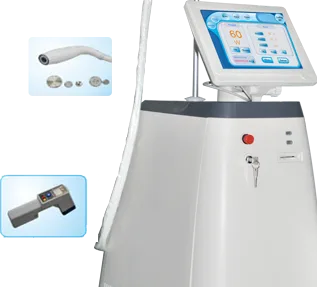
Buying rf beauty equipment for a med-spa comes down to three calls: which RF type matches the treatments you actually sell, whether you want a dedicated unit or a combined RF-plus-light platform, and how well the handpieces protect the epidermis while they heat the dermis underneath. Get those three right and the rest is negotiation.
How does RF beauty equipment actually tighten skin?
Heat does the work, not the electricity itself. Current passes through tissue, the tissue resists it, and that resistance turns current into warmth inside the dermis while the surface stays cooler. Warm collagen contracts on the spot. Over the following weeks a healing response lays down fresh collagen, and that slower second phase is what clients are really paying for when they book rf skin tightening. El-Domyati and colleagues, writing in the Journal of the American Academy of Dermatology in 2011, put it at the molecular level: heat disturbs the collagen molecule's triple-helix structure and breaks intramolecular hydrogen bonds, producing immediate fibril contraction followed by remodeling.
So how hot is hot enough? Lower than most buyers assume, and it matters which temperature you mean. Zhang and colleagues, in a 2026 review in Health Science Reports, describe collagen beginning to denature when the dermis reaches roughly 40 to 48°C, and coagulating in a far higher 55 to 70°C band; for remodeling they favour about 43°C in the dermis, held three to five minutes. That is a tissue temperature, not a reading taken on the skin. Our facial protocols govern the other measurement, the epidermal surface: 40 to 41°C, held one to two minutes and three to five on thicker skin, monitored throughout, capped at 44°C during the session and below 45°C at the end point. Burns come from uncontrolled surface heat, a handpiece parked in one spot or a temperature nobody is checking, not from the dermis reaching the 43°C the literature recommends. Temperature feedback and cooling therefore outrank a big wattage figure.
One variable buyers rarely raise: tissue impedance. Our RF training documentation tabulates fat as roughly an order of magnitude more resistive than skin or muscle, and more resistance means more heat for the same current. That is why one setting behaves so differently on an abdomen and a jawline.
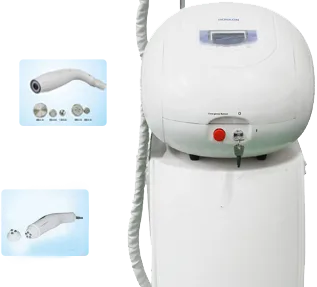
Monopolar, bipolar or multipolar RF: which type does your menu need?
Applicator design decides depth, and depth should follow your treatment list rather than the reverse. Monopolar goes deepest and suits global laxity. Bipolar stays shallow, handling fine lines and texture. Multipolar spreads gentler overlapping heat, which sells well as a comfortable course.
| RF type | How the energy moves | Reported depth | Best fit |
|---|---|---|---|
| Monopolar RF | Current runs from an active electrode to a distant return; heat comes largely from water-molecule rotation and friction | Up to about 20 mm (Zhang et al., 2026) | Deep laxity, jawline, body tightening |
| Bipolar RF | Current stays confined between two electrodes on the skin | Roughly 1 to 4 mm (Zhang et al., 2026) | Fine wrinkles, texture, delicate periorbital work |
| Multipolar RF | Three or more electrodes alternate polarity, overlapping thermal zones | Roughly 0.5 to 3 mm (Zhang et al., 2026) | Comfort-led rejuvenation sold as a course |
| Fractional (microneedle) RF | Needle electrodes place heat in columns below the surface | Operator-set dermal depth | Acne scars, pores, stretch marks, deeper remodeling |
Most med-spas do best with a platform carrying both monopolar and bipolar handpieces. One operator, one room, and the freedom to move from deep body tightening to careful work around the eyes without wheeling in a second machine. For a facial rejuvenation menu, that pairing covers nearly everything you'll be asked for.
Where does fractional RF fit, and when should you hold off?
Fractional RF marries microneedling to thermal remodeling, dropping energy into columns in the dermis while sparing much of the surface. Zhang and colleagues note that needle design changes the picture: insulated needles release energy only at the tip, uninsulated ones along the whole shaft. That detail decides which layer you are really treating, so ask about it.
Add fractional rf once your menu outgrows mild laxity and starts fielding requests for acne scarring, enlarged pores and stretch marks. It is rarely the right first purchase. Start with a versatile monopolar and bipolar unit, prove the demand, then bring fractional RF in as a second platform. Train hard on it. The US FDA has issued a safety communication warning that serious complications, including burns, scarring, fat loss, disfigurement and nerve damage, have been reported with certain uses of RF microneedling devices.
What should you inspect in the handpieces and cooling?
Judge the platform by its handpieces. That is where treatment quality lives. An example from our engineering archive: one RF handle ships with monopolar heads at 10 mm for the eye area, 25 mm for the face and 50 mm for the body, plus bipolar heads at 25 mm and 45 mm working the epidermis, dermis and upper subcutaneous layer to around 5 mm. That spread separates a facial-only device from one that also earns money on abdomens.
- Tip range: small tips concentrate heat for delicate zones, large tips cover body areas faster. Ask which tips are in the box and which get invoiced later.
- Epidermal cooling: our device manuals pair RF output with a cooling function used before, during and after treatment, precisely to blunt predictable heating damage.
- Consumables: reusable tips keep cost per session low. Confirm whether the handle needs coupling gel, return pads or replaceable cartridges before comparing prices.
- Preset structure: our parameter sheets run body monopolar settings several times higher than periorbital ones, with body dwell times near 12 to 16 seconds against 6 to 8 on the face. Presets reflecting that gradient guard against operator error.
- Temperature monitoring: some units offer an infrared skin testing accessory. If yours does not, budget for a thermometer.
Tip layouts and cooling options compare best side by side, so start your shortlist on our RF skin tightening equipment range.
Standalone RF or a combined RF plus light platform?
For a med-spa opening or widening an energy-based menu, a combined platform usually earns more per square metre than a single-purpose unit. Our multifunction systems house an IPL or E-light handle alongside a cooling RF handle carrying several monopolar and bipolar tips, so one footprint covers hair removal, pigment and vascular work, and tightening. Fewer machines, one training curve.
Standalone RF wins in one scenario: tightening is your signature service and volume is high. Room count is the tiebreaker. Two rooms and a broad menu argue for a combined platform; five rooms and a flagship protocol argue for a dedicated one. Configurations sit on our multifunction beauty platforms page, and for body work, see our comparison of cavitation, cryolipolysis and RF body contouring.
Rule of thumb: if RF is one of several services running in the same room, a combined RF plus light platform tends to pay back faster than two single-purpose machines.
A buying checklist you can run on every quote
Run every supplier through the same seven steps. It keeps comparisons honest.
- Write down the treatments you will sell in month one, then match the RF type to those outcomes.
- List which handpieces and tip sizes are included, which are optional, and whether tips are reusable.
- Confirm epidermal cooling is integrated and ask how operators verify skin temperature during a session.
- Request regulatory documentation for your market plus a written specification sheet.
- Pin down warranty length, spare-part lead time and what operator training actually includes.
- Decide standalone versus combined based on room count and menu breadth, not on unit price.
- Ask for a written treatment protocol and a consumable cost estimate so you can model cost per session.
Weighing light-based options for the same room? Our comparison of E-light, IPL and vacuum handpieces will stop you buying the same capability twice.
What are the safety limits, and what should you promise clients?
RF is non-invasive and low-downtime, but it is not for everybody, and exclusions belong in operator training on day one. Our device manuals rule out implanted pacemakers or defibrillators, pregnancy, treatment areas with broken skin, atypical moles, active herpes or malignant lesions, and clients with serious diabetes, uncontrolled hypertension or epilepsy. Metal jewellery comes off before the handle goes on. Technique matters as much: our protocols insist the head stays in full contact and keeps moving in a zigzag or circular path, never parked in one spot.
Stay honest about expectations and you will keep clients longer. Some firming shows up immediately from collagen contraction, but the result people photograph builds over the following weeks, and a course of sessions is normal rather than one visit. Skip the percentages. Document your own before-and-after images and let those sell for you.
Frequently Asked Questions
Is monopolar or bipolar RF better for skin tightening?
Neither is better; they do different jobs. Monopolar reaches deep dermal and sub-dermal tissue, so it suits global facial and body laxity. Bipolar stays superficial and is the safer, more comfortable option for fine lines, texture and the area around the eyes. A platform carrying both handpieces is the usual answer for a med-spa, since one operator can then treat deep and superficial concerns in a single session.
How many RF sessions do clients usually need?
Treat it as a course, not a one-off. Much of the benefit arrives with the new collagen forming in the weeks after treatment, so protocols usually schedule several sessions spaced days to a few weeks apart, then periodic maintenance. The exact number depends on the device, the area and the client's skin. Quote a range and confirm it against your supplier's written protocol.
Does RF beauty equipment need disposable consumables?
It depends on the handpiece. Plenty of monopolar and bipolar tips are reusable, which keeps cost per treatment low, though some setups still need coupling gel or replaceable parts. Fractional RF microneedling normally uses single-use cartridges for hygiene. Check the consumable model before you sign: a cheap machine with expensive disposables can cost more over a year than a dearer one with reusable tips.
Can one platform combine RF with IPL or E-light?
Yes, and it is a common configuration. Multifunction systems pair an IPL or E-light handle with a cooling RF handle, so a single unit covers hair removal, pigment and vascular treatments, and skin tightening. That breadth suits clinics with limited floor space and a wide service list. If RF tightening is your flagship and volume is high, a dedicated unit may still give stronger handpieces and better duty cycle.
Pmise Technical Team: engineers and product specialists supporting laser and light-based aesthetic platforms for clinics and distributors worldwide. This guide draws on our device documentation and published dermatology literature; confirm regulatory status for your own market before purchase.