Pigment Treatment
Seborrheic Keratosis
Seborrheic keratosis is a benign, stuck-on thickening of the epidermis that shows up as people age. Laser seborrheic keratosis removal vaporises that raised tissue in thin layers, usually with a CO2 or Er:YAG beam under strict depth control. Get the depth right and the skin heals flat.
What seborrheic keratosis actually is
A benign overgrowth of the epidermis. Nothing more sinister. Histology shows papilloma-like hyperplasia of the epidermal basal cells with melanocytes proliferating alongside, which is why the surface reads brown or black. The old clinic names still circulate: senile wart, senile plaque, basal cell papilloma. None mean cancer.
What walks through the door:
- Lesions anywhere, though scalp, face, trunk and arms carry most.
- A smooth or faintly greasy surface, slightly raised, with a border that sharpens as it matures.
- Colour from pale tan to near black.
- No itch, no pain, no tendency to clear on its own. Counts climb with age and sun exposure.
Dermoscopy earns its keep. Comedo-like openings, milia-like cysts, the gyri-and-sulci brain pattern, hairpin vessels. Clues missing, or asymmetry, bleeding without trauma, ulceration or fast change? Biopsy first. Pigmented basal cell carcinoma imitates a keratosis, and so does early melanoma. Vaporise either and the pathologist has nothing left to read. A sudden crop of new keratoses, the Leser-Trelat sign, is reported as a paraneoplastic marker of internal malignancy. Rare, but a reason to refer rather than book laser time.
Why the beam targets water, not pigment
Most pigmented-lesion work runs on selective photothermolysis, the principle Anderson and Parrish published in Science in 1983: pick a wavelength the target absorbs strongly, keep the pulse shorter than its thermal relaxation time, and damage stays where you put it. That governs Q-switched work on flat pigment.
Ablating a raised keratosis is a different exercise. Your chromophore is tissue water, and water does not soak up every infrared wavelength equally. Its dominant absorption peak sits at 2940 nm, a figure our engineering archive and the published water spectrum of Hale and Querry agree on. That single number explains most of the CO2 versus Er:YAG argument.
Keep one distinction straight, because sales decks blur it constantly: absorbing a wavelength strongly is not the same as peaking at it. Water absorbs only weakly around 1064 nm. That is exactly why a Q-switched Nd:YAG beam travels deep into skin and does its work on melanin instead of boiling water at the surface.
- Er:YAG at 2940 nm sits on the peak. Absorption is steep, so each pass lifts a thin, predictable layer with little residual heat behind it. Precision is excellent. Haemostasis is poor, so a vascular base weeps.
- CO2 at 10600 nm sits off that peak. Water still absorbs it well enough to vaporise tissue, just far less avidly, so heat spreads deeper. Small vessels seal and tissue shrinks, at the cost of wider collateral heating. That extra heat is what drives pigment trouble in darker phototypes.
Neither wins outright. Thick plaque-like lesions on the trunk come off faster under ultrapulse CO2. Thin facial lesions, or anything on Fitzpatrick IV to VI skin, push you toward Er:YAG. We go deeper in our guide to CO2, Er:YAG and 1550 nm fractional platforms.
Depth control is the whole job
The lesion sits in the epidermis. Drop into the dermis and you have traded a harmless brown papule for a permanent white scar. Three dials govern depth: energy, spot size, passes.
Our ultrapulse CO2 manuals describe a radio-frequency excited platform at 10600 nm with a zoom barrel, focal spots of roughly 50 to 2000 micrometres, pulse energy from 2 to 200 mJ in 2 mJ steps, and three output modes: continuous, ultrapulse and fractional. For a raised keratosis the archive is blunt. Pattern generator off, zoom tip on, ultrapulse mode, local anaesthesia on thicker lesions.
Wipe with saline gauze between passes. Char hides the real endpoint, and operators who skip that step go deeper than they meant to. Moist, pale pink, no keratotic texture left? Stop. Chasing one more pass is how scars get made.
Sessions, healing and what to promise
| Lesion type | Usual modality | Approach | Realistic expectation |
|---|---|---|---|
| Flat, lightly pigmented | Q-switched Nd:YAG, 1064 and 532 nm | Melanin-targeted, no open wound | Gradual lightening over a few visits |
| Slightly raised, facial | Er:YAG or low-energy CO2 | Focused spot, one or two light passes | Often one session, brief crusting |
| Thick, plaque-like, trunk | Ultrapulse CO2, zoom tip | Layered passes under anaesthesia | Usually one session, longer healing |
| Multiple lesions, darker skin | Conservative Er:YAG, staged | Test spot, then treat in batches | Several visits, weeks apart |
Session counts shift with thickness, site and skin type, so treat any quoted figure as an average. Most raised keratoses clear with one careful ablation. A faint pigment shadow sometimes lingers.
Healing follows a predictable arc. Pinpoint crust forms within a day, sits one to two weeks, then separates to leave pink skin that fades over weeks to months. Faces heal quickest. Lower legs drag, and they punish aggressive settings.
Recommended Pmise equipment
For a clinic that wants one machine covering keratoses, skin tags, syringoma and resurfacing, the ultrapulse CO2 fractional laser is the workhorse. Check four things before you compare prices: a radio-frequency excited tube rather than glass, a true ultrapulse mode with sub-millisecond pulses, a detachable fractional handpiece, and a zoom barrel. Fixed lenses force an energy change when all you wanted was a smaller spot.
Add a Q-switched Nd:YAG platform if flat pigmented lesions fill your diary. Our archive is specific on one number: single-pulse output around 400 mJ gives satisfying results here, and units under 200 mJ per pulse are not recommended for the indication. Underpowered machines never quite finish the job.
Er:YAG at 2940 nm is the precision buy. Our manuals list a focusing tip and a fractional pixel tip, pulse energy up to 2000 mJ and spot sizes of 1 to 6 mm.
Request configuration and pricing for the ultrapulse CO2 platform
Tell us your caseload and market and we'll come back with a configuration and quotation. Send your enquiry through the contact page and ask for the certificate pack. What buyers want confirmed first:
- Certification. The compliance file holds CE marking documentation, LVD safety and EMC test reports, plus ISO 9001 and ISO 13485 certificates. Scope and dates differ by machine, so ask for the pack covering your model. We claim no FDA clearance.
- Warranty. One year free from purchase against material and process defects under correct use, with lifelong maintenance afterwards. Free cover excludes the scanner handpiece, foot switch, articulated arm and shipping. Repaired parts carry three months.
- Training and installation. Technical instructors come with the purchase at no charge, backed by phone support from a standing service department.
- What ships with it. The CO2 accessory list covers the articulated arm and transmission system, scanner handpiece, connector, hammer, calibrated tube, clips, foot switch and power cord. Fractional and ultrapulse handpieces are separate handles, so confirm which your quotation includes.
- Spares. Replacement accessories come through us or your regional agent. Keep untrained staff out of the housing, since optical alignment is not a field-repair job.
- OEM. Production under your own branding is available for distribution partners.
Want the clinical detail first? Our article on laser seborrheic keratosis removal covers settings and case selection.
Aftercare and pigment risk
Post-inflammatory hyperpigmentation is the complication that quietly wrecks a clinic's reputation, and most of it is avoidable. Two notes from our own clinical archive, offered as internal observation rather than published evidence: Q-switched work on flat pigment stays superficial and, where strict sun avoidance is enforced, has been the lower-risk option in our hands; fractional CO2 carries a documented risk of pigment change and erythema. Say that before the first pass.
- Leave the crust alone. Picking it off early is the commonest cause of a lasting mark.
- Keep the wound moist with petrolatum or a prescribed ointment until it separates.
- Broad-spectrum SPF 50 daily for at least three months, hat or clothing on top.
- Check phototype first. Fitzpatrick IV to VI need a test spot, lower energy and wider spacing.
- Have a pigment plan. Topical tyrosinase inhibitors and patience settle most cases; see our page on post-inflammatory hyperpigmentation.
- Defer for active infection, recent isotretinoin use, keloid history, or any undiagnosed lesion.
This page is educational material for equipment buyers and clinical teams. It is not medical advice, and it does not replace examination, diagnosis and treatment planning by a qualified practitioner.
Frequently Asked Questions
Does seborrheic keratosis come back after laser removal?
The treated lesion generally does not return once ablated completely. New ones appear elsewhere though, because age and sun exposure keep driving the process. Patients with dozens should be told plainly that they are managing a condition, not buying a cure. Annual touch-ups are normal.
CO2 or Er:YAG for a first machine?
CO2 if you want range. It handles keratoses, resurfacing, scars and minor surgical work, and the haemostatic effect makes bulky lesions easier. Er:YAG if your caseload is mostly fine facial work or darker skin, where the shallower thermal footprint lowers pigment risk. Busy clinics end up running both.
When should the lesion be biopsied instead of lasered?
Any time the diagnosis is not obvious. Asymmetry, irregular colour, recent change in size or shape, bleeding without trauma, or a lesion missing the classic dermoscopic features all warrant histology first. Ablation destroys the specimen, and your chance to confirm goes with it.
Specifying kit for a dermatology room? Contact our team for a quotation, spec sheet and current certification. Tell us which lesion types dominate your bookings.
Recommended Equipment
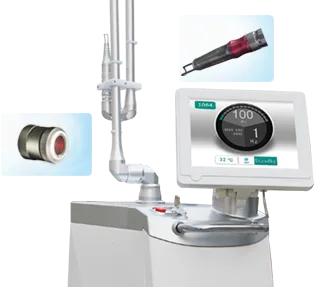
Pmise QE-01
Dual wavelengths (1064nm & 532nm) are convenient to adjust by touching LCD. Multi-spot size (1-7mm) is ideal for a wide…
View details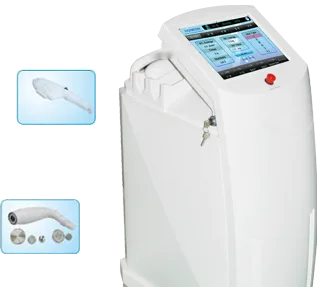
Pmise PE-01
Safe:Single pulse of HPT (Homogeneous Pulse Technology) delivers average energy and avoids the epidermis burns.Efficient…
View details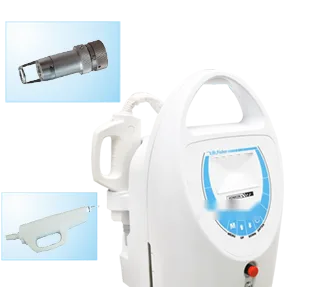
Pmise QN-05
Patented technology of single lamp and dual rods doubles energy output (400mj). Shorter pulse width (6-8ns) than ordina…
View details